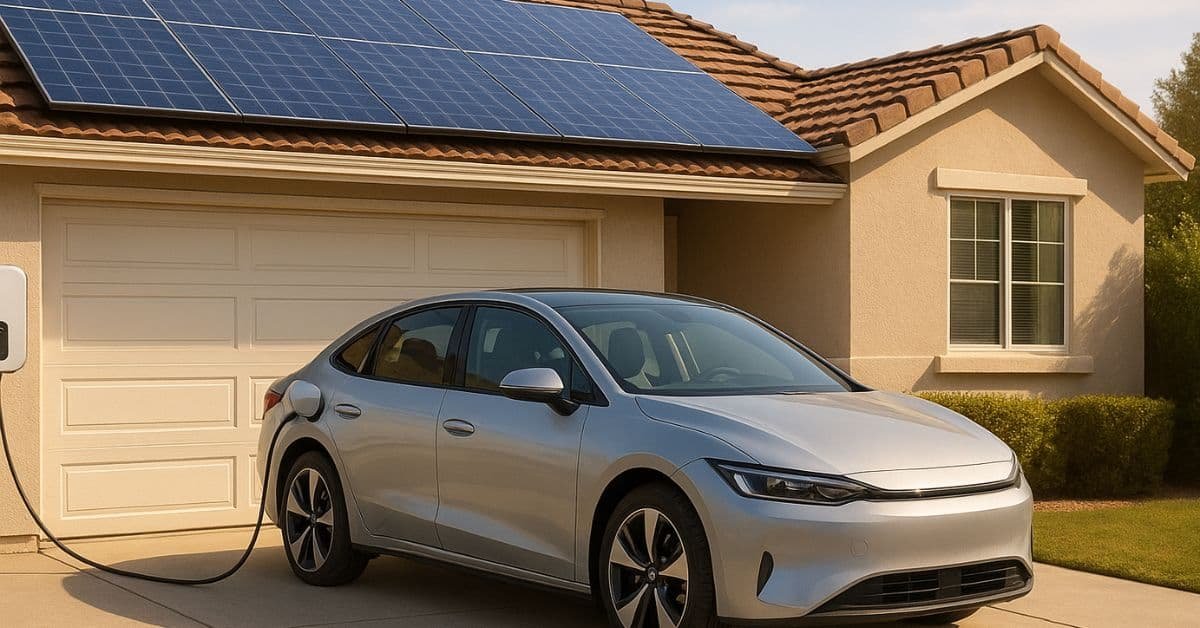
If you are thinking about charging your electric car (EV) with solar power, you are making a good choice. It is a great way to save money and help the Earth. Most people need between 6 and 12 solar panels to make the electricity their EV uses. This number can change significantly based on a few simple factors. These things include how much you drive, the type of EV you have, and how sunny your home is. For a fast answer, you can use a simple rule. You figure out how much you drive each day. Then, you see how many panels it takes to make that power. We will show you how to do this step by step.
How to Figure Out Your Solar Panel Needs
Finding the correct number of solar panels is easy. You must know two main things: how much power your car uses and how much power a single solar panel produces.
Know Your EV’s Power Use
Electric cars use electricity. People measure this electricity in kilowatt-hours (kWh).
- Average EV Use: Most electric cars can travel about 3 to 4 miles per 1 kWh of electricity.
- Your Daily Drive: Think about how many miles you drive each day. We will say you drive 40 miles a day.
- Calculation: 40 miles divided by 3.5 miles per kWh equals 11.4 kWh per day.
- Your Yearly Use: It is better to plan your solar system for a full year.
- Calculation: 11.4 kWh per day multiplied by 365 days equals 4,161 kWh per year.
Your new solar panels need to make this yearly number.
Know How Much Power Your Solar Panels Make
The power a solar panel makes depends on its size and where you live.
- Panel Size: A standard solar panel today makes about 400 watts (W) of power.
- Sunlight: We measure the amount of sun you get in “peak sun hours.” In a sunny place, you might get $5.5$ hours of peak sun a day. In a less sunny place, you might get $3.5$ hours.
- Panel Production: A 400W panel in a place with 4 hours of peak sun will make:
- Calculation: 400 W multiplied by 4 hours equals 1,600 Watt-hours (Wh) per day, or $1.6$ kWh per day.
Put It Together (The Panel Count)
Now, divide your car’s yearly power need by the yearly power output of one panel.
- Yearly Panel Production: 1.6 kWh per day multiplied by 365 days equals 584 kWh per year.
- Total Panels Needed: 4,161 kWh (your car’s need) divided by 584 kWh (one panel’s power) equals 7.1 panels.
In this example, you would need 8 solar panels to charge your EV fully.
| Factor | Example Value | What It Means |
|---|---|---|
| Daily Driving | 40 miles | How much power does your car use? |
| EV Efficiency | 3.5 miles/kWh | Electricity is what your EV needs daily. |
| Daily kWh Needed | 11.4 kWh | Electricity your EV needs daily. |
| Panel Size | 400 Watts | Power produced by one solar panel. |
| Peak Sun Hours | 4 hours | Average strong sunlight per day. |
| Daily Panel Power | 1.6 kWh | Power produced by one panel daily. |
| Total Panels Needed | 8 panels | Number of panels required. |
Driving Habits and Solar Panel Needs
How much you drive is the biggest factor. The more you drive, the more electricity your EV uses. This means you will need more solar panels.
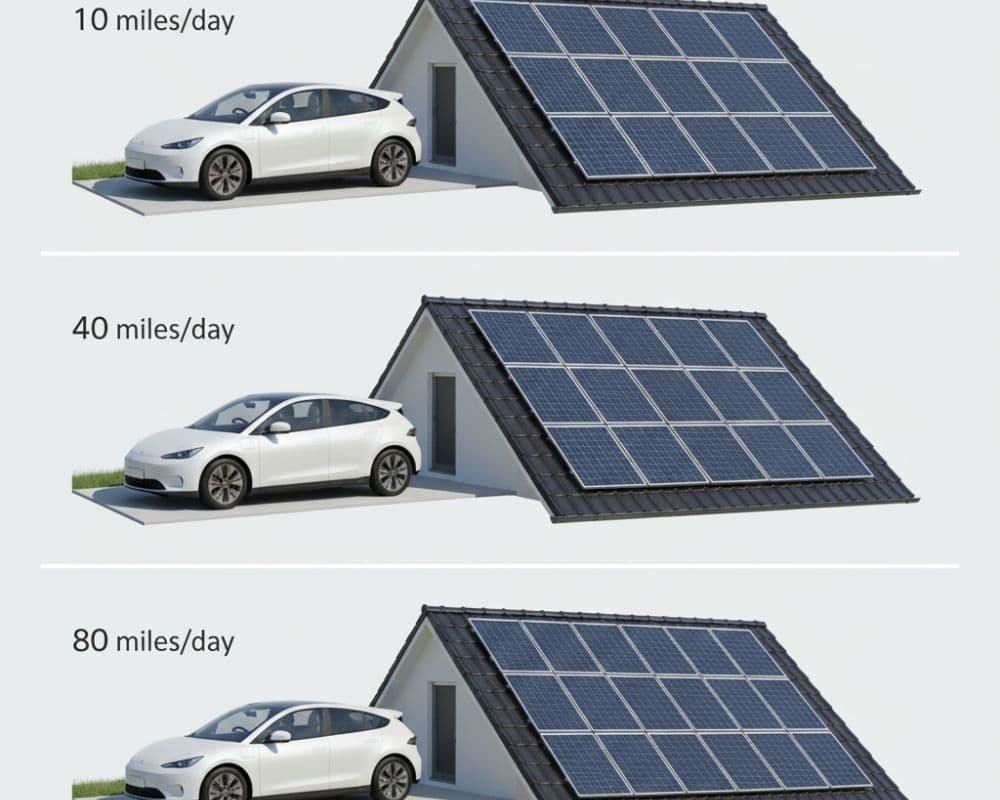
- Low Driver (10 miles/day): You might only need 2 to 3 panels.
- Average Driver (40 miles/day): You will likely need 6 to 8 panels.
- High Driver (80 miles/day): You could need 12 to 16 panels or more.
It is important to check your car’s computer or your electric bill. This shows you how much power you truly use.
Your Electric Vehicle’s Efficiency
Not all EVs are the same. Some are small, light cars that use less power. Others are big trucks or SUVs that use more.
- High Efficiency: A smaller car might get 4 miles per kWh.
- Lower Efficiency: A large truck might only get 2.5 miles per kWh.
If your car uses power less well, you will need more panels to make up the difference.
Where You Live (The Sun Factor)
The amount of sun your roof gets is very important. People call this your solar resource.
- Sunny States (California, Florida, Arizona): You get more sun. Each panel makes more power. You will need fewer panels.
- Cloudy States (Washington, Oregon, New England): You get less sun. Each panel makes less power. You will need more panels to reach your goal.
A solar installer can check your exact location. They can tell you your “peak sun hours.”
The Size and Type of Your Solar Panels
Solar panels come in different sizes and power levels.
- Standard Panel: Makes about 400W.
- High-Efficiency Panel: Can make 450W or more.
If you use a higher-power panel, you will need fewer of them. This is helpful if you have a small roof.
Charging at Home vs. Charging Everything
Are you only adding panels to charge your EV? Or do you want to power your whole house and your EV?
- EV Only: You only need to add the 6-12 panels we discussed.
- Whole House + EV: The average American home uses about 10,000 kWh per year. If you add your EV’s 4,000 kWh, your total need is 14,000 kWh. This could mean you need a total of 25 to 35 panels.
Case study: “When we got our Tesla Model 3, our electric bill went up a lot. We were driving about 50 miles a day. We decided to add solar panels just for the car,” says Mark J. from Austin, Texas. “Our installer told us we needed a 3.5 kW system. This was 9 panels, each 390 watts. It cost us about $10,000 after the tax credit. Now, our car is charged by the sun, and we barely see a change in our electric bill. It was a great choice for us.”
This example shows that the average number of panels (around 9) works well for a typical driver. It also shows that cost is a major factor in the decision.
Things to Consider Before Installing Solar
Getting solar panels for your EV is a big step. Here are a few more things you should consider.
1. Do You Need a Solar Battery?
A solar battery (like a Tesla Powerwall) stores the extra power your panels make during the day.
- Why you need it: Solar panels only make power when the sun is shining. Most people charge their EVs at night while they sleep. If you want to charge your EV only with solar power at night, you must have a battery to store the energy from the day.
- The cost: Adding a battery can add $10,000 to $15,000 to your total cost.
If you do not have a battery, your car will charge at night using power from the electric company. Your solar power will be sent back to the grid during the day. People call this Net Metering.
2. Best Time to Charge an EV with Solar
If you do not have a battery, the best time to charge your EV is during the day. This is when your panels are making the most power.
- Smart Chargers: New EV chargers can talk to your solar system. You can set them to charge your car only when your solar panels are generating more power than your house is using. This ensures you use your own free solar power first.
3. Solar Panel System Cost
People measure the cost of a solar system by its size in kilowatts (kW).
- Average EV System Size: The 6 to 12 panels we talked about make a system of about 2.5 kW to 5 kW.
- Cost: The average cost for a home solar system is about $2.50 to $3.50 per watt.
- A 4 kW system (about 10 panels) would cost around $10,000 to $14,000 before tax credits.
Remember, the Federal Solar Tax Credit can save you 30% of the cost. This makes solar much cheaper.
Conclusion
The question of how many solar panels you need to charge an EV has a clear answer. Most drivers need between 6 and 12 panels. This number is not a guess. It is based on simple math that looks at how much you drive and how much sun you get. You can easily figure out the right size system for you by understanding your car’s power needs and your home’s solar power production. Charging your EV with solar power is a smart, money-saving choice. It makes your driving even cleaner and more environmentally friendly.
FAQs
Can I charge my EV with solar panels at night?
Yes, but only if you have a solar battery installed. The battery stores the extra power your panels make during the day. If you do not have a battery, your car will charge at night using power from the electric company.
Is it cheaper to charge my EV with solar or from the electric company?
It is much cheaper to charge with solar over time. Once you pay for the panels, the electricity they make is free. You will save money on your electric bill every month. The solar system usually pays for itself in 5 to 10 years.
How long does it take to charge an EV with solar panels?
It takes the same amount of time as charging from the wall outlet. The solar power travels through your home’s wiring to your EV charger. The time depends on your charger type and your car’s battery size, not the solar panels themselves.
Do I need a special charger for solar EV charging?
No, you can use any standard Level 2 EV charger. However, a smart EV charger is better. A smart charger can be set to charge your car only when your solar panels are generating power. This helps you use your free solar energy right away.
Will charging my EV make my electric bill go up a lot?
Yes, if you charge your EV without solar panels, your electric bill will go up. An EV can add about 1,000 to 4,000 kWh to your yearly use. This is why adding solar panels is a great way to cover that extra cost and keep your bill low.