
Polestar 2 Battery: Complete Guide

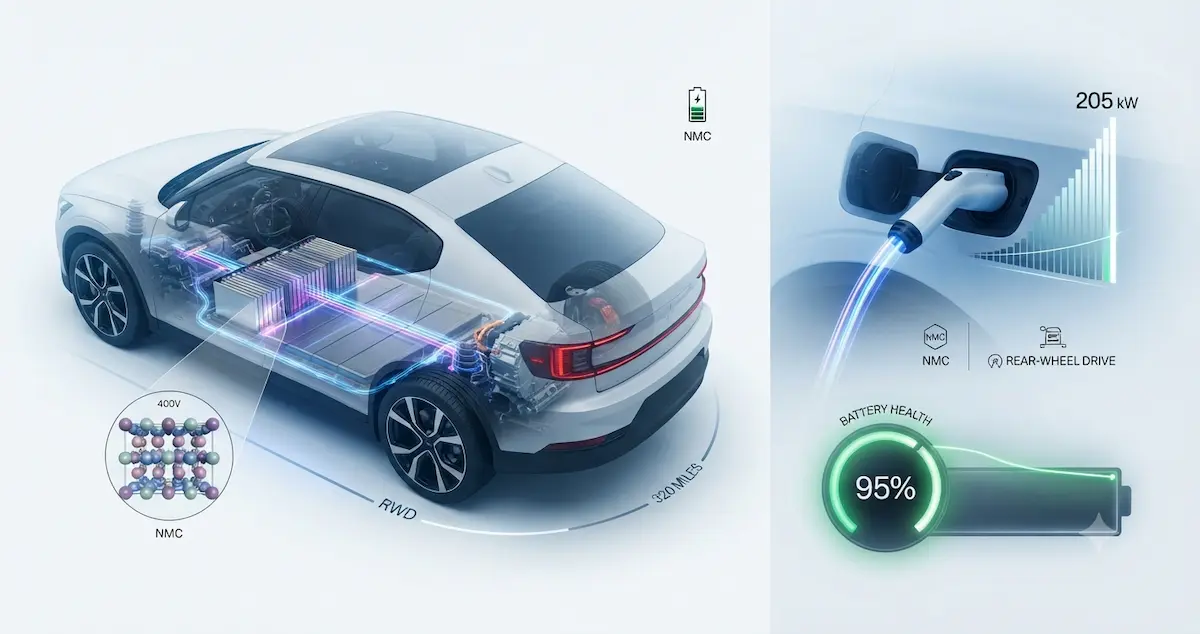
The Polestar 2 battery uses NMC lithium-ion chemistry. It comes in two sizes: a 69 kWh Standard Range pack and a 78 kWh or 82 kWh Long Range pack. The Polestar brand, owned by Volvo Cars and Geely, builds this battery to deliver up to 320 miles of EPA range in the single-motor Long Range model. Real-world data shows most packs keep about 92 to 96 percent of their health at 50,000 miles (80,000 km).
Recent upgrades improved both total capacity and DC fast charging speed. This change is the most important update in the production life of the vehicle.
The Polestar 2 battery is a liquid-cooled NMC lithium-ion pack. U.S. cars use the 78 kWh Long Range pack (2021-2023) or the larger 82 kWh pack (2024 on). EPA range tops out at 320 miles, and DC fast charging peaks at 205 kW on the newer cars.
Key figures: 78 kWh (U.S. 2021-2023) – 82 kWh (2024 on) – Up to 320 miles EPA – 205 kW DC fast charging – Warranty 8 years / 100,000 miles
Polestar 2 Battery Specifications
| Model Year | Battery (Gross) | Battery (Usable) | Drivetrain | EPA Range | Peak DC Rate |
|---|---|---|---|---|---|
| 2021–2023 Standard Range (not sold in the U.S.) | 69 kWh | ~64 kWh | Single motor (FWD) | Not EPA rated | 130 kW |
| 2021–2023 Long Range | 78 kWh | ~75 kWh | Single or dual motor | 249–270 miles | 155 kW |
| 2024 Long Range Single Motor | 82 kWh | ~79 kWh | Single motor (RWD) | 320 miles | 205 kW |
| 2024–2025 Long Range Dual Motor | 82 kWh | ~79 kWh | Dual motor (AWD) | ~276 miles | 205 kW |
The 2024 Battery Upgrade: What Changed?
Larger Battery Capacity
The most significant improvement was the increase from a 78 kWh battery to a larger 82 kWh battery. Usable energy also increased from about 75 kWh to approximately 79 kWh, giving drivers more real-world range. The new 82 kWh pack uses CATL cells in 27 modules, while the Standard Range pack switched to LG Chem cells.
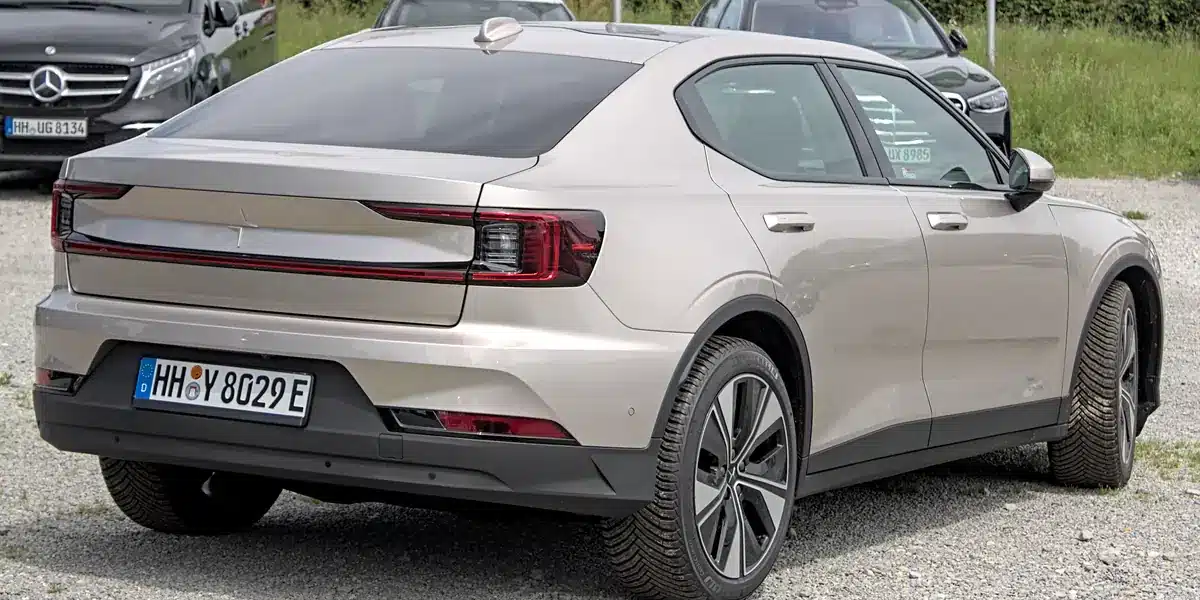
Rear-Wheel Drive Improves Efficiency
Polestar also changed the single-motor version from front-wheel drive (FWD) to rear-wheel drive (RWD). A new permanent magnet motor improved energy efficiency and increased the EPA-estimated driving range to 320 miles, making it the longest-range Polestar 2 ever built.
Faster DC Charging
Charging performance improved just as much as battery capacity.
Peak DC fast charging increased from 155 kW to 205 kW, reducing the typical 10–80% charging time from about 33 minutes to approximately 28 minutes under ideal conditions.
Despite rumors shared in online forums, no Polestar 2 uses an LFP battery. Every version continues to use NMC chemistry, which offers higher energy density and longer driving range.
To maximize battery life, Polestar recommends keeping the daily charging limit between 80% and 90%, using 100% only before long trips.
Inside the Polestar 2 Battery Pack
Battery Design
The Polestar 2 battery sits beneath the cabin floor on Volvo’s Compact Modular Architecture (CMA) platform, which it shares with the Volvo XC40 Recharge.
The battery contains NMC pouch cells arranged inside a reinforced enclosure. This location lowers the vehicle’s center of gravity, improving handling while providing additional crash protection.
400V Battery Architecture
Unlike newer EVs such as the Hyundai Ioniq 5 and Kia EV6 that use 800V systems, the Polestar 2 operates on a 400V architecture.
Although it cannot match the fastest charging speeds of 800V competitors, the latest Polestar 2 still charges quickly enough for most road trips.
Battery Buffer
Not all battery capacity is available to the driver.
For example, the 78 kWh battery provides roughly 75 kWh of usable energy because Polestar reserves several kilowatt-hours as a protective buffer.
This reserve helps:
- Prevent deep battery discharge
- Reduce long-term battery wear
- Improve battery lifespan
- Maintain consistent performance over many years
Polestar 2 Charging Speeds
| Charging Method | Power | 78 kWh (2021–2023) | 82 kWh (2024–2025) |
|---|---|---|---|
| Level 1 (120V) | ~1.4 kW | ~55 hours full | ~58 hours full |
| Level 2 (240V, 11 kW) | 11 kW | ~8 hours full | ~8 hours full |
| DC Fast (155 kW) | 155 kW peak | ~33 min (10–80%) | — |
| DC Fast (205 kW) | 205 kW peak | — | ~28 min (10–80%) |
Polestar 2 Battery Degradation: Real Owner Data
Polestar 2 owners actively track battery state of health (BSOH) using OBD apps, the OrBit data tool, and Polestar’s own CPO (Certified Pre-Owned) certification process. The data shows healthy, manageable degradation:
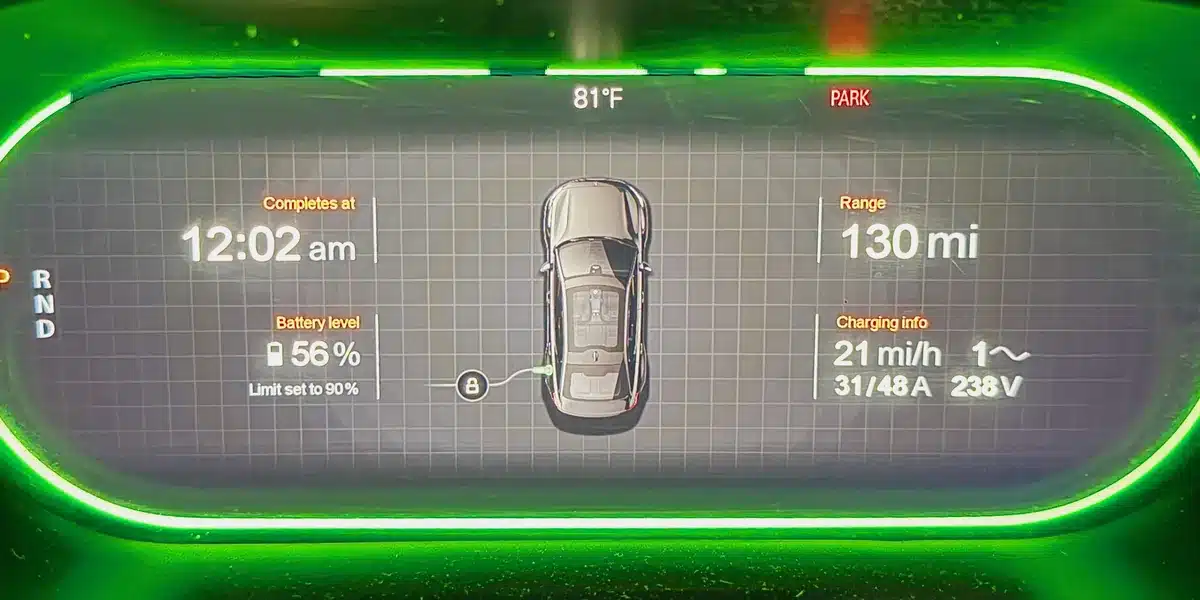
- 35,000 km (about 22,000 miles) cars: Typically 92–95% BSOH based on owner calculations using charge data and trip consumption verification
- 80,000+ km (about 50,000 miles) cars: Still commonly in the 92–95% range — degradation plateaus after the initial first-year settling, as is typical for NMC chemistry
- Around 60,000 miles: Independent AVILOO tests of more than 17,000 Polestar 2s put median battery health at about 93% near 100,000 km (about 62,000 miles).
- Polestar CPO certification: As of 2025, Polestar’s CPO process requires battery health certification — certified used cars come with a documented BSOH percentage, a meaningful advantage for used buyers
- Degradation pattern: Non-linear — most loss occurs in the first 1–2 years, then a long, slow plateau. Owners report this is consistent with well-managed NMC packs across the industry
One important note for used buyers: Polestar’s official certification sometimes reports BSOH based on usable rather than nominal capacity, which can show a higher percentage (e.g. 99%) than owner calculations based on nominal capacity (e.g. 95%). Both are valid — they simply use different reference capacities. Ask which method was used when reviewing a certification.
Polestar 2 Battery Warranty
Polestar covers the 2’s battery with an 8-year / 100,000-mile warranty against defects and capacity loss below 70% of original. As a Volvo-affiliated brand, Polestar’s battery engineering and warranty terms align with Volvo’s EV standards. The battery’s modular design means individual cell modules can be replaced if a single cell fails — rather than requiring full pack replacement, which reduces repair costs significantly compared to monolithic pack designs.

Polestar 2 Battery Replacement Cost
A full Polestar 2 battery replacement is rare, and most owners will never pay for one. The 8-year, 100,000-mile warranty Accident damage is normally an insurance claim, not an owner’s bill.covers defects and heavy capacity loss.
When a pack does fail out of warranty, the modular design helps. The 78 kWh pack has 27 modules, and a workshop can replace a single faulty module instead of the whole pack. That keeps most repairs far below the cost of a complete new pack. For prices across every EV, see our EV battery replacement cost guide.
Polestar 2 vs Competitors: Battery Comparison
| Model | Battery | EPA Range | Peak DC Rate | 10–80% Time |
|---|---|---|---|---|
| Polestar 2 LR Single Motor (2024) | 82 kWh NMC (400V) | 320 miles | 205 kW | ~28 min |
| Tesla Model 3 LR RWD | ~82 kWh NCA | 363 miles | 250 kW | ~20 min |
| Hyundai Ioniq 6 RWD LR | 77.4 kWh NMC (800V) | 361 miles | 235 kW | ~18 min |
| BMW i4 eDrive40 | 83.9 kWh NMC (400V) | 333 miles | 207 kW | ~31 min |
| VW ID.4 Pro | 77 kWh NMC (400V) | 291 miles | 135 kW | ~38 min |
Charging Tips for Polestar 2 Owners
- Set daily charge limit to 90%: Polestar recommends a 90% daily limit for NMC longevity. The car’s charging settings allow this directly. Use 100% only before long trips needing maximum range.
- Precondition for fast charging: The Polestar 2 conditions the battery when routing to a fast charger via Google built-in navigation. This is important for reaching the full 205 kW peak in the 2024 model, especially in cold weather.
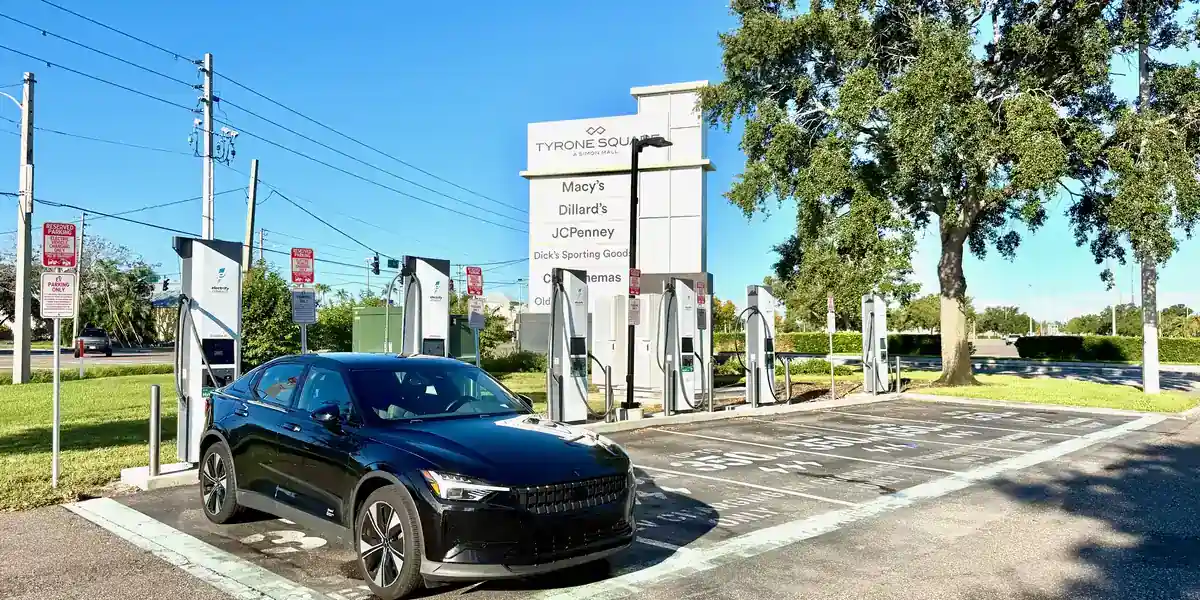
- Use the OrBit or Car Scanner app to monitor BSOH: These tools read actual battery state of health, giving you precise degradation tracking rather than relying on the range display estimate.
- Don’t worry excessively about degradation: Owner data consistently shows Polestar 2 packs settling at 92–95% and plateauing. Modern NMC packs with liquid cooling rarely become a practical concern within the first decade of ownership.
- Know your 12V battery: A separate 12V AGM battery (type H6, 70 Ah) runs the car’s electrical systems. The main battery keeps it charged while you drive. If the 12V battery goes flat, the car will not start or charge until the 12V battery is charged first.
Frequently Asked Questions
What type of battery does the Polestar 2 have?
Every Polestar 2 uses an NMC (nickel manganese cobalt) lithium-ion battery with liquid cooling. No Polestar 2 uses an LFP battery. Long Range cells come from CATL or LG Chem, depending on the model year.
What battery sizes does the Polestar 2 come in?
Three sizes worldwide: a 69 kWh Standard Range pack, a 78 kWh Long Range pack, and an 82 kWh Long Range pack from 2024. U.S. cars only came with the Long Range packs. The 69 kWh Standard Range was not sold in the United States.
How far can a Polestar 2 go on a single charge?
EPA range runs from 249 miles for the early Dual Motor to 320 miles for the 2024 Long Range Single Motor. The popular 2021-2023 Single Motor is rated at 270 miles. Cold weather and highway speed will cut the real figure.
How long will the Polestar 2 battery last?
Owner data and independent tests are reassuring. Most packs still hold about 92 to 95 percent of their health at 50,000 miles. AVILOO testing puts median health at about 93 percent near 60,000 miles, and the loss slows down after the first few years.
What warranty covers the Polestar 2 battery?
Polestar covers the battery for 8 years or 100,000 miles against defects and capacity loss below 70 percent of the original. Certified pre-owned cars also come with a documented battery health percentage, which helps used buyers.
Can the Polestar 2 battery be replaced, and what does it cost?
Yes. The pack is modular, so a workshop can replace a single faulty module instead of the whole battery. Most owners never pay for a replacement, because the warranty covers the first 8 years or 100,000 miles. A complete new pack is a five-figure part, so full replacements are normally insurance claims after accident damage.
How fast does the Polestar 2 charge?
Early cars peak at 155 kW, and 2024-on cars peak at 205 kW on a DC fast charger. Both charge from 10 to 80 percent in about 28 to 33 minutes. The rate is highest at a low state of charge and slows as the battery fills, so arriving near 10 percent gives the fastest stop.
What type of 12V battery does the Polestar 2 use?
The Polestar 2 uses a 12V AGM battery, type H6, rated at 70 Ah with 760 CCA. It powers the car’s electrical systems and is kept charged by the main high-voltage battery. If it goes flat, the car cannot start or charge until the 12V battery is charged.
Conclusion
The Polestar 2 uses a strong NMC system that grew to 82 kWh in a recent upgrade. This update changed the single-motor model to rear-wheel drive, giving it a 320-mile EPA range and 205 kW fast charging speeds.
Real-world data shows 92-95% battery health at about 50,000 miles (80,000 km), which shows the battery lasts a long time. The 400V architecture charges slower than 800V rivals, but Volvo-grade engineering, modular repairs, and CPO battery certification make it a reliable used electric vehicle choice.
