
Is NMC Battery Safe? Risks and Thermal Stability

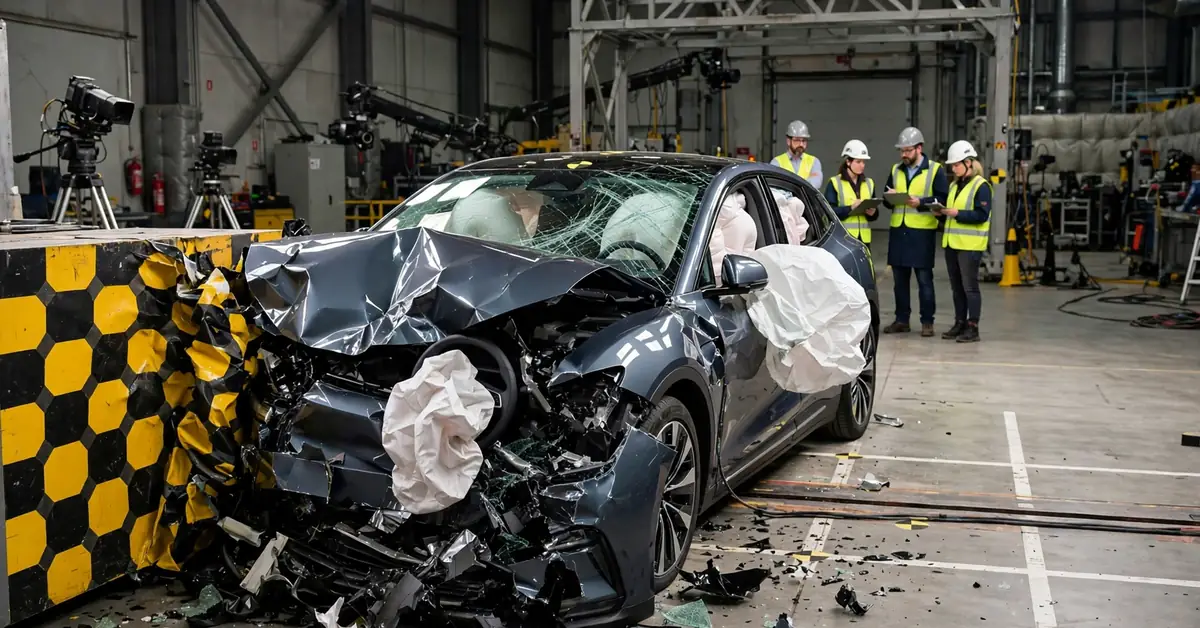
NMC batteries are safe under normal driving and charging conditions — but they carry a higher thermal risk than LFP. NMC’s thermal runaway onset temperature is approximately 210°C, and the cathode releases oxygen under thermal stress — which can sustain and intensify fires. Modern EVs manage this through sophisticated liquid cooling, multi-layer BMS protection, and cell-level fusing. In practice, NMC battery fires are rare — EVs overall catch fire at roughly 5 per billion miles driven, far less than gasoline vehicles at 55 per billion miles.
NMC Safety: The Core Chemistry Challenge
NMC’s layered oxide cathode (LiNixMnyCozO₂) presents two thermal risks:
- Oxygen release: At elevated temperatures (~200–210°C), the NMC cathode begins to decompose, releasing oxygen gas. This oxygen reacts with the flammable electrolyte — creating a self-sustaining, intensifying fire reaction that is very difficult to extinguish
- Exothermic decomposition: Multiple exothermic reactions cascade at different temperatures — SEI decomposition (~80–120°C), separator melting (~130–180°C), cathode decomposition (~200–210°C), and anode-electrolyte reaction (~250–300°C). Once these cascade, the reaction is self-reinforcing
NMC Thermal Stability by Variant
| NMC Variant | Thermal Runaway Onset | Relative Risk |
|---|---|---|
| NMC 532 | ~215–225°C | Lowest risk within NMC |
| NMC 622 | ~210–220°C | Moderate |
| NMC 811 | ~200–210°C | Highest risk within NMC |
| LFP (for comparison) | ~270°C | Significantly lower than any NMC |
How Modern EVs Protect NMC Batteries
Despite the inherent thermal sensitivity of NMC chemistry, modern EVs employ multiple independent protection layers:
- Liquid cooling systems: Coolant circuits maintain pack temperature within 20–35°C during charging and driving — keeping NMC cells well below thermal risk thresholds
- Battery Management System (BMS): Monitors every cell’s voltage and temperature in real time. Cuts power if any cell approaches unsafe limits — before thermal runaway can start
- Pyrotechnic safety disconnects: Physically sever the high-voltage circuit in milliseconds during a crash
- Thermal barriers between cells: Fire-resistant materials containing runaway to single cells
- Cell-level fusing: In cylindrical NMC packs (Tesla), individual cell fuses isolate failing cells before they trigger adjacent cells
- Overcharge protection: Hardware and software limits prevent charging above maximum safe cell voltage (~4.2V)
Common Triggers for NMC Battery Safety Events
- Severe crash damage that physically deforms cells or breaches the pack enclosure
- Overcharging due to BMS failure or third-party charger malfunction
- Manufacturing defects (contamination, separator misalignment)
- Saltwater flooding (creates electrochemical reactions in damaged cells)
- Storage of damaged packs — cells that appear intact may have hidden internal damage
NMC vs LFP: Comparative Safety
While NMC carries higher inherent thermal risk than LFP, it’s important to contextualize this correctly. Research published in 2026 found NMC thermal runaway is approximately 80% more likely than LFP under equivalent abuse conditions. However, NMC EVs still have far fewer fires than gasoline vehicles. The relevant comparison for buyers is not NMC vs theoretical perfection — it is NMC vs gasoline, where NMC clearly wins on fire safety per mile driven.
Frequently Asked Questions
Is NMC battery safe?
Yes — NMC batteries are safe under normal driving and charging conditions. Modern EVs with NMC batteries include multiple independent safety systems (liquid cooling, BMS, pyrotechnic disconnects, thermal barriers) that make thermal runaway under normal use extremely rare. NMC EVs catch fire at approximately 5 per billion miles driven — far less than gasoline vehicles at 55 per billion miles.
Is NMC safer than LFP?
No — LFP is significantly safer than NMC. LFP’s thermal runaway onset (~270°C) is 60°C higher than NMC’s (~210°C), and LFP does not release oxygen under thermal stress — removing the primary fuel source for self-sustaining battery fires. Research shows NMC thermal runaway is ~80% more likely than LFP under equivalent abuse conditions. Both are far safer than gasoline under normal operating conditions.
Does fast charging make NMC batteries more dangerous?
High-power fast charging generates more heat in NMC cells — increasing thermal stress over time. Modern EVs manage this with preconditioning (warming or cooling the battery before fast charging), liquid cooling during charging, and BMS charge rate limits based on current cell temperature. Occasional fast charging poses minimal safety risk in a well-maintained NMC EV. Habitual extreme-speed charging in high-temperature environments does accelerate NMC degradation over time.
Conclusion
NMC batteries carry higher inherent thermal risk than LFP — due to a lower thermal runaway onset temperature and oxygen release under stress. However, modern liquid cooling, BMS systems, and multi-layer cell protection make NMC EVs extremely safe in normal use — significantly safer than gasoline vehicles on fire-per-mile statistics. Buyers choosing between NMC and LFP for safety reasons should understand: LFP is meaningfully safer in worst-case scenarios, but NMC is safe in everyday operation with properly functioning thermal management.
