
Why Are So Many New EVs Switching to LFP Batteries?

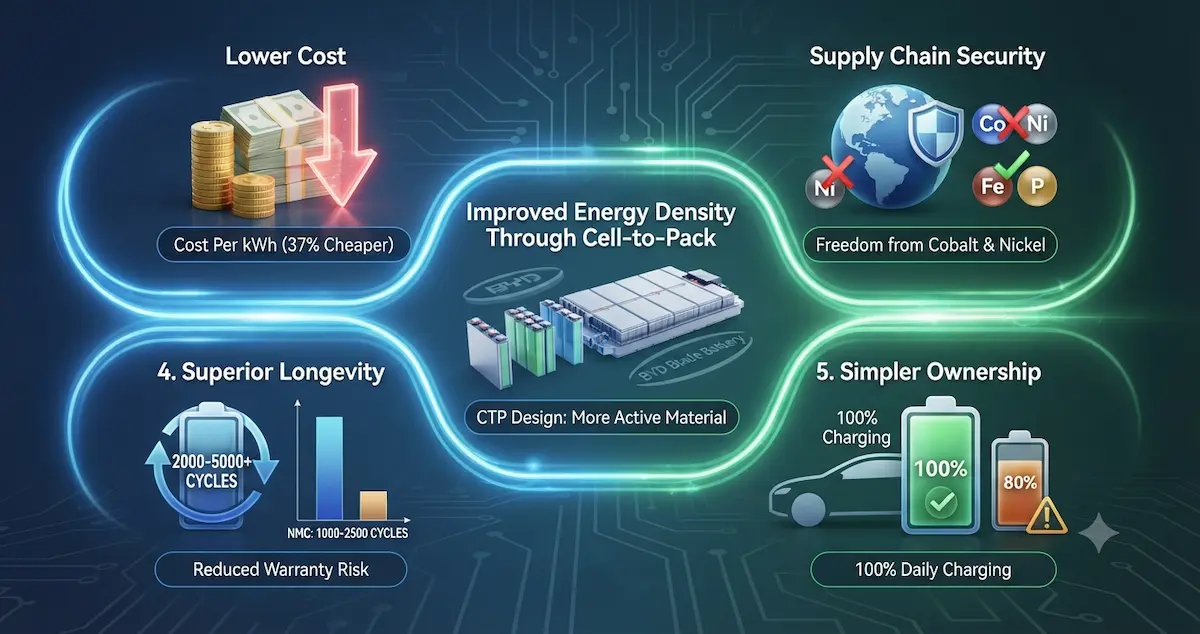
The shift to LFP batteries is one of the biggest structural changes in the EV industry. From under 10% of global EV batteries in 2020 to approximately 50% in 2024, LFP has overtaken NMC as the world’s most common EV battery chemistry. Automakers from Tesla to Volkswagen to GM are expanding LFP adoption across their lineups — driven by three forces: dramatically lower cost, superior safety, and freedom from cobalt supply chains.
New to LFP itself? Start with our full explainer on what LFP battery chemistry is in electric cars.
The Numbers Behind the Switch
LFP’s market share growth has been extraordinary:
- 2020: LFP = less than 10% of global EV battery market
- 2022: LFP = ~30% market share
- 2024: LFP = ~50% market share (IEA Global Critical Minerals Outlook 2025)
- China specifically: ~75% of domestic EV batteries are LFP
- Stationary storage: LFP holds ~70% market share globally
The IEA revised its cobalt and nickel demand forecasts downward specifically because of this shift — LFP’s rise has meaningfully reduced the mineral intensity of the global EV transition.
Reason 1: Cost — LFP Is 37% Cheaper Per kWh
In 2025, LFP packs averaged $81/kWh vs $128/kWh for NMC (BloombergNEF). That $47/kWh gap translates to $3,500+ per vehicle on a typical 75 kWh pack. As EV makers compete aggressively on sticker price — especially below $40,000 — LFP’s cost advantage is often the deciding factor. Tesla saved an estimated $1,500–2,000 per car by switching Standard Range Model 3 and Model Y to LFP in 2021. LFP uses iron and phosphate — far more abundant and stable in price than NMC’s cobalt (~$30–90/kg volatility) and nickel.
Reason 2: Supply Chain Security
~70% of global cobalt comes from the Democratic Republic of Congo. Nickel prices spiked dramatically in 2022 following Russia’s invasion of Ukraine. These supply shocks forced automakers to reckon with NMC’s vulnerability to geopolitical disruption. LFP uses iron and phosphate — minerals available on every continent in virtually unlimited quantities. After the 2022 nickel price spike, multiple major automakers publicly accelerated LFP adoption timelines specifically to reduce raw material risk. The IRA’s domestic content requirements further incentivize LFP, as new U.S. LFP gigafactories in Georgia and Michigan reduce import dependence.
Reason 3: Improved Energy Density Through Cell-to-Pack Design
LFP’s historical disadvantage — lower energy density — has been largely overcome at the pack level through Cell-to-Pack (CTP) design. Traditional NMC packs use only ~40% of total pack volume for active cells. BYD’s blade battery CTP design achieves 72%+ volume utilization — dramatically closing the real-world range gap. At the cell level, LFP is 30% less dense than NMC. At the pack level in a CTP design, that gap shrinks to just 5–20% in many applications. This engineering breakthrough made LFP viable for 300+ mile range vehicles, removing the last major barrier to broad adoption.
Manganese-enhanced LMFP is pushing this even further — see our guide on what LMFP battery chemistry is.
Reason 4: Superior Longevity Reduces Warranty Risk
LFP delivers 2,000–5,000+ charge cycles vs NMC’s 1,000–2,500. For automakers, longer-lasting batteries mean fewer warranty claims, lower liability exposure, and better customer satisfaction scores. With U.S. law mandating 8-year battery warranties, and California requiring 10 years, LFP’s superior cycle life is a meaningful financial advantage for manufacturers. Fleet operators — which represent a large and growing share of EV sales — have almost universally switched to LFP for exactly this reason.
Reason 5: Simpler Ownership — 100% Daily Charging
NMC battery owners are routinely advised to limit daily charging to 80% to reduce degradation. LFP owners can — and are encouraged to — charge to 100% every day. This simplification matters for real-world adoption. Charging anxiety is already a barrier for EV newcomers. An LFP EV that can always be charged full without worry removes one psychological friction point entirely. Tesla’s in-car software for LFP models explicitly recommends 100% as the daily charge target.
Which Automakers Have Switched to LFP?
| Automaker | LFP Models | When Switched |
|---|---|---|
| Tesla | Model 3 Standard Range, Model Y Standard Range | 2021 |
| BYD | All pure-electric models (always LFP) | Founded on LFP |
| Chevrolet (GM) | Equinox EV base trim | 2024 |
| Volkswagen | ID.2 (planned), some ID.4 variants | 2025–2026 |
| Ford | Explorer EV (European) base trim | 2024 |
| Volvo | EX30 Standard Range | 2023 |
Frequently Asked Questions
Why are so many new EVs switching to LFP batteries?
The switch is driven by three forces working simultaneously: LFP costs ~37% less per kWh than NMC, Cell-to-Pack design has largely closed the energy density gap for everyday range needs, and LFP eliminates cobalt and nickel supply chain vulnerabilities. Together, these factors make LFP the superior choice for mainstream and budget EV segments.
Does switching to LFP mean less range?
Not necessarily for everyday driving. While LFP has lower energy density at the cell level, advanced Cell-to-Pack designs close the gap at the pack level. BYD’s LFP blade battery delivers 360+ miles. Tesla’s LFP Standard Range models offer 270–290 miles — sufficient for the vast majority of daily U.S. driving. For 350–400+ mile range needs, NMC still holds a meaningful advantage.
Will LFP replace NMC completely?
Unlikely for all segments. LFP will likely dominate mainstream and budget EVs through the late 2020s. NMC and its high-nickel variants will retain a role in long-range premium vehicles. LMFP (adding manganese to LFP) may eventually bridge the gap — delivering LFP’s cost and safety with near-NMC energy density — potentially enabling one chemistry to serve most segments by 2030.
Wondering if the LMFP upgrade is actually worth it over standard LFP? See our breakdown of LMFP vs LFP: is manganese-enhanced LFP worth it.
Conclusion
New EVs are switching to LFP batteries because the chemistry has crossed a critical threshold: it is now cheaper, safer, longer-lasting, and — with Cell-to-Pack design — competitive in real-world range for everyday driving needs. The cost, supply chain, and longevity advantages together create an overwhelming case for LFP in mainstream vehicle segments. As domestic LFP production scales up in the U.S. and LMFP raises the energy density ceiling further, the switch from NMC to LFP will only accelerate through the remainder of the decade.
