
How Is an EV Battery Chemistry Chosen by Automakers?

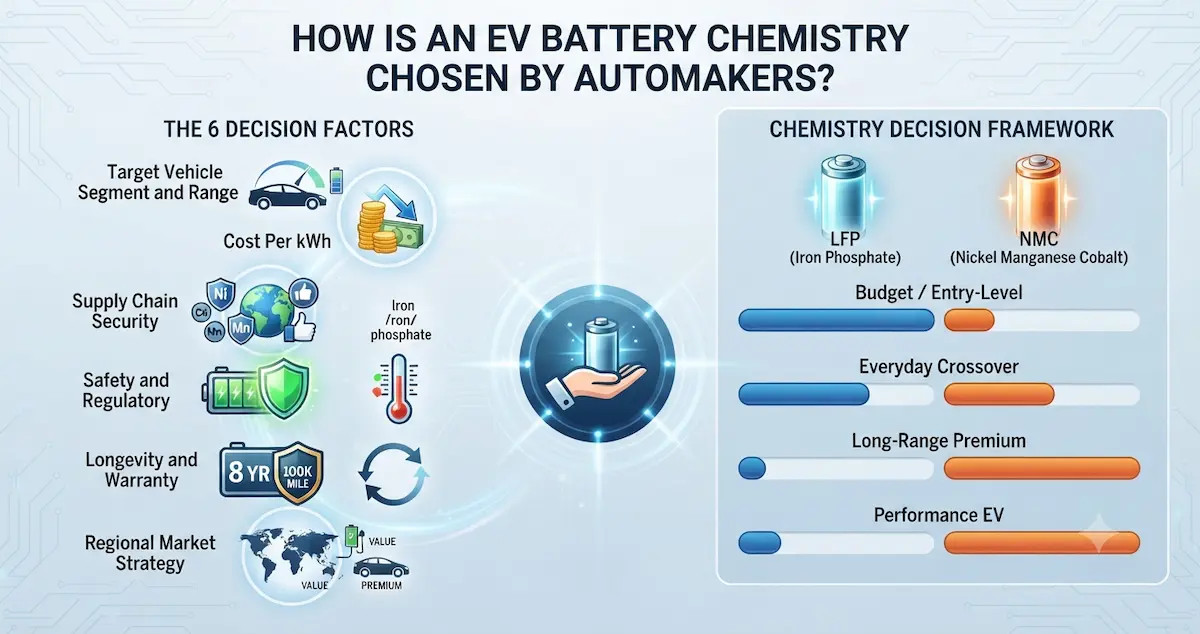
Choosing an EV battery chemistry is one of the most strategic decisions an automaker makes. It determines vehicle cost, range, safety, charging speed, longevity, and supply chain risk — all at once. No single chemistry wins on every factor. That’s why Tesla uses both LFP and NMC across its lineup, and why BYD uses LFP exclusively while Hyundai stays with NMC. The decision is driven by six core factors every automaker weighs differently.
See our full guide to the current market leader’s approach: what battery chemistry GM uses in the Ultium battery.
The 6 Factors That Drive EV Battery Chemistry Selection
1. Target Vehicle Segment and Range
Range is the starting point. Every automaker defines a range target before choosing chemistry. For a vehicle targeting 300+ miles of EPA range, NMC or NCA is almost always chosen — their higher energy density (200–260 Wh/kg) makes hitting that target practical without an excessively heavy pack. For a vehicle targeting 200–250 miles, LFP is increasingly viable — especially with Cell-to-Pack designs that close the energy density gap at the pack level. As Polestar’s engineers note, NMC remains their primary choice because they “strive to offer leading driving range.” BYD counters with blade battery CTP technology that makes LFP competitive up to 360+ miles.
2. Cost Per kWh
Battery cost is the largest single contributor to EV purchase price. In 2025, LFP packs averaged $81/kWh globally versus $128/kWh for NMC — a 37% difference (BloombergNEF 2025). For a 75 kWh pack, that’s a $3,525 cost difference per vehicle. At scale across hundreds of thousands of units, this becomes a decisive competitive advantage. This cost gap is the primary reason Tesla added LFP to Standard Range models in 2021, Chevrolet used LFP in the Equinox EV base trim, and virtually every Chinese automaker defaults to LFP.
3. Supply Chain Security and Raw Material Access
NMC and NCA batteries depend on cobalt (~70% from DRC), nickel (Indonesia and Russia are major sources), and manganese. These supply chains carry geopolitical and price volatility risk — cobalt alone has ranged from $30,000 to $90,000+ per metric ton. LFP uses iron and phosphate — among the most abundant and geographically distributed minerals on Earth. Automakers choosing LFP gain significant supply chain stability and eliminate ethical concerns around DRC cobalt mining. After Russia’s 2022 invasion of Ukraine caused nickel price spikes, multiple automakers accelerated LFP adoption specifically to reduce nickel exposure.
4. Safety and Regulatory Requirements
LFP’s thermal runaway onset temperature (~270°C) is significantly higher than NMC’s (~210°C). For automakers selling in markets with strict fire safety requirements — or designing vehicles for commercial fleet, taxi, and ride-share use where vehicles cycle constantly — LFP’s superior thermal stability is a meaningful engineering advantage. China’s GB/T standards and Europe’s upcoming UN ECE R100 revision both incentivize safer battery chemistry. BYD’s blade battery passed nail penetration tests that most NMC cells fail — a key selling point in safety-conscious markets.
5. Longevity and Warranty Requirements
U.S. federal law mandates an 8-year / 100,000-mile battery warranty minimum. California requires 10 years / 150,000 miles. LFP’s 2,000–5,000+ cycle life makes warranty obligations far easier and cheaper to guarantee than NMC’s 1,000–2,000 cycles. For fleet operators — taxis, delivery vehicles, ride-share fleets — cycle life is the primary selection criterion. This is why virtually every commercial EV fleet globally has shifted to LFP: the lower replacement risk reduces total cost of ownership dramatically over a fleet’s operating life.
6. Regional Market Strategy
Battery chemistry choice is also a regional market strategy. In China, where 75% of domestic EV batteries are LFP and CATL/BYD dominate supply, LFP is the natural default — it’s cheaper, locally supplied, and government policy supports it. In Europe and North America, NMC still dominates premium models, but LFP is growing rapidly in affordable segments as IRA-compliant LFP gigafactories come online in Georgia, Michigan, and Tennessee. An automaker selling globally — like Tesla — uses different chemistries in different models and markets to optimize for each region’s price expectations and infrastructure.
Chemistry Selection by Vehicle Type: A Decision Framework
| Vehicle Type | Typical Chemistry Choice | Primary Reason |
|---|---|---|
| Budget / entry-level EV | LFP | Lowest cost per kWh |
| Everyday crossover / sedan | LFP or NMC | Balance of cost and range |
| Long-range premium EV | NMC 811 or NCMA | Maximum energy density |
| Performance EV | NMC or NCA | High power output + energy density |
| Commercial fleet / taxi | LFP | Cycle life + low replacement cost |
| Electric truck | NMC or LFP (large pack) | Range vs. cost tradeoff by brand |
Real-World Examples: How Major Automakers Decided
- Tesla: Uses LFP (CATL-supplied) for Standard Range models — cost and longevity. Uses NMC/NCA for Long Range and Performance — maximum energy density.
- BYD: Exclusively LFP (blade battery) — controls its own supply chain, prioritizes cost and safety, uses CTP to overcome energy density gap.
- Hyundai/Kia: NMC for all main models — targets long range (350+ miles) and performance on 800V platform. See our full guide: what battery chemistry Hyundai and Kia use
- GM (Ultium): NCMA (nickel-cobalt-manganese-aluminum) — hybrid chemistry balancing NMC range with reduced cobalt.
- Polestar: NMC from CATL and SK On — range leadership is core brand positioning.
- Volkswagen: Transitioning to LFP for entry models (ID.2), retaining NMC for longer-range ID.4 and ID.7. See our full guide: what battery chemistry Volkswagen uses in EVs
Frequently Asked Questions
How do automakers choose EV battery chemistry?
Automakers choose battery chemistry based on six key factors: target range, cost per kWh, supply chain security, safety requirements, warranty obligations, and regional market strategy. No single chemistry wins on all factors — which is why most global automakers use multiple chemistries across their lineups to optimize each model for its target segment and market.
Why are some automakers switching from NMC to LFP?
The switch is driven primarily by cost (LFP is ~37% cheaper per kWh), supply chain security (no cobalt or nickel dependence), and improving energy density through Cell-to-Pack design. As LFP’s real-world range becomes competitive for everyday use, the cost and safety advantages make it the better choice for mainstream and budget vehicle segments.
Does battery chemistry affect vehicle price?
Significantly. A 75 kWh LFP pack costs approximately $3,500–$5,000 less to manufacture than an equivalent NMC pack at 2025 prices. This difference flows directly through to either lower vehicle pricing or higher manufacturer margins. Tesla’s ability to offer Standard Range models at lower price points is directly enabled by LFP’s cost advantage.
Will all EVs eventually use LFP?
Not all — but LFP will likely power the majority of mainstream EVs by the late 2020s. NMC and its high-nickel variants will retain a role in long-range premium applications where energy density matters most. The emerging LMFP chemistry may ultimately bridge the gap — delivering LFP’s safety and cost with energy density approaching NMC — potentially making one chemistry sufficient for most vehicle segments.
Conclusion
Automakers choose EV battery chemistry by balancing six competing priorities — range, cost, supply security, safety, longevity, and market strategy. There is no universal right answer. Tesla uses two chemistries. BYD committed to one. Hyundai stays with NMC for range leadership. Each decision reflects a specific product strategy and target customer. As LFP energy density improves through LMFP and Cell-to-Pack innovation, and as solid-state batteries approach commercialization, the chemistry selection landscape will continue shifting — but these six decision factors will remain the framework automakers use to navigate it.
Curious how a newer, vertically-focused automaker approaches this decision? See our full guide: what battery chemistry Rivian uses.
