
Why Does NMC Battery Need Active Cooling?

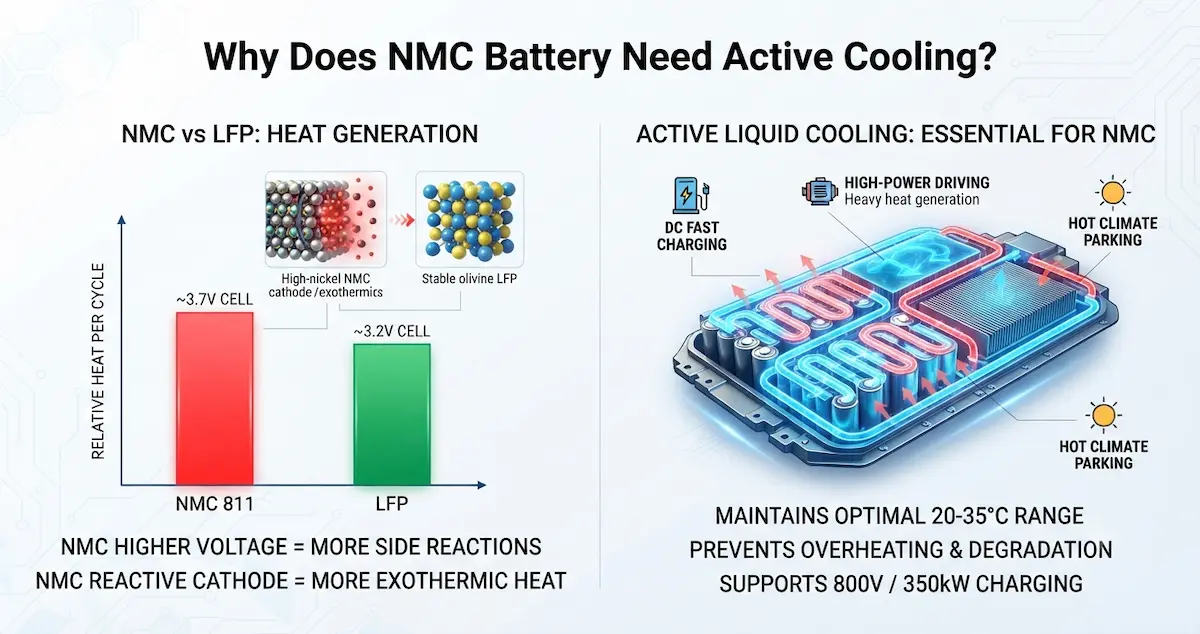
NMC batteries need active cooling because their high-nickel cathode generates more heat during charging and discharging — and because heat is a primary driver of NMC degradation and thermal safety risk. Without active liquid cooling, NMC batteries would overheat during DC fast charging, degrade rapidly in warm climates, and face a higher thermal runaway risk. Every premium long-range EV using NMC chemistry uses liquid cooling as a non-negotiable system requirement.
New to NMC chemistry itself? Start with our full explainer on what NMC battery chemistry is.
Why NMC Generates More Heat Than LFP
Heat generation in a battery cell comes from two sources: internal resistance (I²R losses) and electrochemical side reactions. NMC has higher heat generation per cycle than LFP for several reasons:
- Higher operating voltage: NMC operates at ~3.7V per cell vs LFP’s ~3.2V. Higher voltage drives slightly more heat-generating side reactions at the cathode surface
- More reactive cathode: High-nickel NMC 811’s layered oxide structure undergoes more exothermic reactions during lithium intercalation than LFP’s stable olivine structure
- Faster charging sensitivity: NMC 811’s thermal runaway onset is ~210°C — a 60°C smaller margin above typical operating temperatures than LFP’s ~270°C. In fast charging at 150–350 kW, even moderate heat buildup brings NMC closer to its thermal safety threshold
This same reactivity is why NMC 811 delivers so much extra range — see our explainer on why NMC 811 has more range than older NMC.
How Active Cooling Protects NMC Batteries
Liquid cooling systems maintain NMC pack temperature within the optimal 20–35°C range during charging, driving, and storage. They work by circulating a 50/50 ethylene glycol-water coolant mix through channels, plates, or ribbons in direct thermal contact with cells:
- During DC fast charging: Coolant removes heat generated at 150–350 kW charge rates — preventing cells from exceeding 40–45°C which would force the BMS to throttle charge speed
- During high-power driving: Motor demand can draw 200–500+ kW from the pack — generating significant I²R heat that cooling manages continuously
- During hot-weather parking: Some systems continue cooling even when parked to prevent “soak” temperature buildup in summer heat
- In cold weather (reverse): The same coolant circuit runs warm fluid to preheat cold cells before charging or driving — restoring full NMC performance
NMC Cooling Systems by Manufacturer
| Manufacturer | Cooling Design | Key Feature |
|---|---|---|
| Tesla | Serpentine ribbon between cylindrical cells | Individual cell contact — most precise |
| Hyundai (E-GMP) | Liquid cooling plates under cells | Supports 800V / 350 kW charging |
| BMW | Side-cooling plates between modules | Uniform temperature across pack |
| CATL (Kirin NMC) | Cooling plates between every cell pair | 4x heat transfer area vs traditional |
What Happens Without Active Cooling?
The early Nissan Leaf used passive air cooling on its NMC/LMO cells — with no liquid coolant circuit. In hot climates like Arizona and Texas, the pack regularly exceeded 45°C. Owners in these regions reported 20–30% capacity loss within 3–5 years. This is widely cited as the defining example of what happens when NMC chemistry operates without adequate thermal management. Every modern NMC EV uses active liquid cooling — the Leaf’s experience made passive cooling essentially extinct for NMC applications.
Curious which specific EVs run this chemistry? See our list of which EVs use NMC batteries.
Frequently Asked Questions
Why does NMC battery need active cooling?
NMC batteries need active liquid cooling because their high-nickel cathode generates more heat per cycle than LFP, has a lower thermal runaway onset (~210°C vs LFP’s ~270°C), and degrades significantly faster when operating above 35–40°C. Without liquid cooling, NMC batteries degrade rapidly in warm climates and cannot safely support DC fast charging at 100+ kW rates.
Does LFP also need liquid cooling?
LFP benefits significantly from liquid cooling — especially for DC fast charging support and cold-weather preconditioning. However, LFP’s higher thermal runaway threshold (~270°C) and lower heat generation per cycle mean it tolerates imperfect thermal management better than NMC. The original Nissan Leaf showed that NMC/LMO without active cooling is unacceptable — but some lower-power LFP applications (like stationary storage) do use only air cooling with reasonable results.
How hot does an NMC battery get during fast charging?
Without cooling intervention, a 75 kWh NMC battery accepting 150 kW of DC charging could rise 2–5°C per minute at peak rate. Active liquid cooling manages this to stay within 20–40°C during normal fast charging sessions. If cell temperature approaches 45–50°C, the BMS automatically throttles the charge rate to protect cells — which is why preconditioning to optimal temperature (25–35°C) before fast charging maximizes both speed and battery health.
Conclusion
NMC batteries need active liquid cooling because their high-nickel chemistry generates more heat, operates closer to thermal runaway thresholds, and degrades significantly faster when temperature management is inadequate. The early Nissan Leaf demonstrated the consequences of passive-only cooling on NMC cells in warm climates. Every modern NMC EV addresses this with sophisticated liquid cooling systems that maintain cells within 20–35°C during all operating conditions — enabling both the fast charging speeds and long-term durability that premium NMC vehicles promise.
