
NCA vs NMC Battery: Key Differences Explained

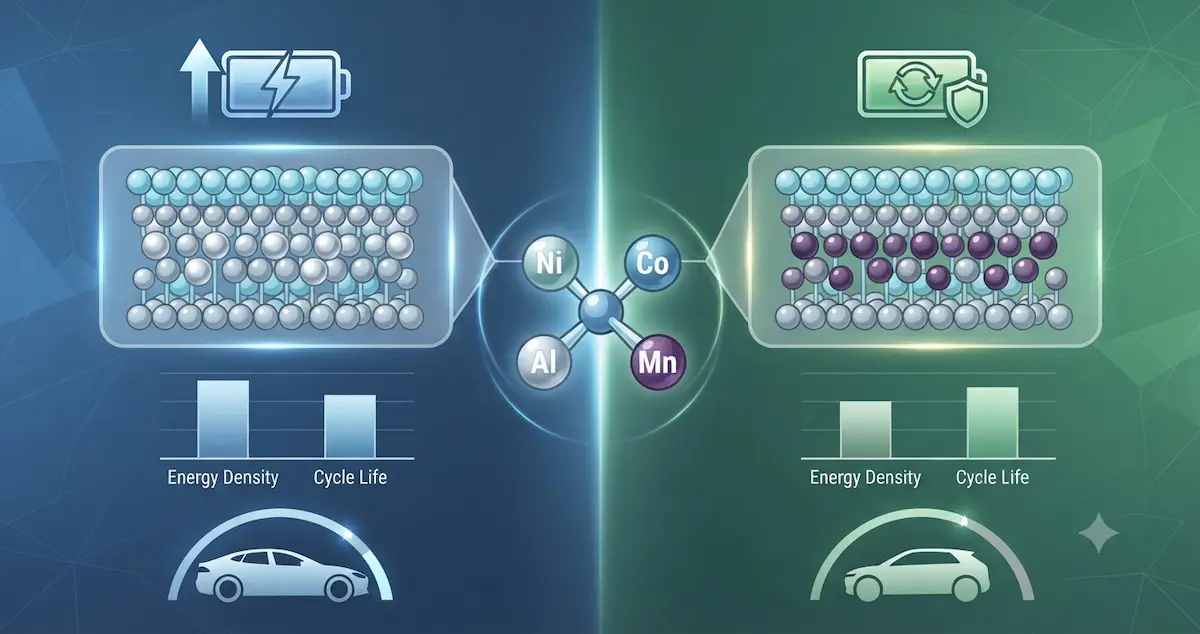
NCA and NMC are the two dominant high-nickel EV battery chemistries — closely related, but with a key structural difference. NMC uses manganese as the third cathode metal; NCA uses aluminum. NCA slightly edges NMC on energy density. NMC slightly edges NCA on cycle life and thermal stability. In practice, the differences between modern NMC 811 and NCA are small — which is why many manufacturers are converging on NCMA (combining elements of both) as the next step.
New to NCA itself? Start with our full explainer on what NCA battery chemistry is in electric vehicles.
NCA vs NMC: Full Comparison
| Feature | NCA | NMC 811 |
|---|---|---|
| Cathode formula | LiNiCoAlO₂ | LiNi₀.₈Mn₀.₁Co₀.₁O₂ |
| Third metal | Aluminum (Al) | Manganese (Mn) |
| Nickel content | ~80–85% | ~80% |
| Cobalt content | ~15% | ~10% |
| Cell energy density | 220–300+ Wh/kg | 220–260 Wh/kg |
| Thermal runaway onset | ~180–210°C | ~200–210°C |
| Cycle life (to 80%) | 1,000–2,000 cycles | 1,000–2,500 cycles |
| Cobalt dependence | Higher (~15%) | Lower (~10%) |
| Cold weather performance | Similar | Similar |
| Primary users | Tesla (Panasonic cells) | Hyundai, BMW, VW, Kia, many others |
| Main supplier | Panasonic (Tesla) | CATL, LG, SK On, Samsung SDI |
The Role of Aluminum vs Manganese
The core chemistry difference between NCA and NMC is the third metal in the cathode:
- Aluminum in NCA: Does not participate in electrochemical cycling (it’s electrochemically inactive). Instead, it stabilizes the layered oxide structure by reducing cation disorder at high states of charge. Aluminum is lighter than manganese (27 g/mol vs 55 g/mol) — contributing to NCA’s slightly higher gravimetric energy density.
- Manganese in NMC: Provides structural support and improves thermal stability. Manganese helps suppress the phase transitions that occur at high charge voltages — giving NMC slightly better thermal behavior and longer cycle life than equivalent NCA at the same nickel content.
Energy Density: NCA’s Small Advantage
Tesla’s Panasonic NCA 2170 cells achieve approximately 322 Wh/kg at the cell level — among the highest production EV cells available. This enables Tesla’s Model S to achieve 405 miles EPA range. Comparable NMC 811 cells from CATL or LG achieve ~240–260 Wh/kg — meaningful but smaller. In real-world vehicles, this cell-level difference often translates to 30–50 miles of range advantage for NCA-equipped models vs comparable NMC vehicles with the same pack size.
Cycle Life: NMC’s Small Advantage
NMC 811 typically delivers 1,000–2,500 cycles to 80% capacity. NCA typically delivers 1,000–2,000 cycles. The difference is modest — but it reflects manganese’s superior structural stabilization benefit over aluminum at the same nickel content. For commercial fleet use where cycle count matters most, NMC holds an edge over NCA.
For a full look at NCA’s other tradeoffs, see our breakdown of the downsides of NCA batteries.
The Convergence: NCMA
NCMA (Nickel Cobalt Manganese Aluminum) combines elements of both NMC and NCA — using all four metals together. This hybrid cathode captures both manganese’s structural stability and aluminum’s lightweight stabilization benefits. GM’s Ultium battery platform uses NCMA cells from LG Energy Solution. Samsung SDI and other manufacturers are developing NCMA variants. NCMA represents the current frontier of high-nickel cathode chemistry, targeting 270+ Wh/kg cell density with improved durability vs either pure NMC or NCA.
Frequently Asked Questions
What is the difference between NCA and NMC batteries?
NCA uses aluminum as the third cathode metal (alongside nickel and cobalt), while NMC uses manganese. NCA achieves slightly higher energy density (220–300+ vs 220–260 Wh/kg) due to aluminum’s lighter weight and structural role. NMC has slightly better cycle life and thermal stability due to manganese’s superior structural support. Both require identical active cooling and 80–90% daily charging limits.
Is NCA better than NMC for EVs?
NCA offers marginally higher energy density — better for maximum-range applications. NMC offers slightly better cycle life and cobalt efficiency. For most EV applications, the practical difference is small. The industry trend is toward NCMA — combining both — rather than choosing between NCA and NMC. Both are significantly outperformed by LFP on cost, safety, and longevity.
Why doesn’t every automaker use NCA like Tesla?
NCA manufacturing is technically demanding — Panasonic has developed specialized processes over decades that other cell manufacturers haven’t fully replicated. NMC has a broader manufacturing base (CATL, LG, SK On, Samsung SDI all excel at NMC). NCA also carries slightly higher cobalt content than NMC 811. For automakers not partnered with Panasonic, NMC 811 delivers nearly equivalent energy density with a more accessible supply chain and slightly better cycle life.
Conclusion
NCA vs NMC comes down to aluminum vs manganese as the third cathode metal — a difference that gives NCA a marginal energy density edge and NMC a marginal cycle life and thermal stability advantage. In practical terms, the gap between modern NMC 811 and NCA is narrow. Both are being superseded by NCMA hybrids that capture the best of both chemistries. For EV buyers, the choice between an NCA Tesla and an NMC Hyundai or BMW affects chemistry details — but both deliver excellent real-world performance with the right charging habits.
Curious how NCA compares to the safest mainstream chemistry instead? See our range comparison of LFP vs NCA: which has more range.
