
What Is NCA Battery Chemistry in Electric Vehicles?

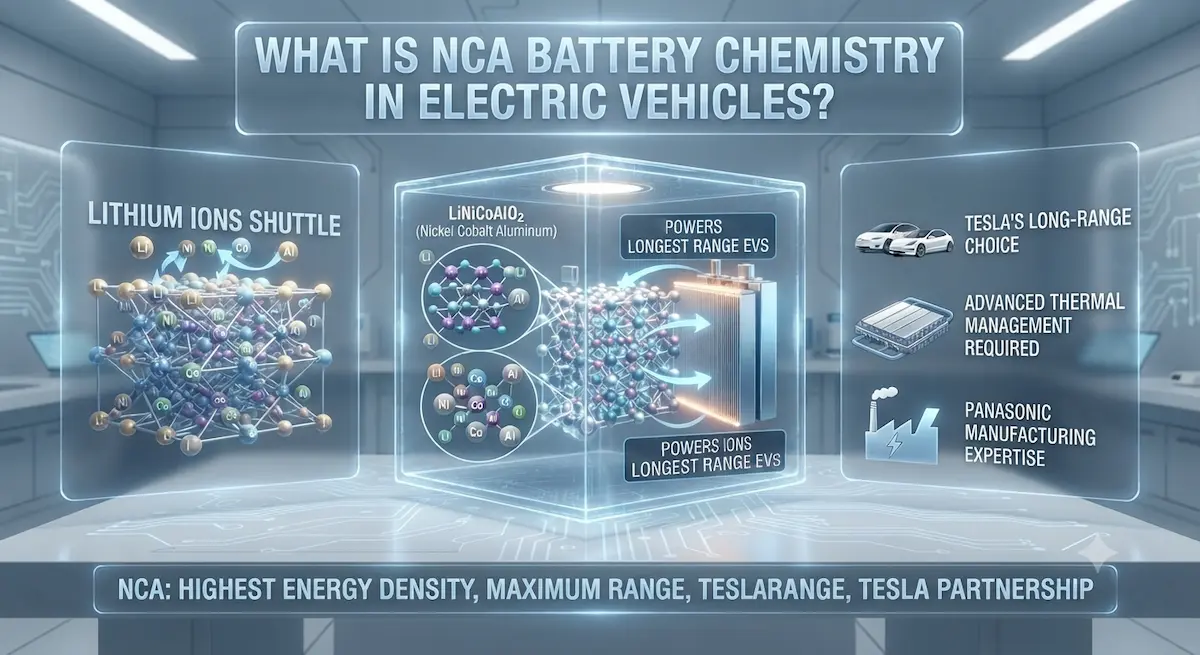
NCA (Nickel Cobalt Aluminum) is a lithium-ion battery chemistry that uses lithium nickel cobalt aluminum oxide (LiNiCoAlO₂) as the cathode material. It delivers the highest energy density of any mainstream EV battery chemistry — up to 300+ Wh/kg at the cell level — making it the chemistry behind Tesla’s longest-range vehicles. Tesla has used NCA cells from Panasonic since the original Roadster in 2008, and it remains the chemistry in the Model S, Model X, and many U.S.-market Model 3 and Model Y Long Range variants in 2025–2026.
Curious how it stacks up directly against NMC? See our comparison of NCA vs NMC battery: key differences.
What Does NCA Stand For?
NCA stands for Nickel Cobalt Aluminum — the three metal constituents in the cathode material:
- Nickel (Ni): ~80–85% of cathode metals — primary contributor to high energy capacity
- Cobalt (Co): ~15% — maintains structural order of the layered cathode, improves conductivity
- Aluminum (Al): ~5% — replaces manganese (which NMC uses); stabilizes the cathode structure and reduces thermal degradation
The key difference between NCA and NMC: NCA substitutes aluminum for manganese. Aluminum is lighter and provides better structural stabilization at high states of charge — which is why NCA achieves slightly higher energy density than equivalent NMC formulations despite using similar nickel content.
NCA Battery Key Specifications
| Specification | NCA Value |
|---|---|
| Cell energy density | 220–300+ Wh/kg |
| Nominal cell voltage | ~3.6–3.65V |
| Cycle life (to 80%) | ~1,000–2,000 cycles |
| Thermal runaway onset | ~180–210°C |
| Pack cost | ~$130–150/kWh (premium) |
| Daily charge recommendation | 80–90% (not 100%) |
| Cobalt content | ~15% of cathode metals |
Why Tesla Uses NCA
Tesla’s partnership with Panasonic for NCA cells dates to 2009. NCA was chosen for two reasons: maximum energy density and Panasonic’s manufacturing expertise with NCA cylindrical cells. Tesla NCA cells (Panasonic-manufactured in Nevada) achieve approximately 322 Wh/kg at the cell level — enabling the Tesla Model S Long Range’s 405-mile EPA range.
NCA vs NMC: How They Differ
| Feature | NCA | NMC 811 |
|---|---|---|
| Cathode metals | Ni, Co, Al | Ni, Mn, Co |
| Energy density | 220–300+ Wh/kg | 220–260 Wh/kg |
| Thermal runaway onset | ~180–210°C | ~200–210°C |
| Cycle life | 1,000–2,000 cycles | 1,000–2,500 cycles |
| Cobalt content | ~15% | ~10% |
| Primary user | Tesla (US models) | Hyundai, BMW, VW, most others |
NCA’s Advantages and Limitations
Advantages:
- Highest energy density of mainstream EV chemistries — enables maximum range
- Aluminum stabilization provides slightly better structural durability at high charge than standard high-nickel NMC
- Proven at massive scale — billions of cells in Tesla vehicles since 2012
Limitations:
- Thermal runaway onset of ~180–210°C — slightly lower than NMC 811, requires sophisticated cooling
- Higher cobalt content (~15%) than NMC 811 (~10%) — more supply chain exposure
- Recommended daily charge limit: 80–90% — similar to NMC ownership requirements
- Higher cost than both NMC and LFP
For a deeper look at these tradeoffs, see our full breakdown of the downsides of NCA batteries.
Frequently Asked Questions
What is NCA battery chemistry in electric vehicles?
NCA (Nickel Cobalt Aluminum) is a lithium-ion battery chemistry using LiNiCoAlO₂ as the cathode. It replaces NMC’s manganese with aluminum for improved structural stability at high energy density. NCA delivers 220–300+ Wh/kg and is primarily used by Tesla via Panasonic for Model S, Model X, and many U.S. Model 3/Y Long Range variants.
Is NCA the same as NMC?
NCA and NMC are related but distinct chemistries. Both use high nickel content for energy density. NMC uses manganese as the third metal; NCA uses aluminum instead. Aluminum provides slightly better structural stabilization at high charge states, enabling NCA’s marginally higher energy density. Both require active liquid cooling and daily 80–90% charging limits for longevity.
Is NCA battery safe?
NCA is safe under normal operating conditions with proper thermal management. Its thermal runaway onset (~180–210°C) is slightly lower than NMC 811 (~200–210°C) and significantly lower than LFP (~270°C). Modern EVs using NCA include sophisticated cooling, BMS protection, and cell fusing that make thermal events under normal use extremely rare.
Conclusion
NCA battery chemistry is Tesla’s original high-performance chemistry — chosen for its exceptional energy density (220–300+ Wh/kg) that enables the longest-range EVs in production. The aluminum substitution for manganese gives NCA a marginal density advantage over NMC 811, but at the cost of slightly higher cobalt content and thermal sensitivity. To see how NCA compares to LFP, NMC, LMFP, sodium-ion, and all other EV battery chemistries in one place, see our complete guide: EV Battery Chemistry Explained: NMC, LFP, NCA & Beyond.
