
What Is NMC Battery Chemistry? Full Explanation

Figures on this page are drawn from the IEA’s Global EV Outlook, BloombergNEF’s 2025 battery price survey, peer-reviewed thermal-stability research, NHTSA recall filings and manufacturer specifications.
NMC is the chemistry behind most long-range electric cars sold outside China — and the one most often confused with its neighbours.
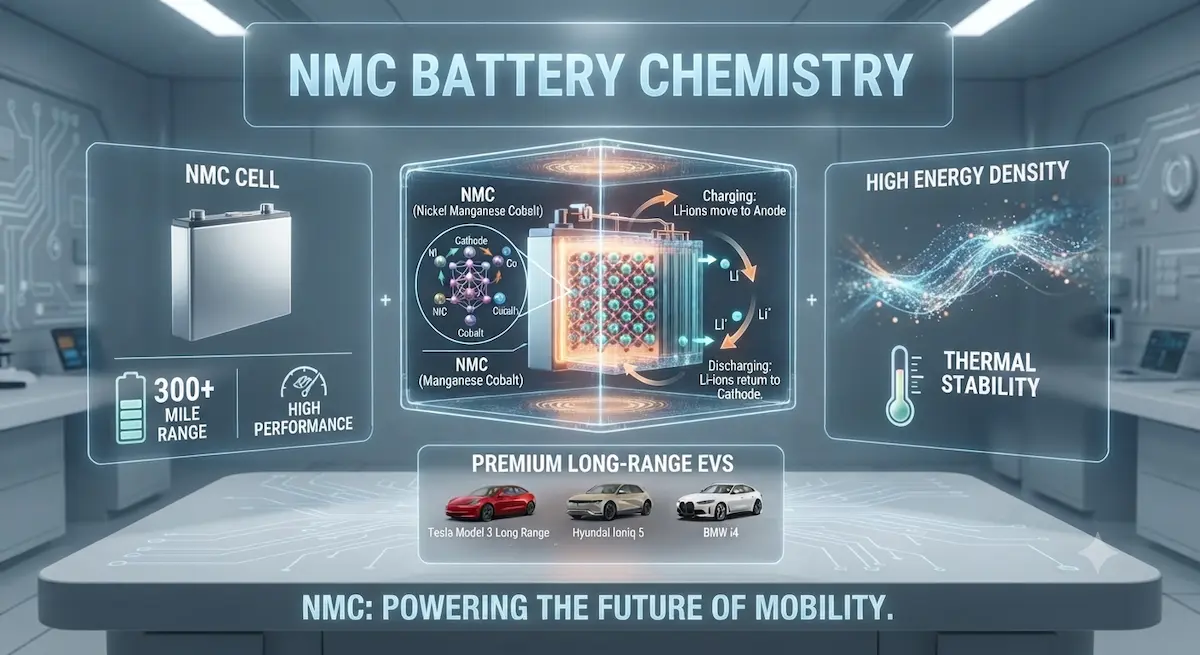
NMC stands for nickel manganese cobalt, the three metals in its cathode. It earned its place by storing more energy per kilogram than any other mass-produced EV chemistry of its generation, which is why it powers everything from a Hyundai Ioniq 5 to a Mercedes EQS. Its position is no longer unchallenged: LFP (lithium iron phosphate) passed 55% of global EV battery deployment in 2025 on cost alone, according to the IEA, and now owns the affordable end of the market.
This guide explains what NMC is, how its variants differ, how it compares with LFP and NCA, and exactly which EVs sold in the United States use it, including the one famous name that does not.
Quick answer
NMC is a lithium-ion battery chemistry whose cathode is made from nickel, manganese and cobalt (LiNiMnCoO₂). Nickel provides the energy, manganese the stability and cobalt the conductivity and structure, and the balance between the three defines each variant, from NMC 111 to today’s nickel-rich NMC 811.
Key figures:
Cell energy density: 200–260 Wh/kg · Nominal voltage: about 3.6–3.7 volts · Cycle life: roughly 1,000–2,500 full cycles · Average pack cost 2025: about $128 per kWh (BloombergNEF)
What does NMC stand for?
NMC stands for nickel manganese cobalt — the three metals combined with lithium and oxygen in the cathode, written LiNiMnCoO₂.
Each metal does a different job. Nickel is the capacity carrier: the more nickel in the mix, the more energy the cathode can store. Manganese stabilises the crystal structure as lithium moves in and out. Cobalt improves conductivity and holds the layered structure together, but it is the most expensive and most supply-constrained of the three, which is why the industry’s whole direction of travel has been more nickel, less cobalt.
You will also see the same chemistry written NCM. The letters are identical, just ordered differently by different makers and regions; NMC and NCM are the same cathode family. The wider lithium-ion family includes LFP, NCA and LCO, and NMC is compared with the first two in the comparison section below.
How an NMC battery works
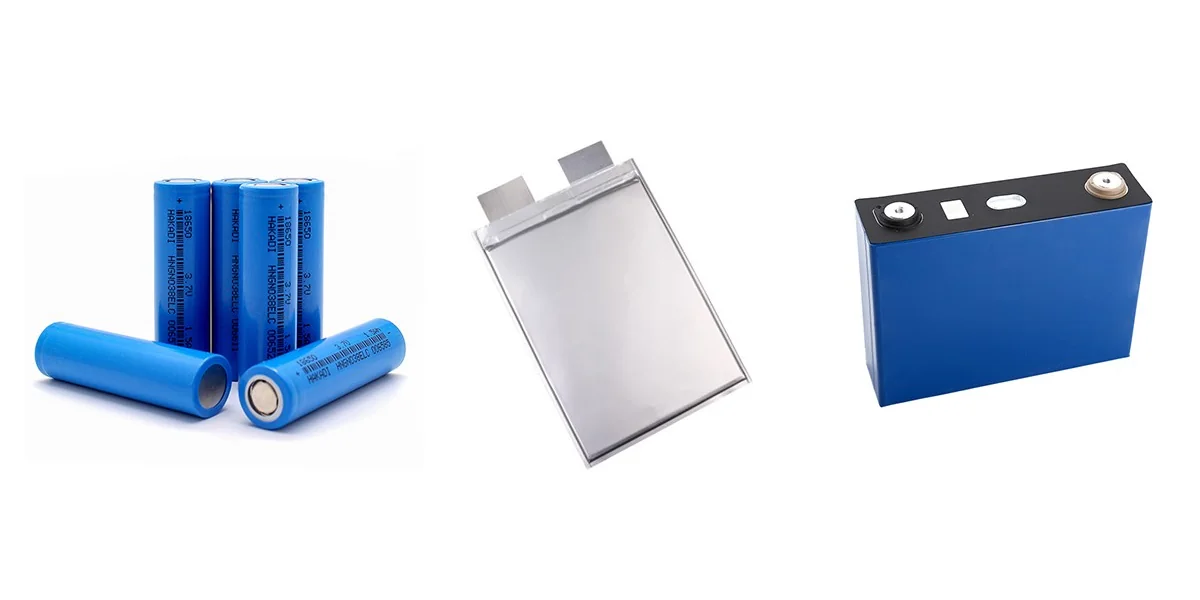
An NMC cell works by shuttling lithium ions between the NMC cathode and a graphite anode through an electrolyte.
When the battery charges, lithium ions leave the layered NMC cathode and slot into the graphite anode; when it discharges, they flow back, and that movement is the electric current. A separator keeps the electrodes apart while letting the ions pass, and the battery management system watches voltage, temperature and current to keep every cell inside its safe window.
The nominal voltage of an NMC cell is about 3.6 to 3.7 volts, higher than LFP’s roughly 3.2 to 3.3 volts, which is one reason NMC packs reach high energy density in practice as well as on paper. Most NMC cells pair the cathode with a graphite anode, sometimes blended with a small amount of silicon to raise capacity.
NMC variants: 111, 532, 622, 811 and beyond
The numbers after NMC give the proportions of nickel, manganese and cobalt in the cathode — and the history of the chemistry is the story of the first number rising.
NMC 111 splits the three metals equally. Each generation since has raised the nickel share: 532, then 622, then 811, which is roughly 80% nickel, 10% manganese and 10% cobalt. The newest automotive cathodes push nickel to around 90% (sometimes written 9½½). Because cobalt falls from a third of the cathode metals in NMC 111 to a tenth in NMC 811, the newest variants also use roughly a third as much cobalt per kilowatt-hour, while storing more energy. The trade is stability: the higher the nickel share, the more carefully the cell must be made and managed.
| Variant | Cathode mix (Ni-Mn-Co) | Character |
|---|---|---|
| NMC 111 | 33-33-33 | The original balance: most stable, lowest energy density |
| NMC 532 | 50-30-20 | Mid-2010s mainstream, less cobalt |
| NMC 622 | 60-20-20 | Higher capacity, widely used in EVs |
| NMC 811 | 80-10-10 | Today’s long-range standard: highest density of the mainstream variants, least cobalt |
| 90-class (9½½) | ~90-5-5 | The newest automotive cathodes, in the latest long-range models |
Key specifications
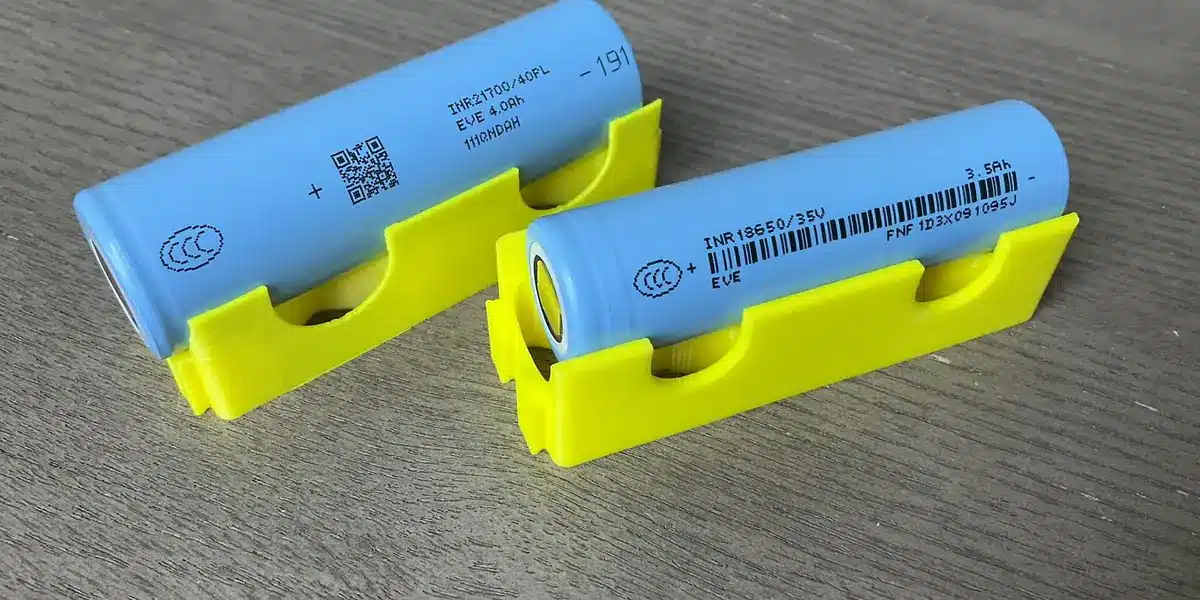
A current NMC cell stores about 200 to 260 watt-hours per kilogram — the figure that decides how much range fits in a car.
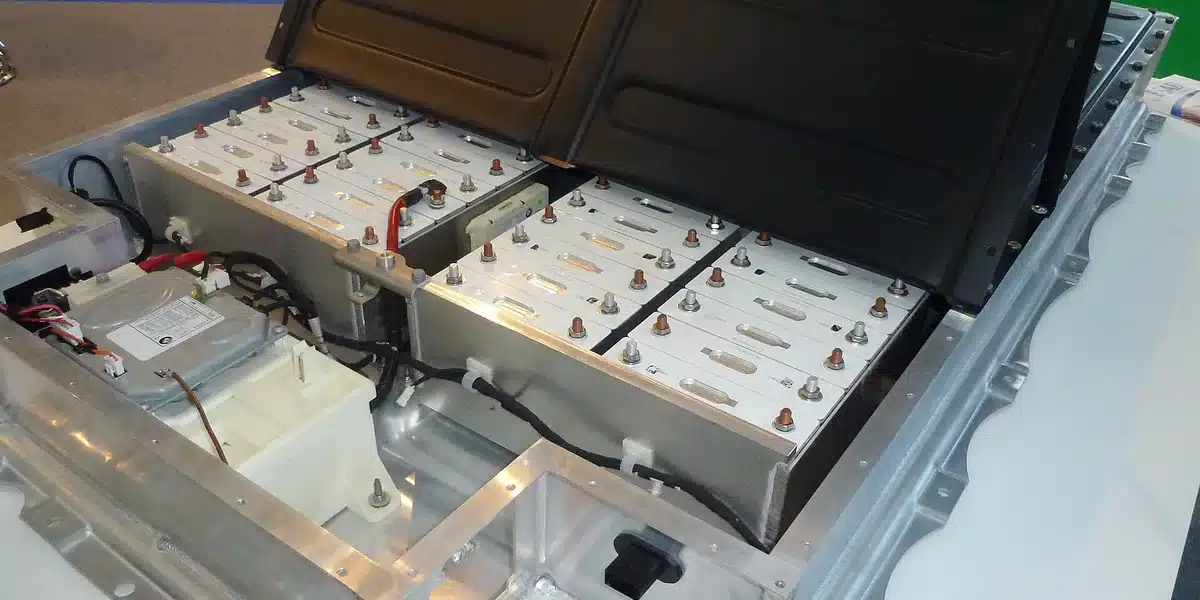
At pack level the number is lower, because the pack adds housing, cooling and electronics: complete NMC packs typically land around 150 to 200 Wh/kg. Cycle life is roughly 1,000 to 2,500 full charge cycles depending on the variant and how the battery is treated, with the middle of that range typical for automotive cells. Higher-nickel variants sit toward the lower end of the cycle-life range and the top of the energy-density range.
NMC vs LFP vs NCA
NMC, LFP and NCA are three different answers to the same question, and the right one depends on whether the car needs range, low cost or the last word in density.
LFP swaps the nickel, manganese and cobalt for iron and phosphate: cheaper, longer-lived and more thermally stable, but heavier for the same energy. NCA replaces the manganese with aluminium and is Tesla’s long-standing choice for its long-range cars, built by Panasonic; it is a close cousin of NMC, not the same chemistry. A fourth relative, NCMA, adds aluminium to an NMC recipe and is the cathode in General Motors’ Ultium batteries.
| NMC | LFP | NCA | |
|---|---|---|---|
| Cathode metals | Nickel, manganese, cobalt | Iron, phosphate (no nickel or cobalt) | Nickel, cobalt, aluminium |
| Cell energy density | 200–260 Wh/kg | 90–190 Wh/kg | Comparable to high-nickel NMC |
| Cycle life | ~1,000–2,500 | ~2,000–5,000+ | ~1,000–2,000 |
| Thermal stability | Cathode decomposition begins around 200–210 °C in 111/622-class cells | Highest of the three, around 270–300 °C | Comparable to, or slightly below, high-nickel NMC |
| Pack cost (2025) | ~$128/kWh | ~$81/kWh | Not split out in the survey |
| Typical US use | Most long-range EVs | Standard-range and affordable EVs | Tesla Long Range and Performance (Panasonic-built) |
Advantages and disadvantages
NMC’s advantage is energy in a small, light package; its disadvantages are cost, cobalt and a lower thermal ceiling than LFP.
The energy density is why long-range and performance EVs still choose nickel chemistries, and NMC also keeps more of its capacity in cold weather than LFP does, whose winter range loss is consistently the larger of the two. Against that, the cathode’s metals are expensive and price-volatile, the cobalt supply chain carries well-documented ethical problems, and the chemistry gives up cycle life to LFP.
The safety difference is real but specific. An NMC cathode is a layered oxide, and when it is heated far enough it breaks down and releases the oxygen held in its structure, which can then feed a fire. For 111 and 622-class cells that decomposition begins around 200 to 210 °C; higher-nickel variants break down at lower temperatures, and LFP’s cathode holds together to roughly 270 to 300 °C.
That is why thermal stability ranks LFP first, then mid-nickel NMC, with NCA and the highest-nickel NMC variants the most sensitive — and why every NMC pack carries serious cooling and monitoring hardware. In normal use, managed by those systems, NMC cars meet the same safety standards as any other EV.
Which EVs use NMC?
Most long-range EVs sold in the United States use NMC or a close variant of it — with verified exceptions that matter.
Hyundai and Kia’s E-GMP cars (Ioniq 5, Ioniq 6, EV6, EV9 and the Genesis GV60) use SK On’s NMC 811-class cells. US-built Volkswagen ID.4s use SK On cells from Georgia, while the imported 2021–22 cars used LG Energy Solution cells of an NMC 712 recipe. BMW’s current EVs use NMC cells dual-sourced from Samsung SDI and CATL.
The Ford Mustang Mach-E’s nickel packs are LG Energy Solution NMC (its standard-range version switched to LFP in May 2023). Mercedes’ EQS and EQE use NMC cathodes. Rivian’s R1 trucks use Samsung SDI nickel-chemistry cells, and its range is now all-nickel following the reported discontinuation of the LFP Standard trim in June 2026.
The exception to state plainly: Tesla’s US Long Range and Performance cars are not NMC. They use Panasonic-built NCA cells, and Tesla’s US standard-range cars use CATL LFP — the exceptions being the Giga Texas-built Model Y’s 4680 cells, which are a nickel chemistry of the NMC class, and the October 2025 Model 3 Standard, which uses a smaller nickel pack. General Motors’ Ultium cars use NCMA, the aluminium-added relative described above.
How long does an NMC battery last, and how should you charge it?
An NMC pack in a modern EV is built to outlast the car’s warranty by a wide margin, and the honest state of the evidence is that chemistry-specific fleet data is still thin.
The best public fleet dataset, Geotab’s study of 10,000 EVs, puts average degradation at about 1.8% per year across all chemistries; it does not publish a separate NMC rate, and no large public study yet does. What is established is the pattern of care: nickel chemistries age fastest at the extremes of charge, so makers of NMC cars typically recommend a daily limit around 80%, keeping 100% for trips, and avoiding long periods parked full or empty.
Charging to 100% when you need the range does no sudden harm — it is the habit of living at the extremes that adds up. Every US-sold EV carries at least an 8-year/100,000-mile battery warranty, and most NMC cars are covered to a 70% capacity floor.
Frequently asked questions
What does NMC stand for?
NMC stands for nickel manganese cobalt, the three metals in the battery’s cathode alongside lithium and oxygen. The same chemistry is also written NCM; the letters and the metals are identical.
Is NMC still the most common EV battery chemistry?
It depends where you look. NMC and its variants remain the default for long-range EVs in North America and Europe, but LFP passed 55% of global EV battery deployment in 2025, driven by China and by standard-range models everywhere.
How long does an NMC battery last?
Automotive NMC cells are rated for roughly 1,000 to 2,500 full cycles, and fleet data across all chemistries averages about 1.8% degradation per year. In practice an EV’s NMC pack is expected to outlast the car for most owners, and it is warranted for at least 8 years or 100,000 miles in the US.
Can I charge an NMC battery to 100%?
Yes, whenever you need the range. For daily driving, a limit around 80% is the pattern most makers recommend for nickel chemistries, because time spent at full charge is what ages the cathode fastest.
Is NMC safer or less safe than LFP?
LFP is the more thermally stable chemistry: its cathode holds together to around 270 to 300 °C, while an NMC cathode begins to decompose and release oxygen around 200 to 210 °C in mid-nickel variants, and earlier in high-nickel ones. Both chemistries are sold in cars that meet the same safety standards, with the difference managed by pack design, cooling and monitoring.
Does Tesla use NMC batteries?
Mostly not, in the United States. US Long Range and Performance Teslas use Panasonic NCA cells and standard-range cars use CATL LFP; the nickel-chemistry exceptions are the Giga Texas Model Y’s 4680 cells and the 2025 Model 3 Standard’s smaller nickel pack.
Conclusion
NMC is the energy-density chemistry: the cathode that made long-range EVs practical, now sharing the market with a cheaper rival. Its variants keep pushing nickel up and cobalt down, its cost gap against LFP is the industry’s central tension, and in the US it remains the chemistry of long range — as long as it is not confused with Tesla’s NCA, which it often is. Knowing which chemistry a car carries tells you how it will age, how to charge it, and what its battery is worth.
