
Tesla Supercharger vs Electrify America: Which Is Better?

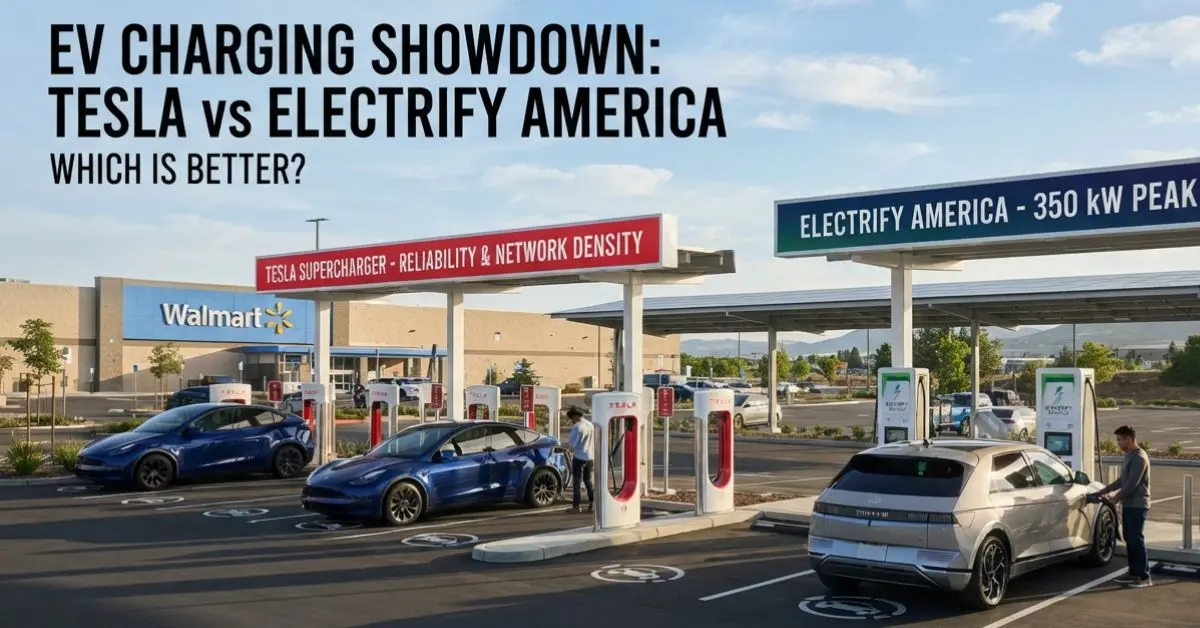
Choosing the right fast-charging network can save you time, money, and stress on every road trip. Here’s how Tesla Supercharger and Electrify America compare so you can pick the best option for your EV.
Tesla Supercharger wins for reliability, speed, and network coverage. It offers 3,088 U.S. stations and 37,400+ ports. It provides consistent 250 kW charging performance.
Electrify America wins for maximum peak power. It offers up to 350 kW at premium stations. This makes it the better choice for 800V EVs like the Hyundai Ioniq 5 and Kia EV6 that accept more than 250 kW.
For everyday drivers, the Tesla Supercharger network is the better overall choice due to its reliability and density. For 800V EV owners who want the fastest peak speed, Electrify America stations deliver faster sessions.
Charging at a hotel or apartment instead of the highway? See our guide to the Blink Charging network.
Tesla Supercharger vs Electrify America: Head-to-Head Comparison
| Feature | Tesla Supercharger | Electrify America |
|---|---|---|
| US stations | ~3,088 stations | ~1,000 stations |
| US ports | 37,400+ ports | ~5,800 ports |
| Peak charging speed | 250 kW (V3/V4) | 350 kW (premium HPC) |
| Typical station size | 8–24 stalls | 4–10 stalls |
| Connector | NACS (native) + CCS adapter | CCS1 + NACS adapter (2025+) |
| Cost (no membership) | $0.32–$0.50/kWh | $0.48–$0.56/kWh |
| Membership discount | Varies (subscription plans) | 25% off with Pass+ ($4/mo) |
| Reliability (2024–2026) | Excellent — industry best | Improved — good, with some issues |
| Available to all EVs | Yes (with NACS or adapter) | Yes |
| Urban coverage | Excellent | Good |
| Rural/highway coverage | Excellent | Good on major corridors |
Tesla Supercharger Reliability and Integration
Tesla designs and builds its own Supercharger hardware. This allows the company to control quality from the first design to the final installation. Tesla also operates and maintains every station directly instead of using other companies.
This vertical integration helps Tesla Superchargers achieve the highest reliability scores in surveys such as the J.D. Power EV Experience Study. Each station has many stalls, usually between 8 and 24. If one stall breaks, others still work. The Tesla app shows how many stalls are open before you arrive, which helps you avoid wasted trips.
Electrify America High Power Charging
Electrify America’s High Power Charging (HPC) stations deliver up to 350 kW. This is the highest charging power available in the U.S. market. This speed helps 800V EVs charge much faster. A Hyundai Ioniq 5 can charge from 10% to 80% in about 18 minutes at these stations.
A Tesla Supercharger V3 delivers 250 kW. Charging the same car there takes about 22 minutes. That 4-minute difference saves significant time during a long road trip. You can find Electrify America stations at Walmart stores, highway rest areas, and city commercial sites in every U.S. state.
Cost Comparison: Which Is Cheaper?
Tesla Supercharger rates average $0.32–$0.50/kWh for non-Tesla drivers. Tesla owners with a subscription pay lower prices. Electrify America charges non-members an average of $0.48–$0.56/kWh, which costs more than Tesla’s standard rate.
You can join Electrify America Pass+ for $4 per month to lower your cost to $0.36–$0.42/kWh. This plan helps frequent users save about $5–$15 per visit, meaning the monthly fee pays for itself after just one or two charges. Tesla also offers discount programs that vary based on your vehicle and subscription type.
Which Network Should You Use?
- Tesla Model 3/Y/S/X owners: Tesla Supercharger always — native integration, best reliability, and built-in app experience
- Non-Tesla 400V EV owners (VW ID.4, Chevy Equinox, BMW i4): Tesla Supercharger via NACS port or adapter — better reliability and station density than Electrify America for typical 150–250 kW charge rates
- 800V EV owners (Hyundai Ioniq 5/6, Kia EV6, Porsche Taycan): Electrify America for the 350 kW sessions; Tesla Supercharger as backup — but EA’s HPC speed advantage is meaningful if the stations are working
- General road-trippers: Plan routes using ABRP and use whichever network has working stations along your route — flexibility beats loyalty in road trip scenarios
Electrify America and Tesla Supercharger Reliability
Electrify America faced numerous reliability issues in the past because many stations were out of service. This frustrated owners of electric vehicles that were not made by Tesla.
The company made big improvements recently. New stations now have an uptime rate of over 95 percent, meaning they work almost all the time. However, the Tesla Supercharger network is still more reliable because it has more stations and stalls.
While both networks are better, the Tesla Supercharger network remains the goal for all other companies. It is the standard that others try to match.
Want to see how these two rank against every other network out there? Check our list of the best EV charging network by stations and fast chargers.
Conclusion
The Tesla Supercharger network is the best choice for most drivers. It offers better reliability, more stations, and more chargers at each site. It also has lower prices for drivers who just show up to charge.
Electrify America is the winner for top charging speeds. It is better for 800V EVs that can use its 350 kW fast chargers. Most drivers should use the Tesla Supercharger network as their main choice since all NACS vehicles can plug in directly.
Use Electrify America Pass+ as a cheaper backup option. This is especially helpful if you own an 800V EV that needs the 350 kW speed.
Wondering which network is most consistent overall? See our breakdown of which EV charging network is most reliable.
FAQs
Is Tesla Supercharger better than Electrify America?
Yes. Tesla Supercharger is generally better because it offers higher reliability, more charging locations, and more charging stalls across the U.S.
Which EVs benefit most from Electrify America’s 350 kW chargers?
800V electric vehicles such as the Hyundai Ioniq 5, Hyundai Ioniq 6, Kia EV6, and Porsche Taycan benefit the most from Electrify America’s 350 kW charging stations.
Can non-Tesla EVs use Tesla Superchargers?
Yes. Many non-Tesla EVs can use Tesla Superchargers with a native NACS port or a compatible adapter, depending on the vehicle and Supercharger location.
