
Lithium-Ion Battery Chemistry: How It Works in EVs

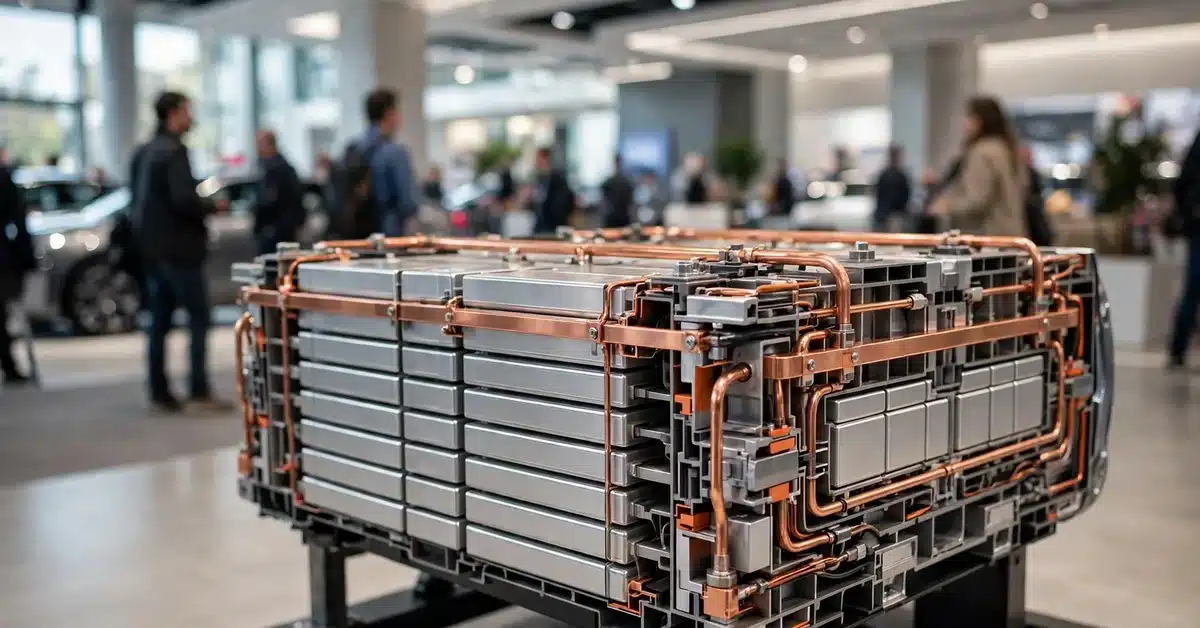
Lithium-ion battery chemistry is the electrochemical process that makes EV batteries work. At its core, lithium ions shuttle between a graphite anode and a lithium metal oxide cathode — storing energy when charging and releasing it when driving. This reversible ion movement is what makes lithium-ion batteries rechargeable hundreds to thousands of times, powering EVs for 150,000–300,000+ miles over their lifetime.
The Basic Working Principle
Every lithium-ion cell has four core components:
- Cathode (positive electrode): Contains lithium in a metal oxide compound — NMC, LFP, or NCA
- Anode (negative electrode): Graphite structure that stores lithium ions during charging
- Electrolyte: Lithium salt solution (typically LiPF₆) that carries Li⁺ ions between electrodes
- Separator: Porous polymer membrane preventing direct contact while allowing ion flow
How Charging Works (Ion Storage)
During charging, an external voltage pushes lithium ions out of the cathode and through the electrolyte to the anode, where they intercalate (slot into) the graphite layers. Simultaneously, electrons travel through the external circuit — this is the charging current. The battery is now “full” — lithium ions are stored in the graphite anode, holding chemical potential energy.
How Discharging Works (Energy Release)
When the EV drives, lithium ions spontaneously want to return to the cathode. They flow through the electrolyte back to the cathode — and the electrons they leave behind flow through the external circuit (the motor wiring). This electron flow is electrical current that powers the motor, climate control, and all vehicle systems.
Why the Cathode Chemistry Matters So Much
The cathode determines how much lithium the battery can store and at what voltage. Higher voltage × more lithium = more energy. This is why NMC 811 (high nickel) stores more energy per kilogram than LFP (iron-phosphate) — the nickel-rich oxide cathode holds more lithium at a higher voltage (~3.7V) than iron-phosphate (~3.2V).
| Chemistry | Cathode Voltage | Energy Density | Key Advantage |
|---|---|---|---|
| NMC 811 | ~3.7V | ~220–260 Wh/kg | Long range |
| NCA | ~3.65V | ~230–300 Wh/kg | Highest density |
| LFP | ~3.2V | ~90–170 Wh/kg | Safety, longevity |
SEI Layer: The Critical Interface
During the first few charge cycles, the electrolyte partially decomposes at the anode surface — forming a thin, stable layer called the Solid Electrolyte Interface (SEI). This SEI layer is critical: it protects the anode from further electrolyte decomposition while still allowing lithium ions to pass through. The quality of SEI formation during manufacturing (called “formation cycling”) directly determines battery cycle life and performance stability.
Why Lithium-Ion Dominates EVs
- High energy density: Stores far more energy per kg than NiMH or lead-acid alternatives
- Reversible chemistry: Can charge and discharge 1,000–5,000+ times without catastrophic failure
- No memory effect: Unlike older NiMH batteries, lithium-ion doesn’t need full discharge cycles to maintain capacity
- Scalable: Same cell chemistry works from a phone battery to a 200 kWh EV truck pack
Frequently Asked Questions
How does lithium-ion battery chemistry work in EVs?
Lithium ions move between the graphite anode and metal oxide cathode through a liquid electrolyte. Charging stores ions in the anode. Discharging releases them back to the cathode, pushing electrons through the external circuit as usable electric current. This reversible process can repeat thousands of times before significant capacity loss occurs.
What makes lithium-ion better than older battery types?
Lithium-ion offers 3–5x higher energy density than NiMH and 10–15x more than lead-acid. It has no memory effect, maintains performance over hundreds to thousands of cycles, and can be configured in almost any form factor. These advantages make it the only viable chemistry for long-range electric vehicle applications today.
What is the SEI layer and why does it matter?
The SEI (Solid Electrolyte Interface) is a thin protective layer that forms on the anode surface during the first few charge cycles. It forms from partial electrolyte decomposition and then stabilizes — protecting the anode while allowing lithium ions to pass. A well-formed SEI extends battery life significantly. Poor SEI formation (from bad manufacturing or extreme charging conditions) is a major cause of premature degradation.
Conclusion
Lithium-ion battery chemistry works by reversibly moving lithium ions between cathode and anode through an electrolyte — converting chemical energy to electrical energy and back again. The cathode material (NMC, LFP, NCA) defines the battery’s voltage, energy density, and safety characteristics. Understanding this chemistry helps EV owners make smarter decisions about charging habits, temperature management, and long-term battery care.
