
What Is a Silicon Anode Battery?

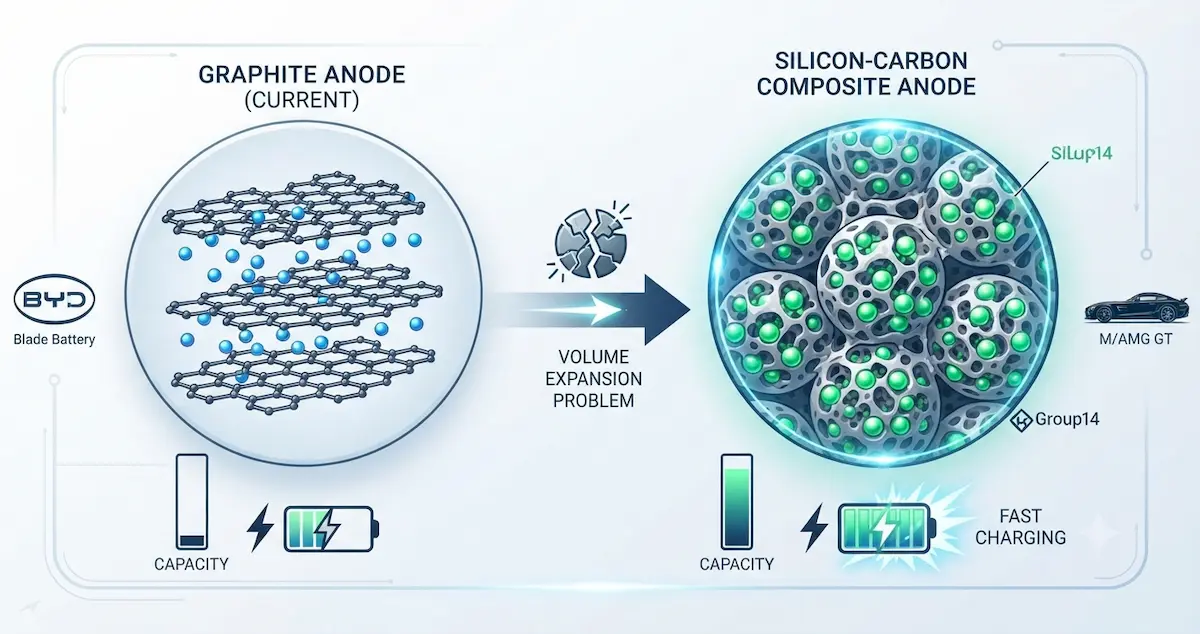
A silicon anode battery uses silicon — either pure or mixed with graphite — as the negative electrode (anode) material instead of graphite alone. Silicon stores approximately 10x more lithium per gram than graphite (4,200 mAh/g vs 372 mAh/g), making it the most promising route to dramatically higher EV range and faster charging without increasing pack size. In 2026, silicon-carbon composite anodes are entering commercial EV production — BYD’s Gen 2 Blade Battery uses a silicon-carbon anode, Mercedes-Benz’s AMG GT deploys it for 600 kW / 11-minute charging, and Sila Nanotechnologies’ Moses Lake, Washington plant is scaling production for mainstream EV deployment in 2026–2027.
New to the anode material it’s replacing? Start with our full explainer on what a graphite anode in an EV battery is.
Why Silicon Stores More Energy Than Graphite
Lithium alloying with silicon follows a different mechanism than graphite’s intercalation. In graphite, lithium ions slot between carbon layers (intercalation) at a stoichiometric limit of one lithium per six carbons (LiC₆) — yielding 372 mAh/g. Silicon alloys directly with lithium through an electrochemical reaction, forming Li₄.₄Si at maximum lithiation — yielding a theoretical specific capacity of 4,200 mAh/g. Even at a practical silicon content of 55% by weight in a composite (Group14’s SCC55 material), the achievable capacity is approximately 1,500–2,000 mAh/g — 4–5x graphite’s practical capacity. This dramatic capacity improvement translates directly to energy density improvement at the cell level.
The energy density calculation is straightforward: energy density (Wh/kg) = capacity (mAh/g) × voltage (V). If the anode capacity improves by 4–5x while the cathode stays constant, the cell’s overall energy density improves by 15–50% depending on how much silicon is incorporated. Sila Nanotechnologies claims its nano-composite silicon anode delivers 20% more range vs graphite in the same cell size and weight. Group14 claims 55% more energy vs traditional graphite packs with 100% silicon-carbon composite anodes. A Tesla Model 3 with 340 miles range could theoretically reach 410–480 miles with a silicon-carbon anode without changing pack size or weight.
The Silicon Volume Expansion Problem
Silicon’s extraordinary capacity comes with an equally extraordinary mechanical challenge: it expands by approximately 300–400% in volume when fully alloyed with lithium, and contracts back to its original size when de-alloyed. Graphite, by comparison, expands only ~10% per cycle. This extreme volume change causes three types of damage that limited silicon anodes for decades:
- Particle fracture: Silicon particles crack under the stress of repeated expansion and contraction — breaking into smaller fragments. Each fracture exposes fresh silicon surface to the electrolyte, triggering more SEI formation and consuming more lithium. Over hundreds of cycles, this gradually reduces capacity and increases impedance.
- SEI instability: The continuously expanding and contracting silicon surface tears the protective SEI layer with every cycle — unlike graphite’s stable, nearly constant surface. The SEI must re-form after each cycle, consuming lithium and electrolyte in each repair. This SEI instability is the primary reason pure silicon anodes have poor cycle life in conventional liquid electrolyte cells.
- Electrode delamination: The electrode coating (silicon particles + binder + conductive carbon on copper foil) loses adhesion over many cycles as volume changes stress the binder matrix—causing portions of the electrode to delaminate and lose electrical contact.
How Silicon-Carbon Composites Solve the Problem
The solution is not pure silicon — it is silicon-carbon composite structures where silicon’s volume expansion is managed by surrounding it with carbon in engineered nanoarchitectures. Different companies use different approaches, but the shared principle is constraining silicon particles at the nanoscale within a carbon matrix that accommodates the expansion:
Group14 Technologies: SCC55 Silicon-Carbon Composite
Group14’s SCC55 material embeds silicon nanoparticles within a porous carbon scaffold (derived from hard carbon precursors). The porous carbon provides void space that accommodates silicon expansion without cracking the overall particle structure. Silicon content is approximately 55% by weight (hence SCC55). Key results: over 1,000 charge cycles at 80% capacity retention in automotive-relevant full pouch cells at 60°C (high temperature). SCC55 is described as “drop-in” compatible with existing lithium-ion manufacturing lines — no new electrode coating equipment required. Group14’s BAM-3 factory in South Korea began producing SCC55 for Asian battery manufacturers in 2025, with the Moses Lake, Washington plant targeting 20 GWh capacity by 2026.
Sila Nanotechnologies: Titan Silicon
Sila’s approach uses a nano-composite structure where silicon sub-particles are enclosed within a carbon microstructure with engineered void space. The key innovation is that the void space allows silicon to expand internally without the overall composite particle changing volume significantly — eliminating the electrode-level mechanical stress that kills conventional silicon anodes. Sila claims 20% range improvement vs graphite anodes in the same cell architecture. Sila received a $100 million DOE grant in 2022 and $375 million in private funding for its Moses Lake, Washington production facility, targeting 20 GWh capacity by 2026 — enough for approximately 200,000 EVs. Sila’s material has already shipped in consumer electronics (Whoop 5.0, some Android smartphones) and is entering automotive applications with Panasonic’s collaboration.
BYD Gen 2 Blade Battery: Silicon-Carbon Anode
BYD’s second-generation Blade Battery (launched March 2026) pairs an LMFP cathode with a silicon-carbon composite anode — claiming the combination reduces internal resistance by 50%, heat generation by 50%, and enables 10–70% charging in 5 minutes on 1,500 kW Flash chargers. BYD developed its silicon-carbon anode in-house, combining LMFP’s higher voltage with silicon-carbon’s higher capacity to push LFP-family energy density significantly closer to NMC without using any cobalt or nickel.
Mercedes-Benz AMG GT: 600 kW Charging
The Mercedes-Benz AMG GT uses silicon-containing anode chemistry — enabling its extreme 600 kW peak charge rate and 10–80% charging in approximately 11 minutes. Silicon’s faster lithium acceptance rate vs graphite is directly responsible for this charging speed — silicon can absorb lithium ions without the intercalation bottleneck that limits graphite at very high charge rates. Production started at Sindelfingen in summer 2026.
Silicon Anode EV Battery Performance Summary
| Property | Graphite Anode (current) | Silicon-Carbon Composite (2026) | Theoretical Pure Silicon |
|---|---|---|---|
| Theoretical capacity | 372 mAh/g | 600–2,000 mAh/g (composite) | 4,200 mAh/g |
| Volume expansion per cycle | ~10% | ~50–150% (managed) | ~400% (destructive) |
| Cell energy density improvement | Baseline | +15–55% vs graphite | +300–500% (theoretical) |
| Range improvement (example) | Baseline | +20–55% (Sila: 20%, Group14: 55%) | +300%+ (not practical) |
| Fast charging improvement | Baseline | Significant — less intercalation bottleneck | Maximum — no intercalation bottleneck |
| Cycle life | 2,000–5,000+ cycles | 1,000–2,000+ cycles (improving) | <100 cycles (commercially impractical) |
| Commercial status | Universal | Entering commercial production (2026) | Lab only |
Why Silicon Anodes Enable Faster Charging
In graphite, lithium ions must travel to the edges of graphene sheets and then diffuse between the tightly stacked layers — a process with relatively slow solid-state diffusion kinetics, particularly at high charge rates where the “traffic” of incoming lithium ions outpaces the rate they can intercalate. This intercalation bottleneck is one reason graphite anodes are more prone to lithium plating at very high charge rates.
Silicon alloys with lithium through a different, faster reaction mechanism — and silicon’s 3D structure offers more lithium acceptance sites per unit area than graphite’s 2D layered structure. The result: silicon-carbon anodes can accept lithium at higher rates without plating, enabling faster charging at equivalent or reduced temperature rise. Group14 claims less than 10-minute charging with SCC55. Mercedes-Benz’s AMG GT demonstrates this in a production vehicle at 600 kW — the fastest charging rate of any Western automaker’s production EV as of mid-2026.
See the full head-to-head breakdown of these two anode materials in our guide on silicon vs graphite anode: which is better for EVs.
Silicon Anode Market Growth
The silicon anode battery market was valued at $536.6 million in 2025 and is projected to reach $31.27 billion by 2035 — a compound annual growth rate of 50.16% (SNS Insider, 2026). Key drivers: EV fast-charging requirements, energy density demands, and the need to reduce dependence on Chinese graphite supply chains. Silicon anodes are attractive partly as a supply chain hedge — U.S. silicon raw materials and production capabilities reduce China’s 65% graphite supply dominance that currently exists in the graphite anode supply chain.
Frequently Asked Questions
What is a silicon anode battery?
A silicon anode battery replaces graphite (the standard EV anode material) with silicon or silicon-carbon composite as the negative electrode. Silicon stores approximately 10x more lithium per gram than graphite (4,200 vs 372 mAh/g), enabling 15–55% more energy density and faster charging. Commercial silicon-carbon composite anodes (BYD Gen 2 Blade, Group14 SCC55, Sila Titan Silicon) are entering EV production in 2026, offering the most significant anode material improvement in EV battery history.
Does silicon anode battery last as long as graphite?
Current silicon-carbon composites achieve approximately 1,000–2,000+ cycles at 80% capacity — somewhat less than graphite’s 2,000–5,000+ in equivalent cells. The silicon volume expansion challenge means some additional capacity fade occurs vs pure graphite. However, commercial silicon-carbon composites have dramatically improved — Group14/Sionic achieved 1,200+ cycles in automotive cells at 60°C. The cycle life gap between silicon-carbon and graphite is narrowing with each generation, and the energy density benefit is considered worth the trade-off in performance applications.
Which EVs use silicon anode batteries in 2026?
As of mid-2026: BYD’s Gen 2 Blade Battery uses silicon-carbon anode (in its latest models). Mercedes-Benz AMG GT uses silicon-containing anode chemistry enabling 600 kW / 11-minute charging. The McMurtry Spéirling hypercar uses Group14 SCC55 silicon-carbon anode via Molicel cells. Panasonic is integrating Sila’s Titan Silicon into its next-generation 4680 cells for Tesla. Most mainstream EV deployment of silicon-carbon anodes at scale is expected 2027–2030 as production scales and costs fall.
Conclusion
Silicon anode batteries represent the most commercially near-term step-change improvement in EV battery performance — offering 15–55% more energy density and faster charging capability over graphite, using existing cell manufacturing infrastructure. The 300–400% volume expansion challenge that blocked silicon for decades is being solved through silicon-carbon nanocomposite architectures where silicon is embedded in porous carbon structures that accommodate expansion while maintaining cycle life. With BYD’s Gen 2 Blade, Mercedes AMG GT, Group14, and Sila all commercializing in 2025–2026, silicon-carbon anodes are transitioning from performance vehicle niche to mainstream EV technology — the most significant anode development since graphite was first used in lithium-ion batteries in 1991.
Silicon is also a stepping stone toward pure lithium metal anodes — see our explainer on what a lithium metal anode battery is.
