
State Rebates for Home EV Charger Installation

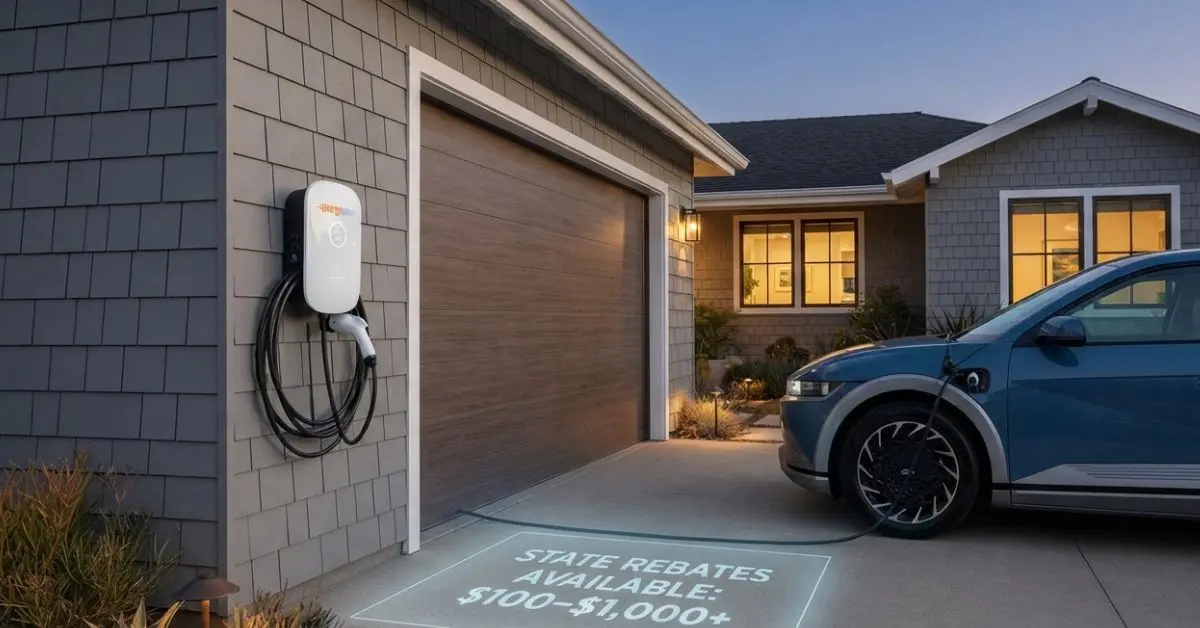
Most U.S. states offer rebates, tax credits, or programs for home EV charger installation, in addition to the 30% federal tax credit. State rebates usually range from $100 to $1,000. Utilities, state energy offices, or public utility commissions usually manage these savings.
Some programs receive funding directly from the state. Other programs come from individual electric companies within the state. Use this guide to find and claim state rebates for your home EV charger installation.
These stack on top of the federal program — see our guide on the federal tax credit for EV home charger installation.
Examples of State EV Charger Rebates in 2026
| State / Utility | Rebate Amount | Programme | Notes |
|---|---|---|---|
| California (PG&E) | $500–$1,000 | PG&E EV Charger Rebate | Income-qualified tiers available; must use approved charger list |
| Colorado | Up to $500 | Xcel Energy EV Charger Rebate | Customers of Xcel Energy only; combined with federal credit |
| New York (NYSERDA) | Up to $500 | NYSERDA EV Charger Incentive | Statewide; applies to Level 2 residential |
| Maryland | Up to $700 | Maryland EV Rebate / BGE programme | BGE utility customers; income-based tiers |
| Oregon (PacifiCorp) | Up to $500 | EV Charging Equipment Rebate | Qualifying Level 2 chargers; list on utility website |
| Texas (Oncor) | Up to $250 | Oncor EV Charger Rebate | Oncor customers only |
| Illinois (ComEd) | Up to $750 | ComEd EV Charging Rebate | ComEd customers; eligible chargers listed |
How to Find Your State’s Rebates
- DSIRE.org (Database of State Incentives for Renewables and Efficiency): The most comprehensive, regularly updated database of U.S. state and utility incentives — search your state and filter for “EV charging” to see all current programmes
- Your utility’s website: Search “[Your Utility Name] EV charger rebate” — most utilities maintain a dedicated EV charging incentives page with current rebate amounts, qualifying charger lists, and application forms
- DOE Alternative Fuels Data Centre (afdc.energy.gov): The federal database of all state EV-related incentives — includes both charger installation rebates and EV purchase incentives
- EV charger manufacturer websites: ChargePoint, Emporia, and JuiceBox maintain their own pages listing which of their products qualify for which state and utility rebates
How to Apply for State Rebates
- Check the qualifying charger list before buying: Most rebate programmes only apply to specific UL-listed, ENERGY STAR certified charger models — confirm your chosen charger is on the list before purchasing
- Keep installation receipts and photos: Most rebate applications require proof of purchase and installation — photographing the installed charger and keeping all electrician receipts is essential
- Apply promptly: Many rebate programmes have limited funding pools and are first-come, first-served — apply as soon as possible after installation to avoid missing the window
- Stack with federal credit: State rebates and the federal 30% tax credit can be combined — apply for the utility rebate immediately after installation and claim the federal credit on your next tax return
How Much Can You Save in Total?
A typical homeowner in a utility rebate state who installs a $600 Level 2 charger with $400 electrician installation ($1,000 total) qualifies for: $300 federal tax credit (30% of $1,000) plus a $500 utility rebate = $800 total savings on a $1,000 project. The net out-of-pocket cost: just $200. In high-rebate states like California and Maryland, the combination of federal credit and utility rebate can reduce or eliminate the entire cost of Level 2 charger installation — making it effectively free for qualifying customers.
Renting instead of owning? See our guide on whether a landlord can deny EV charging installation.
Conclusion
State rebates for home EV charger installation give you between $100 and $1,000. You can stack these deals with the federal 30% tax credit. Homeowners in eligible areas can save $500 to $1,000 or more, which drops the cost of a Level 2 installation to under $200.
First, check DSIRE.org and your utility website before you buy anything. Make sure your charger model is on the qualifying list. Hire a licensed electrician to do the work, keep all your receipts, and apply for your utility rebate right away.
Adding a large charger to your panel? See our guide on what load balancing is for home EV charging.
Frequently Asked Questions
Can I combine a state EV charger rebate with the federal tax credit?
Yes. In most cases, you can claim both the state rebate and the federal 30% tax credit if you meet the eligibility requirements for each programme.
Do all states offer rebates for home EV charger installation?
No. Rebates vary by state and utility company. Some states offer statewide programmes, while others provide incentives only through participating utility providers.
What documents are usually required to claim a home EV charger rebate?
Most programmes require a purchase receipt, installation invoice, proof of residence, and photos of the installed charger. Some may also require proof that the charger is on the approved equipment list.
