
Can a Landlord Deny EV Charging Installation?

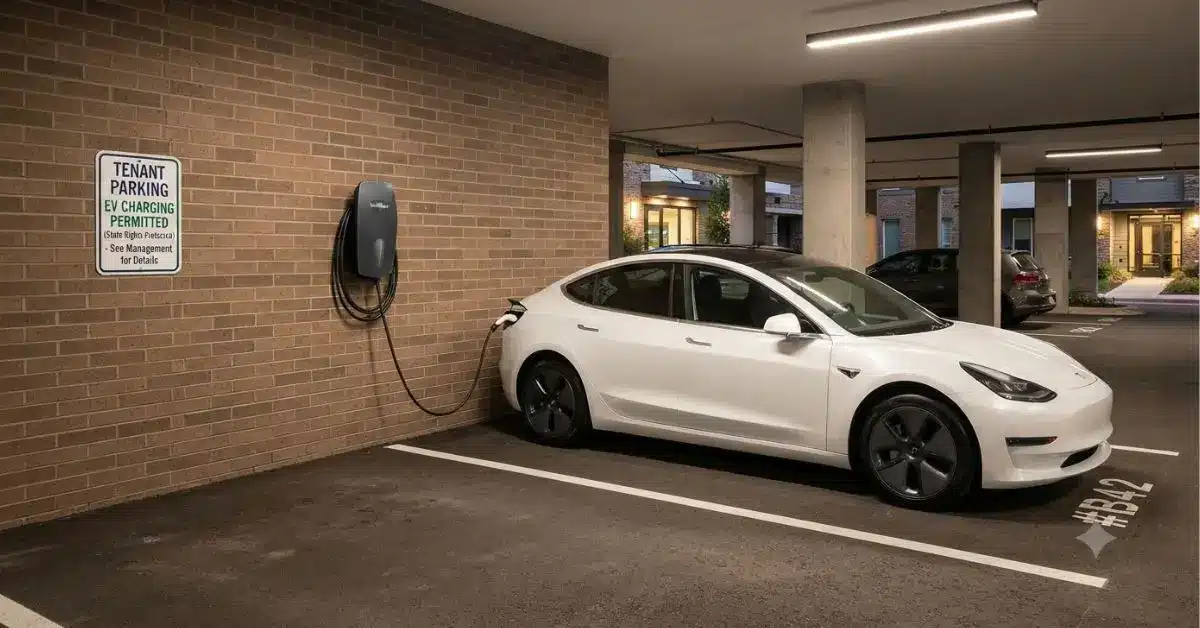
Want to charge your EV at home but rent an apartment? Your rights depend on where you live, and knowing the law can help you avoid unnecessary delays or refusals.
In many U.S. states, a landlord cannot legally deny a tenant’s request to install EV charging if certain conditions are met. California, Colorado, Florida, Hawaii, New York, Oregon, Washington, and more than a dozen other states have passed laws protecting tenants’ right to install EV chargers at their personal parking spot. In states without specific EV charging laws, landlords may still deny installation, but many are receptive when approached correctly. Here is the complete guide to EV charging rights for apartment renters.
Building shared electrical capacity can also be a factor — see our guide on what dynamic load management is in EV charging.
States With Tenant EV Charging Rights Laws
| State | Key Law / Provision | What It Requires |
|---|---|---|
| California | Civil Code Section 1947.6 | Landlords cannot unreasonably deny EV charger installation at a tenant’s dedicated parking spot; the tenant pays installation costs |
| Colorado | HB 21-1165 (2021) | Landlords must permit EV charger installation; tenant pays; landlord may require reasonable conditions |
| Florida | Florida Statutes § 83.682 | Tenants in multi-family housing have right to install EV chargers with landlord approval (cannot be unreasonably withheld) |
| Hawaii | HRS § 196-7.5 | Landlords cannot prohibit EV charger installation; tenant pays; must comply with landlord-set installation standards |
| New York | Multiple ordinances (NYC) | New York City requires EV-ready parking in new construction; landlord refusal rules vary |
| Oregon | ORS § 90.730 | Landlords must permit EV charger installation; reasonable conditions allowed |
| Washington | RCW § 59.18.615 | Landlords cannot prohibit EV charger installation; tenant responsible for costs and compliance with safety codes |
Conditions Landlords Can Require
Even in states with tenant EV charging rights, landlords can usually impose reasonable conditions. Common requirements include:
- The installation must comply with all local electrical codes and building regulations.
- The tenant must use a licensed electrician and obtain all required permits.
- The tenant must provide proof of liability insurance covering the installation.
- The charger must be installed only at the tenant’s dedicated parking spot.
- The tenant must restore the parking space to its original condition when moving out.
What Landlords Cannot Do
In states with EV charging rights laws, landlords generally cannot:
- Refuse permission without going through the approval process.
- Charge excessive fees unrelated to actual costs.
- Require the tenant to use the landlord’s contractor, except for specific safety-related work.
- Unreasonably delay the approval process.
- Prohibit charging at any time of the day or night.
If a landlord violates these rules, tenants may have legal options through the state attorney general’s office or small claims court to recover damages and legal fees.
How to Request EV Charging Installation
- Step 1 — Research your state’s laws: Look up your state’s specific EV charging tenant rights — search your state name + “tenant EV charging right” or check the Department of Energy’s Alternative Fuels Station Locator state policy pages
- Step 2 — Submit a written request: Put your request in writing (email or formal letter) — cite the specific state law if applicable. A written request creates a record and demonstrates seriousness
- Step 3 — Offer to cover all costs: Volunteering to pay for installation, permits, liability insurance, and restoration removes the landlord’s primary objection
- Step 4 — Propose a reasonable installation plan: Have an electrician quote a neat, code-compliant installation in advance — showing the landlord exactly what will happen reduces uncertainty-based resistance
What If Your State Has No EV Charging Law?
In states without specific EV charging tenant rights, landlords can legally deny installation requests.
Your options include:
- Negotiate by offering to pay installation costs, provide insurance, and guarantee restoration.
- Use alternative charging options such as workplace charging, public Level 2 chargers, or DC fast chargers.
- Consider whether owning an EV is practical for your current living situation before buying one.
If you are a long-term tenant, a professional proposal that explains the property value, benefits, and installation plan may improve your chances of approval.
Once approved, good daily habits help protect your investment — see our guide on best EV charging habits to extend battery life.
Conclusion
Whether a landlord can legally deny installation of an EV charging station depends on your state. More than a dozen states now protect tenants through EV charging laws, with California’s Civil Code Section 1947.6 and Colorado’s HB 21-1165 offering some of the strongest protections. In protected states, landlords can set reasonable conditions but cannot simply refuse installation. In states without these laws, negotiation and a clear proposal to cover all costs remain the best approach. Always check your state’s rules before requesting installation so you understand your legal rights.
Also ask about available savings — see our guide on state rebates for home EV charger installation.
FAQs
Can my landlord refuse to install an EV charger if I pay for it?
It depends on your state. In states with tenant EV charging laws, landlords usually cannot unreasonably deny your request if you meet the legal requirements.
Who pays for EV charger installation in a rental property?
In most cases, the tenant pays for installation, permits, insurance, maintenance, and any required restoration when moving out.
Do I need a licensed electrician to install an EV charger?
Yes. Most state laws and landlords require that a licensed electrician complete the installation and ensure it complies with local electrical codes.
