
How Weather Affects EV Charging: Cold, Heat, Rain, and More

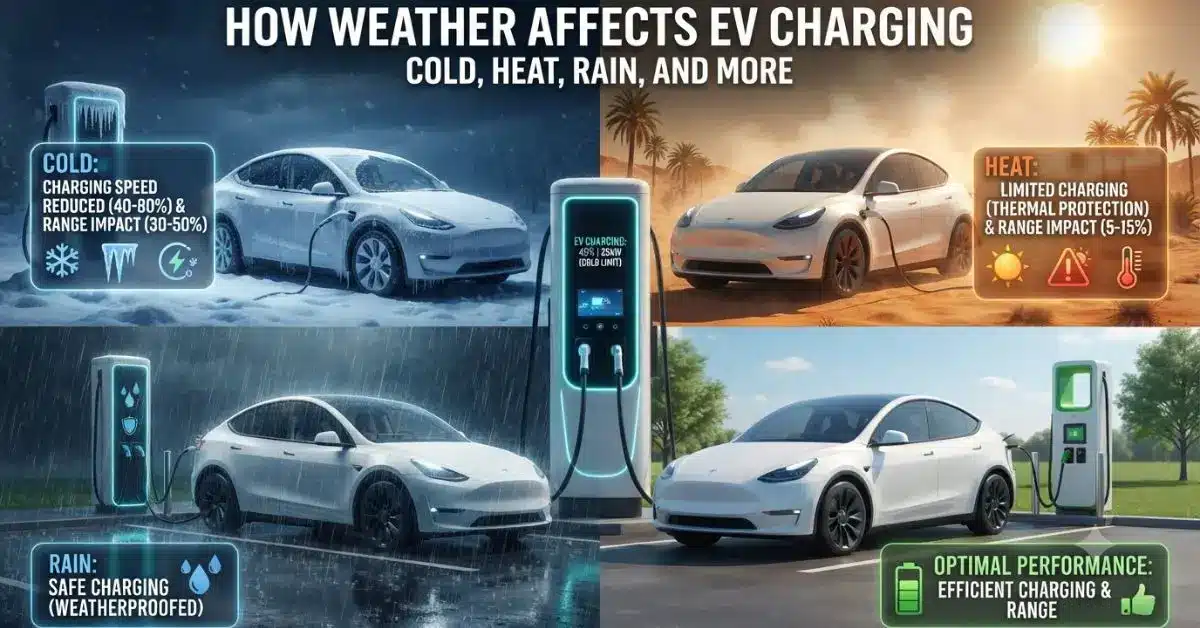
Session data from Idaho National Laboratory, the Canadian Automobile Association’s 2025 winter test and InsideEVs’ instrumented comparisons; fleet figures from Recurrent (30,000+ US EVs) and AAA’s 2019 dynamometer study (November 2026).
Ask owners what winter does to charging and you will hear a number — usually a scary one, rarely a sourced one. The truth is more useful and more specific: weather does not set your charging speed; your battery’s temperature does. A car that arrives at a fast charger with a warm battery charges at full speed in a blizzard. The identical car, cold-soaked overnight on the same street, can take twice as long. Every condition below — cold, heat, rain, snow — works through that one mechanism, plus a short list of practical exceptions.
This page separates what is measured from what is folklore: the instrumented sessions, the fleet data, the reason your car slows itself down in the cold (it is protecting itself, permanently), and the routines that actually fix it. (If your car is charging slowly right now for reasons unknown, our slow-charging troubleshooting guide works through the causes one by one.)
Cold is the big one — but only through the battery: a cold-soaked pack fast-charges slowly (a Model Y test: 42 minutes and a 135 kW peak cold-soaked vs 33 minutes and 238 kW preconditioned). Warm the battery — drive, or navigate to the charger so the car preconditions — and the weather stops mattering. Heat throttles fast charging only at extremes (heat-soaked pack, back-to-back sessions). Rain and snow are safe by design — the connector carries no live power until it is latched and checked. Home charging barely notices any of it, with one winter exception explained below.
Key figures: Recurrent fleet: EVs keep ~78% of range at 32°F · CAA winter test: 10–80% in 33–92 minutes depending on the car’s thermal system
Cold: It Is the Battery’s Temperature, Not the Air’s
A cold battery accepts charge slowly because fast charging a cold battery would damage it — permanently.
The mechanism is worth one plain paragraph. Lithium ions move through the battery’s electrolyte, and cold electrolyte is sluggish: ions arrive at the anode faster than they can slot into it. Push a high charge rate into that state and lithium plates out as metal on the anode surface instead of storing — lithium plating, a permanent loss of capacity and, in severe cases, a safety concern as deposits grow. So the car’s battery management system does the only responsible thing: it limits the charge rate according to pack temperature. That limit — not the charger, not the weather directly — is what you experience as “winter charging”.
The measured size of the effect, from the hardest data available:
- Same car, same charger, two days apart (InsideEVs, Dec 2023): a Model Y with a preconditioned battery at 30°F charged 10–80% in 33 minutes, peaking at 238 kW. After sitting outside at 21°F with a cold-soaked pack: 42 minutes, peaking at 135 kW. The weather barely changed; the battery’s starting temperature was the whole difference.
- A winter fleet (CAA, Feb 2025): 13 EVs fast-charged at 19 to 5°F after a highway drive (packs driving-warmed): 10–80% took from 33 minutes (Kia EV9) and 37 minutes (Tesla Model 3) to 92 minutes in a Toyota bZ4X averaging 33 kW. The spread is thermal-system design and preconditioning quality — which is why two cars side by side in the same cold can have utterly different sessions.
- The extreme historical anchor (Idaho National Laboratory): ~500 fast-charge events from a New York fleet of previous-generation, air-cooled Leaf taxis found 36% less charge delivered in 30 minutes at 32°F, and rates roughly three times slower in the coldest conditions. Print the caveat with it: a 2012-era air-cooled car on 50 kW hardware proves the mechanism and its direction, not the penalty in a modern liquid-cooled car. An owner test of a cold-soaked Chevy Bolt makes the same point at the harsh end: under 15 kW accepted from a 50 kW charger, and the same energy took 45 minutes cold that took 23 minutes warm.

The Level 1 winter trap
Home charging shrugs off cold — except at the very bottom of the power scale.
Level 2 rates are modest next to what even a cold pack can accept, so the rate itself is rarely the problem at home; the quiet tax is that the car spends part of the session heating its own battery, so less of each hour ends up stored. Level 1 is the real casualty: in deep cold, pack heating can consume most of a 1.4 kW outlet supply, and overnight gains can collapse to a trickle.
If you winter on a household outlet and the car barely gains charge, that is the arithmetic — not a fault. (One chemistry footnote for the future: sodium-ion cells hold up unusually well in the cold — our sodium-ion cold-weather explainer covers the evidence; almost no US car offers one yet.)
The Cold Routine: What Actually Fixes It
Four habits, in order of how much time they buy back.
- Navigate to the charger. Routing to a DC fast charger in the car’s own navigation triggers battery preconditioning — the car heats the pack en route so you arrive in the fast zone. Tesla’s guidance is to give it 30–45 minutes of driving; starting preconditioning in your driveway five minutes out does almost nothing. The Mach-E owner logs show the same gap (165 kW peak preconditioned vs 110 kW not, at the same station).
- Charge on arrival, not after the soak. A pack warmed by highway driving is a fast-charging pack. The expensive sequence is the reverse: drive home, let the car cold-soak overnight, then fast-charge in the morning.
- Stay plugged in through cold nights. Plugged in, many EVs maintain battery temperature from wall power instead of draining the pack; Recurrent’s parked-car guidance is a charge limit around 70–80% and the cable in, all winter. Tesla’s blue snowflake icon is the visible version of the same physics: a slice of energy is marked unavailable until the pack warms — it comes back; nothing is lost.
- Know your car’s hardware. Preconditioning quality varies (the CAA spread above), and so does cabin heating: Recurrent’s US list shows heat pumps are standard on the 2025+ Mustang Mach-E (absent on 2021–24 cars) and have never been offered on the US Volkswagen ID.4. A heat-pump car kept about 83% of its range at 32°F in Recurrent’s fleet data versus ~75% without — relevant if you are shopping, decisive if you are comparing your car to a neighbour’s winter numbers.
- Frozen port or latch? Tesla’s manual remedies, which generalize: the Schedule feature’s latch behaviour prevents a frozen charge-port latch; Defrost Car melts ice at the port; maximum (HI) cabin preconditioning can thaw a stuck latch. Warm water on the connector and forcing it are the two things not to do.
How preconditioning itself works — the heating hardware, the per-brand behaviour — is a subject of its own: our battery preconditioning guide.
Heat: The Smaller, Slower Problem
Heat rarely ruins a session — it shortens tempers at the extremes: a heat-soaked pack, a second session in a row, a charger baking in the sun.
Fast charging generates serious heat inside the pack. When the pack arrives already hot — soaked in a 110°F parking lot, or fresh off hard driving — the cooling system spends the session fighting both the weather and the charge itself, and past roughly 45–50°C cell temperature the management system trims the rate to protect the cells. The practical signatures: a first session that tapers earlier than expected, a second back-to-back fast charge that runs notably slower than the first, and occasional charger-side derating on the hottest afternoons. No honest fleet-wide percentage exists for any of this — be suspicious of any article that gives you one.
The routine is the cold routine’s mirror: charge in the shade or in the cooler hours when you can, pre-cool the cabin while plugged in, and do not plan a road-trip day around repeated maximum-rate sessions in extreme heat. What heat does to range is smaller than folklore says — Recurrent’s summer fleet data (29,716 vehicles) puts the loss at ~5% at 90°F and 17–18% at 100°F, mostly the air conditioning’s 3–5 kW pull-down — and what heat does to long-term battery health is a storage-and-habits story, told properly on our charging habits page.
Rain, Snow and Storms: Safe by Design, With a Short Exception List
The connector in your hand carries no live power until it is latched into the car and the two have checked each other — that handshake, not hope, is why rain is fine.
Charging equipment is outdoor equipment: connectors are sealed and ingress-rated as a mated pair, stations and home units carry ground-fault protection that cuts power on any fault, and the high-voltage side only energizes after the latch-and-communication check passes. Snow on the connector, rain on the car, a wet cable — all inside the design envelope; 4 in 10 drivers in CAA’s 16,000-driver survey named slower cold charging as their winter complaint, and essentially none named safety. The honest exception list is short:
- A damaged connector or cable — cracked housing, exposed conductors, a plug that won’t latch. Do not use it, in any weather.
- A flooded or submerged station — water over the equipment is a different event from rain on it; skip it and report it. (What saltwater flooding can do to a battery days later is a fire story, told on our EV fire page.)
- An ice-packed connector or port — clear it gently first; forcing a frozen latch breaks the part you need.
- Lightning — split it out from rain: the risk in a thunderstorm is a grid surge damaging equipment, not electrocution through the cable. Charger makers’ on-record advice (Emporia among them) is the cheap precaution: pause and unplug during an electrical storm if you conveniently can, and resume after. Rain alone asks nothing of you.
Charging Speed Is Not Range: The Two Numbers Owners Mix Up
Cold taxes both, heat mainly taxes range, and neither tax is damage.
Keep the ledgers separate. Charging speed in winter is a pack-temperature story (above); driving range is an energy story: Recurrent’s fleet (34 models, 30,000+ US vehicles) kept 78% of range at 32°F and 70% at 20°F on average against each car’s ideal-temperature best, with cabin heating the major driver; AAA’s dynamometer study found −41% at 20°F with the HVAC running (and only −12% with it off) — one reason preconditioning the cabin while plugged in is free range.
Both studies agree on the reassurance owners actually search for: winter loss is temporary. Recurrent’s wording is that there is “no long term detriment to your battery” — the energy is unavailable while cold, not gone. (AAA’s famous figures, for the record, measured range only; the study contains no charging-time measurement, whatever later articles claim.)
Frequently Asked Questions
Does cold weather always slow EV charging?
No — a cold battery does. A car that arrives warm (driven for half an hour, or preconditioned by navigating to the charger) fast-charges at full speed in freezing weather: in InsideEVs’ same-car test, preconditioning at 30°F produced a 238 kW peak and a 33-minute 10–80% session, against 135 kW and 42 minutes cold-soaked. What slows you is the pack’s temperature, and that is under your control.
Can I charge my EV in the rain?
Yes — it is a designed-for case. The connector is sealed and ingress-rated as a mated pair, no high voltage is present until the connector latches and the car and charger complete their safety check, and ground-fault protection guards the circuit. The genuine exceptions are a damaged connector, a flooded station, or an ice-packed port — not rain itself.
Should I unplug during a thunderstorm?
As a precaution, yes if it is convenient — the concern is a lightning-driven power surge damaging the car or charger electronics, not any danger to you from the cable. Charger makers advise pausing during electrical storms; ordinary rain needs no such step. Never handle charging equipment because a storm forces you to — finishing a session early is fine, rushing out into a storm to unplug is its own bad idea.
Why did my fast charge crawl at a 350 kW charger last winter?
Almost certainly a cold-soaked battery meeting its protective limit: the car caps the rate to prevent lithium plating until the pack warms, so the station’s headline number never applied to your session. The fix is upstream — drive 30–45 minutes first, navigate to the charger in the car’s own system so preconditioning runs, or charge at the end of a drive rather than the start of one.
Does cold weather damage an EV battery?
The seasonal effects themselves do not: range and charging speed return with the temperature (Recurrent: no long-term detriment). The one genuinely damaging cold behaviour is the one the car prevents — forcing high charge rates into a frozen pack causes lithium plating, which is exactly why the car limits the rate and why defeating or resenting that limit is a mistake.
Why does my car barely charge overnight on a wall outlet in deep cold?
Because on a 1.4 kW Level 1 supply, the car’s battery-heating system can consume most of the incoming power just keeping the pack above its minimum temperature — little is left to store. It is the known deep-cold weakness of outlet charging. A Level 2 circuit, a garage, or charging right after driving (while the pack is still warm) all break the trap.
Does hot weather slow charging too?
At extremes, yes: a heat-soaked pack fast-charges into its own cooling limits, the management system trims the rate past roughly 45–50°C cell temperature, and a second consecutive session on a hot day tapers harder than the first. In ordinary summer weather, home charging is unaffected and fast charging is close to normal — heat’s bigger effect is range (about 5% at 90°F, 17–18% at 100°F in Recurrent’s fleet data), not speed.
My charge port or cable is frozen shut. What now?
Use the car’s own heat: Tesla’s manual route is the Defrost Car function to melt ice at the port, maximum cabin preconditioning to thaw a stuck latch, and the Schedule feature to keep the latch from freezing in the first place — the same warm-air logic helps on other brands. Do not force the latch and do not pour hot water on the connector; both trade a frozen morning for a broken part.
Conclusion
Weather is the messenger; battery temperature is the message. Cold slows charging only when the pack is cold, and the fix — precondition on the way, charge while warm, stay plugged in — is a routine, not a purchase. Heat nibbles at the extremes, rain asks nothing of you beyond a sound connector, and winter’s range loss comes back in spring. The owners who suffer in January are not the ones with the wrong car; they are the ones fast-charging a cold-soaked battery and blaming the sky.
