
What Is SEI Layer Formation in EV Batteries?

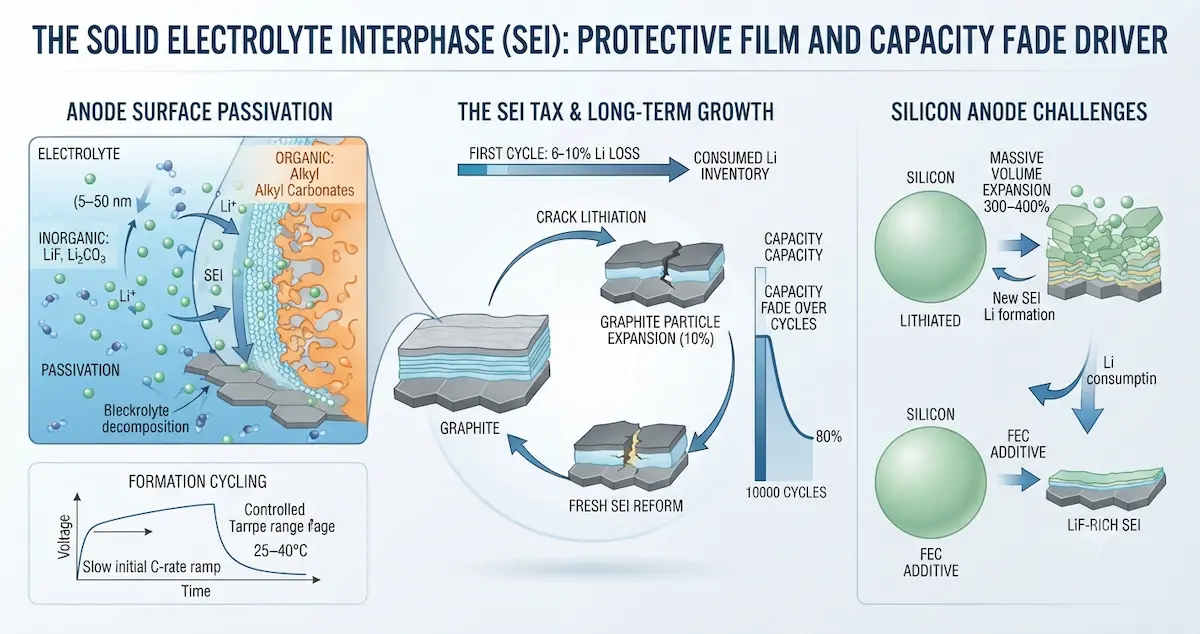
The SEI (Solid Electrolyte Interphase) is a thin protective film that forms on the surface of the graphite anode during the first charge cycles of a lithium-ion battery. It is one of the most important features of lithium-ion battery chemistry — simultaneously enabling the battery to function at all while also being the primary driver of long-term capacity fade. The SEI allows lithium ions to pass through to graphite while blocking further electrolyte decomposition on the anode surface. Without a stable SEI, the electrolyte would continue reacting with graphite every cycle, consuming all available lithium and electrolyte within a few charges. With a good SEI, the battery can operate for thousands of cycles.
The cathode side faces a parallel aging challenge — see our explainer on what cathode cracking is in high-nickel EV batteries.
What Is the SEI Layer and Why Does It Form?
The graphite anode operates at very low electrochemical potentials — approximately 0.05–0.3V vs Li/Li⁺. At these potentials, the organic carbonate solvents in the electrolyte (ethylene carbonate, dimethyl carbonate, ethyl methyl carbonate) are thermodynamically unstable and spontaneously decompose through reductive reactions at the anode surface. This is an unavoidable consequence of using graphite as an anode material: the electrochemical potential needed for effective lithium intercalation is below the stability window of all practical organic electrolytes.
During the very first charge cycle — often called “formation cycling” — lithium ions begin intercalating into graphite for the first time. Simultaneously, the electrolyte begins decomposing at the graphite surface through these reductive reactions, producing a mixture of inorganic compounds (Li₂CO₃, LiF, Li₂O) and organic compounds (lithium alkyl carbonates like ROCO₂Li). These decomposition products precipitate on the graphite surface as a thin, dense film — the SEI layer. Critically, once formed, the SEI is a reasonable ion conductor (allows Li⁺ to pass through) but an electronic insulator (blocks electron transfer) — meaning it prevents further direct contact between the electrolyte and the graphite surface, halting further bulk electrolyte decomposition.
SEI Composition: What It’s Made Of
The SEI layer has a complex, heterogeneous composition that varies depending on electrolyte formulation, electrode materials, and formation conditions. Generally, it consists of two zones:
- Inner inorganic layer (closest to graphite surface): Dense, well-organized inorganic compounds — primarily lithium fluoride (LiF), lithium carbonate (Li₂CO₃), lithium oxide (Li₂O), and lithium hydroxide (LiOH). LiF is particularly valued: it has excellent chemical stability, high ionic conductivity for Li⁺, and good mechanical properties. A LiF-rich inner SEI layer is associated with better cycle life and higher Coulombic efficiency. FEC (fluoroethylene carbonate) additive specifically promotes LiF formation in the inner SEI.
- Outer organic layer (electrolyte-facing side): Porous, variable organic compounds — lithium alkyl carbonates (ROCO₂Li from EC, DMC, EMC decomposition), lithium methoxide, and semi-carbonate species. This layer is less dense, more permeable, and more reactive — it is continuously reacting with trace electrolyte and evolving over the battery lifetime.
Total SEI thickness is typically 5–50 nm — extraordinarily thin, but sufficient to passivate the anode surface effectively. This nanometer-scale precision determines whether the battery lasts 500 or 5,000 cycles.
First Cycle Efficiency Loss: The SEI Tax
SEI formation consumes lithium ions and electrolyte irreversibly during the first charge cycle. Every lithium ion consumed in forming the SEI is one that never returns to the cathode — permanently reducing the battery’s total lithium inventory and usable capacity. This is quantified as the first-cycle Coulombic efficiency (CE):
- Standard graphite anode: First-cycle CE typically 90–94% — meaning 6–10% of the lithium charged in the first cycle is permanently lost to SEI formation
- Silicon-carbon composite anode: First-cycle CE typically 75–85% — silicon’s more reactive surface and greater volume change consume more lithium in initial SEI formation
Battery manufacturers compensate for this first-cycle SEI “tax” by adding extra lithium to the cathode — essentially over-designing the cathode capacity to account for the SEI formation loss. This “excess lithium” strategy works for graphite but becomes a more significant cost and design challenge for silicon-carbon anodes where first-cycle CE is lower. “Prelithiation” — adding pre-formed lithium to the anode before cell assembly — is an alternative approach that compensates for SEI formation loss without enlarging the cathode, enabling better overall cell design.
Why SEI Growth Continues After Initial Formation
The initial SEI formation during the first few charge cycles creates a passivating layer that dramatically slows (but never completely stops) further electrolyte decomposition. Over hundreds to thousands of subsequent cycles, the SEI continues to grow slowly through several mechanisms:
- Mechanical cracking: The graphite anode expands ~10% per cycle during lithiation and contracts during de-lithiation. This repeated volume change cracks the SEI, exposing fresh graphite surface to electrolyte — which immediately begins forming new SEI. This crack-and-reform cycle is the primary driver of long-term SEI growth and lithium inventory loss.
- Dissolution and redeposition: Some SEI components (particularly the organic outer layer) are slightly soluble in the liquid electrolyte and dissolve during high-temperature storage or operation, exposing more graphite surface to electrolyte decomposition. The dissolved components may redeposit elsewhere on the electrode — contributing to overall SEI thickening.
- Sustained electrochemical reactions: Even where the SEI is intact, trace electrolyte molecules that permeate through the porous outer layer slowly react with the graphite at low rates — continuous slow growth that accumulates over the battery’s lifetime.
The practical result: SEI growth continues slowly throughout the battery’s lifetime, consuming small amounts of lithium and electrolyte with each cycle. This slow, cumulative lithium inventory loss is one of the primary mechanisms of long-term capacity fade in all lithium-ion batteries — regardless of cathode chemistry.
How Operating Conditions Affect SEI Growth Rate
| Condition | Effect on SEI | Capacity Fade Impact |
|---|---|---|
| High temperature (>40°C) | Accelerates dissolution and redeposition; faster organic layer growth | 2–3x faster capacity fade vs 25°C operation |
| High SoC (90–100%) | Lower anode potential = more driving force for SEI growth; more reactive cathode surface | 20–30% faster fade at constant 100% vs 80% SoC (NMC) |
| Frequent high-rate charging | More mechanical stress from rapid graphite volume change; micro-cracking | Modest additional fade beyond calendar aging |
| Deep discharge (<5%) | Risk of copper current collector dissolution; SEI at extreme anode potential | Significant if routinely depleted below 5% |
| Cold storage (<0°C) | Slows most SEI reactions; less harmful than heat for storage | Minimal SEI growth during cold storage |
SEI in Silicon-Carbon Anode Batteries: A Harder Problem
Silicon’s 300–400% volume expansion per cycle makes SEI management far more challenging than for graphite. The silicon surface changes drastically in area between charged and discharged states — continuously tearing the SEI and exposing fresh silicon to electrolyte. Without intervention, pure silicon anodes lose 5–10% capacity per cycle from SEI instability alone — completely unacceptable for any practical application. This is why FEC (fluoroethylene carbonate) electrolyte additive is essential for silicon anode batteries: FEC preferentially decomposes on silicon surfaces, forming a LiF-rich SEI layer with better mechanical flexibility that better tolerates silicon’s volume changes. Even so, silicon anode SEI management remains more challenging than graphite SEI management, contributing to silicon-carbon composite cells’ somewhat shorter cycle life vs pure graphite cells at equivalent test conditions.
When SEI cracking becomes severe, it can create the conditions for a much more dangerous failure — see our explainer on what lithium dendrite growth is and why it’s dangerous.
The Formation Cycling Process: Manufacturing the SEI
The quality of the initial SEI — formed during the first few charge/discharge cycles — determines much of the battery’s long-term performance. Battery manufacturers invest significant effort in “formation cycling” — carefully controlled first charge-discharge sequences that create the best possible initial SEI:
- Slow initial charge rate: The first charge cycle uses a very slow rate (typically C/20 to C/10) — allowing the SEI to form slowly and uniformly across all electrode surfaces rather than rapidly and heterogeneously
- Controlled temperature: Formation cycling at 25–40°C promotes better inorganic SEI component formation vs room temperature
- Electrolyte degassing: Gases generated during SEI formation (CO₂, H₂) are removed by degassing the cell before final sealing — these gases would otherwise cause pressure buildup and pack swelling
- Formation time: Full formation cycling for a production cell typically takes 2–4 weeks — one of the longest and most energy-intensive steps in battery manufacturing, contributing significantly to gigafactory capital and operating costs
Frequently Asked Questions
What is SEI layer formation in EV batteries?
SEI (Solid Electrolyte Interphase) is a thin protective film (5–50 nm) formed on the graphite anode surface during the first charge cycles, when the electrolyte decomposes at the low electrochemical potential needed for lithium intercalation. The SEI allows Li⁺ to pass through while blocking further electrolyte decomposition. It consumes 6–10% of lithium in the first cycle (first-cycle efficiency loss) and continues growing slowly throughout battery lifetime, driving long-term capacity fade.
Does the SEI cause capacity fade in EV batteries?
Yes — SEI growth is one of the primary drivers of long-term capacity fade. Each cycle, the SEI grows slightly thicker through crack-reform cycles and slow electrochemical reactions, consuming small amounts of lithium that are permanently removed from the active cycling pool. This cumulative lithium inventory loss manifests as gradually decreasing battery capacity over thousands of cycles. Higher temperature, higher SoC, and frequent deep charge-discharge cycles all accelerate SEI growth rate.
How do manufacturers improve SEI quality?
Through electrolyte additive packages: VC (vinylene carbonate) and FEC (fluoroethylene carbonate) form thinner, more stable SEI layers with higher LiF content — reducing ongoing growth rates. Slow formation cycling (C/20–C/10 first charge) creates more uniform, better organized initial SEI. Novel electrolyte formulations including LiFSI co-salt and localized high-concentration electrolytes provide superior interfacial stability, extending the period between SEI cracks and reformations. Artificial SEI layers created by atomic layer deposition or chemical treatment of graphite particles before electrode coating are emerging as manufacturing techniques.
Conclusion
SEI layer formation is one of the defining features of lithium-ion battery chemistry — simultaneously enabling long cycle life by passivating the reactive graphite anode surface, and driving long-term capacity fade through its ongoing slow growth. Every lithium consumed in SEI formation or repair is permanently removed from the battery’s active energy storage pool. The quality of the initial SEI — determined by electrolyte formulation, additive packages, and formation cycling protocol — strongly influences how fast the SEI grows over the battery’s lifetime. For EV owners, the practical implications are clear: operating at lower states of charge (80% daily limit for NMC), avoiding sustained high temperatures, and minimizing deep discharges all directly slow SEI growth rate — the mechanism responsible for a significant fraction of long-term battery capacity fade.
SEI instability at the anode is also closely tied to lithium plating — see our explainer on what causes lithium plating in EV batteries.
