
What Is Lithium Dendrite Growth and Why Is It Dangerous?

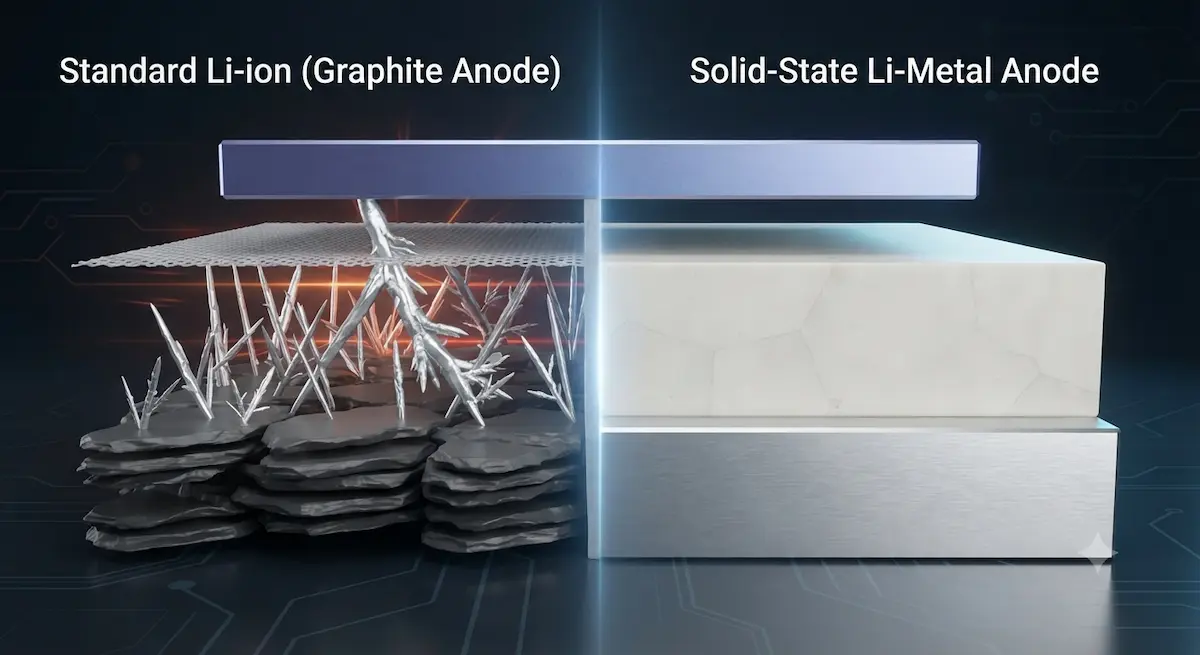
Lithium dendrite growth is the formation of needle-like metallic lithium structures on battery anodes during charging — one of the most serious safety concerns in advanced lithium battery technology. In standard graphite-anode lithium-ion batteries, dendrites can form from lithium plating at low temperatures or high charge rates. In lithium metal anode batteries and solid-state batteries, dendrite formation is the defining engineering challenge that must be solved before these next-generation technologies can be commercially deployed in EVs. Dendrites that grow long enough to pierce the separator between anode and cathode cause catastrophic internal short circuits — generating heat that can trigger thermal runaway, fire, and explosion.
Severe dendrite growth often traces back to lithium plating in the first place — see our explainer on what causes lithium plating in EV batteries.
What Are Lithium Dendrites?
Dendrites (from the Greek “dendron” — tree) are branching, tree-like or needle-like metallic structures that grow on battery anode surfaces when lithium deposits unevenly during charging. Instead of lithium atoms depositing uniformly across the anode surface (which would be the ideal behavior), they preferentially nucleate at specific high-energy sites — impurities, surface defects, edges of SEI cracks, or areas of locally higher electric field — and then continue growing at these preferential sites because the growing tip presents a higher surface electric field that attracts additional lithium deposition. The result is an accelerating growth process where small protrusions grow into longer needles, then branching tree-like structures that can extend micrometers to millimeters in length.
Lithium dendrites are not hypothetical — they have been directly observed using cryo-electron microscopy, X-ray tomography, and synchrotron imaging in lithium battery research. Their composition is metallic lithium (Li⁰) — the same element that travels as ions (Li⁺) through the electrolyte, but deposited as electrically conducting metal rather than intercalating into an electrode material. The combination of high electrical conductivity, sharp tip morphology, and metallic lithium’s high reactivity makes dendrites both an internal short-circuit risk and a fire hazard if they rupture the battery casing.
The Two Contexts Where Dendrites Matter Most
Context 1: Graphite Anode Batteries (Lithium Plating-Induced Dendrites)
In standard graphite-anode lithium-ion batteries (all current commercial EVs), dendrites can form as a consequence of lithium plating — when lithium ions deposit as metallic lithium on the graphite surface rather than intercalating between graphene layers. Under mild plating conditions, plated lithium deposits as a relatively flat film that may partially re-intercalate during subsequent discharge. Under more severe plating conditions (very cold temperatures, very high charge rates, or repeated plating events), the deposited metallic lithium develops dendritic morphology — branching needle-like structures that grow into the electrolyte and separator.
In graphite cells, dendrite growth is typically self-limiting in modern EVs because: BMS systems monitor for voltage signatures associated with plating and limit charging current before dendrites can grow extensively; the polymer separator has some mechanical resistance to penetration; and thermal management systems prevent the temperature extremes that would cause severe plating. However, dendrites from repeated severe lithium plating events accumulate over time — contributing to the “dead lithium” that increases capacity fade in aged cells and representing a rare but real internal short-circuit risk in severely degraded batteries.
Context 2: Lithium Metal Anode Batteries (The Fundamental Challenge)
For lithium metal anode batteries — the foundation of all solid-state battery technology — dendrite formation is not an edge-case risk but the central engineering challenge. When metallic lithium is used as the anode (rather than graphite), every charge cycle involves depositing lithium metal directly onto the anode surface. This lithium metal deposition is inherently prone to non-uniform, dendritic growth because:
- The lithium surface is electrochemically heterogeneous — covered with a variable SEI/interface layer of different thicknesses and compositions that create locally varying resistance to lithium ion transfer
- The “tip effect” means that small protrusions on the lithium surface develop higher local electric field, attracting more lithium deposition and growing faster than surrounding flat areas — a positive feedback loop for dendrite growth
- Lithium metal is soft and creeps under mechanical stress — meaning dendrites that form can push through many materials rather than being purely electrically controlled
In liquid electrolyte cells with lithium metal anodes (which were researched extensively in the 1980s), dendrites consistently caused short circuits within 50–200 cycles — making rechargeable lithium metal batteries commercially impractical and contributing to the shift to graphite anodes in the 1990s. The theoretical energy density of lithium metal anodes (3,860 mAh/g vs graphite’s 372 mAh/g) makes their commercial revival — safely — one of the most valuable technological goals in battery research.
Why Solid Electrolytes Were Expected to Block Dendrites (And Why That Was Wrong)
Early solid-state battery research assumed that hard ceramic solid electrolytes would mechanically block dendrite growth through simple physical obstruction — a lithium dendrite is a soft metal needle, and a hard ceramic should be able to stop it. This assumption was appealing but proved incorrect. Research published from 2017 onward (notably from groups at MIT, Stanford, and RWTH Aachen) showed that lithium dendrites can propagate through solid electrolytes by growing along grain boundaries — the interfaces between individual crystallites in polycrystalline ceramic electrolytes. Electronic conductivity at grain boundaries or local mechanical weakness allows dendrites to “thread” through the ceramic along these paths, even in apparently dense ceramic electrolytes.
The mechanism depends on the solid electrolyte type:
- Oxide ceramics (LLZO): Dendrites propagate through grain boundaries. Achieving near-zero porosity (>99.9% dense) through advanced sintering techniques dramatically reduces but doesn’t completely eliminate grain boundary pathways.
- Sulfide electrolytes: More electronically conductive than oxides, which means sulfide electrolytes can actually facilitate rather than block electronic current through dendrite channels — creating an even more challenging environment for dendrite suppression.
- Polymer electrolytes: Dendrites penetrate polymer electrolytes by a pressure-driven creep mechanism — lithium metal’s mechanical creep force pushes through the polymer network regardless of the polymer’s modulus, unless the modulus is extremely high (above ~10 GPa) which most practical polymers don’t achieve.
Successful Dendrite Suppression Strategies
Despite the complexity of the dendrite problem, several engineering approaches have demonstrated effective suppression in research and early commercial validation:
- Stack pressure: Applying external mechanical pressure (1–10 MPa) to lithium metal anode cells significantly suppresses dendrite formation by preventing void formation at the lithium-electrolyte interface during discharge (void formation creates topographic heterogeneity that seeds dendrite growth). Physical stack pressure promotes uniform, planar lithium deposition rather than preferential deposition at surface protrusions. Most practical solid-state cell designs incorporate stack pressure management as a required feature.
- Anode-free design: QuantumScape’s approach eliminates the pre-formed lithium metal anode entirely. In the first charge cycle, lithium plates directly onto a smooth, flat copper current collector — creating a lithium metal anode in-situ. Plating on an initially flat, featureless surface promotes more uniform nucleation than plating on a pre-formed lithium surface. Combined with LLZO ceramic solid electrolyte, QuantumScape has demonstrated 800+ cycles at 15-minute charging rates.
- Artificial SEI / interface engineering: Applying ultrathin coatings (Al₂O₃, LiF, Li₃PO₄) to the lithium metal surface or current collector before cell assembly creates a uniform, low-resistance interface that promotes homogeneous lithium nucleation — suppressing preferential deposition at defect sites that seed dendrites.
- Highly dense solid electrolytes: Achieving >99.9% relative density in ceramic solid electrolytes (near-zero porosity) by optimizing sintering conditions drastically reduces grain boundary pathways for dendrite propagation. This requires processing temperatures above 1,200°C for LLZO ceramics — costly but achievable.
- High-modulus solid electrolytes: Solid electrolytes with Young’s modulus above approximately 10 GPa can suppress dendrite penetration through a purely mechanical blocking mechanism. LLZO ceramics achieve 150–200 GPa — well above this threshold — but the brittle nature of ceramics creates other engineering challenges.
Interface breakdown at the anode surface is closely related — see our explainer on what SEI layer formation is in EV batteries.
Dendrite Growth in Different Battery Types: A Summary
| Battery Type | Dendrite Risk | Primary Context | Current Status |
|---|---|---|---|
| Graphite-anode Li-ion (current EVs) | Low-moderate (lithium plating events) | Cold-weather fast charging; end-of-life cells | Managed by BMS; rare safety events |
| Silicon-carbon anode Li-ion | Low (graphite majority provides stability) | Similar to graphite but somewhat improved rate capability reduces plating risk | Well-managed in current commercial designs |
| Liquid Li-metal anode (obsolete) | Very high (fatal to cycle life within 100 cycles) | All charge cycles involved metallic lithium deposition | Abandoned commercially in 1990s |
| Solid-state with Li-metal anode (future) | High — primary challenge for commercialization | All charge cycles; grain boundary propagation | Being solved through stack pressure, ALD coatings, dense electrolytes |
| Solid-state anode-free (QuantumScape) | Moderate — improved vs pre-formed Li metal | In-situ lithium plating on Cu current collector | 800+ cycles demonstrated at 15-min charge |
Frequently Asked Questions
What is lithium dendrite growth and why is it dangerous?
Lithium dendrites are needle-like metallic lithium structures that grow on battery anodes when lithium deposits unevenly during charging. They are dangerous because: they are electronically conductive and can bridge the anode-cathode gap to cause internal short circuits; short circuits generate heat that can trigger thermal runaway, fire, and explosion; and metallic lithium is highly reactive with organic electrolytes, generating additional heat and gas upon contact. Dendrite formation is the primary safety challenge preventing lithium metal anode batteries from mainstream EV deployment.
Do current EV batteries (graphite anodes) have dendrite problems?
Yes — but it’s well-managed. Graphite-anode EV batteries can experience dendrite formation from lithium plating under severe conditions (cold-weather fast charging, very high charge rates). Modern BMS systems prevent most plating events by limiting charge current at low temperatures and high SoC. End-of-life batteries with accumulated damage are more vulnerable to dendrite formation from plating events than fresh cells. Catastrophic dendrite-induced short circuits from plating in graphite cells are very rare in properly functioning modern EVs.
How do solid-state batteries handle dendrite growth?
Solid electrolytes cannot simply block dendrites through hardness — they propagate through grain boundaries. Solutions include: mechanical stack pressure (suppressing void formation that seeds dendrites), anode-free designs (QuantumScape — plating on flat copper surface promotes uniform nucleation), artificial SEI coatings on current collectors (promoting homogeneous lithium nucleation), and achieving near-zero porosity solid electrolytes (eliminating grain boundary pathways). Toyota and QuantumScape claim to have made sufficient progress on dendrite suppression to enable their 2027–2028 commercial production targets.
Conclusion
Lithium dendrite growth is one of the fundamental safety challenges in advanced lithium battery technology — affecting graphite cells under severe plating conditions and representing the central engineering barrier for lithium metal anode solid-state batteries. The mechanism is well-understood: preferential lithium deposition at surface heterogeneities creates growing protrusions that threaten to bridge the anode-cathode gap and cause short circuits. Solutions including BMS current management (for graphite cells), stack pressure, anode-free design, artificial SEI coatings, and near-zero-porosity electrolytes are enabling next-generation lithium metal batteries to demonstrate hundreds to thousands of cycles without dendrite failure. The commercial debut of solid-state batteries — beginning with Toyota in 2027–2028 — will be the proof point that dendrite management in production-scale cells has been solved sufficiently for automotive deployment.
Metallic lithium reacting with electrolyte also accelerates a related breakdown pathway — see our explainer on what causes electrolyte breakdown in EV batteries.
