
Best EV Charging Habits to Extend Battery Life

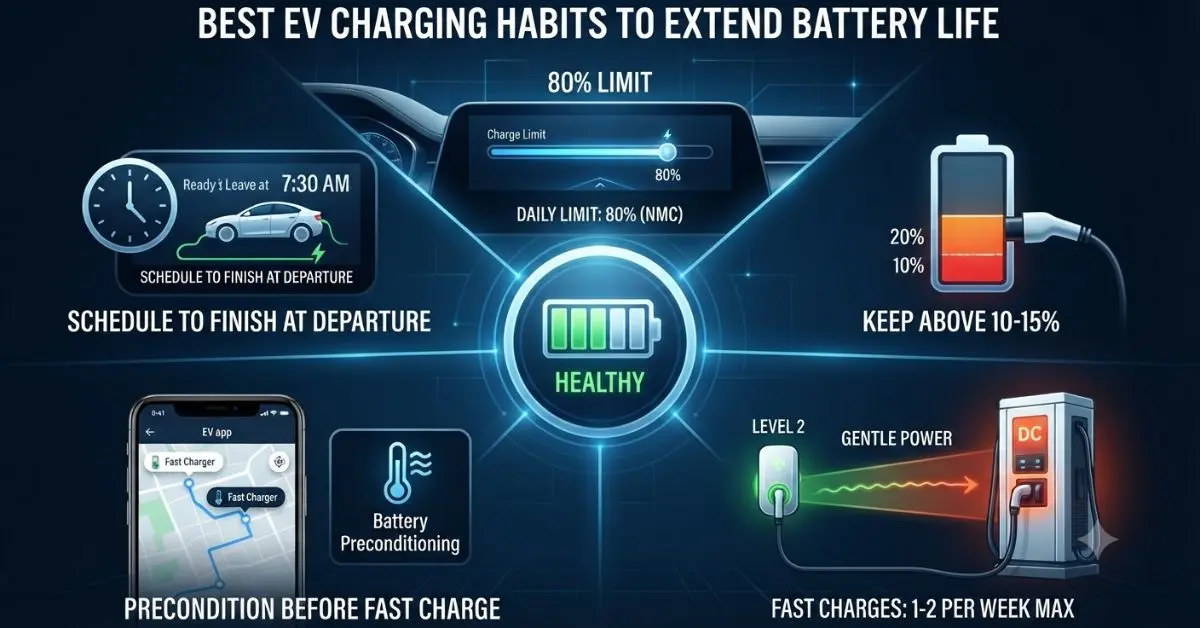
Built from manufacturer manuals (Tesla, Ford, Volkswagen, Hyundai, GM guidance) and Geotab’s 2026 analysis of 22,700 real EVs (November 2026).
Charging advice is the most folklore-dense corner of EV ownership. For every rule with data behind it, there is a ritual somebody’s uncle swears by — and at least one number that was simply invented, then copied from site to site until it looked like research. This page sorts the habits by evidence: the two or three that genuinely move the needle first, the useful supporting habits after, and honest labels on the ones that are mostly ceremony.
The calibration to hold in your head: in Geotab’s 2026 analysis of 22,700 EVs, the average pack degrades about 2.3% a year — most batteries will outlast the cars around them. Habits decide whether you land on the good or the bad side of that average. They do not decide whether the pack survives.
The habits that matter most: don’t leave the car sitting at 100% or near-empty for days — especially in heat; keep DC fast charging a minority of your charging (share matters, not a weekly quota); and set the daily limit your brand recommends — 80% for most nickel-based packs, 100% for LFP. After that: plug in little and often, park out of the heat, charge to full just before a trip rather than days ahead, and store a parked car around 50%. Everything else is fine-tuning.
Key figures: fleet average degradation ~2.3%/yr · heavy fast-charging pattern up to ~3.0%/yr · AC-dominant ~1.5%/yr
The Two Habits That Actually Move the Needle
Time spent at the extremes — full or empty, hot — ages a pack faster than how you drive it.
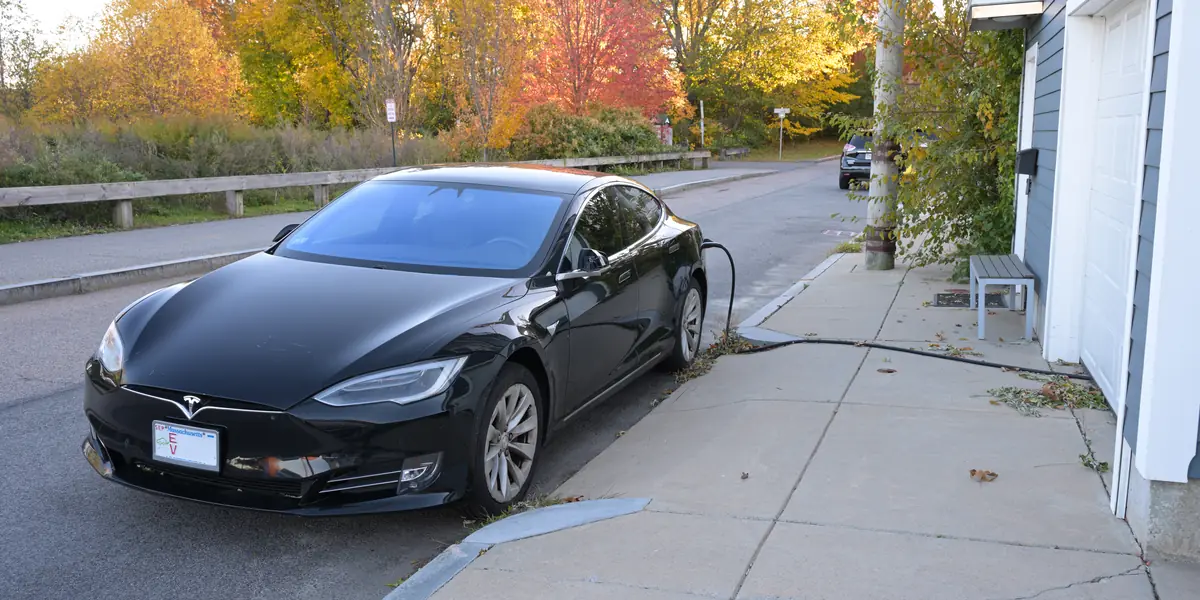
Geotab’s most useful finding is not about charging speed at all. Cars that spent more than 80% of their total time sitting at very high or very low states of charge degraded measurably faster (about 2.0%/yr) than cars that lived in the middle (about 1.4–1.5%/yr). Read that carefully: it is time parked at an extreme, not the act of visiting one.
Charging to 100% before a road trip is fine. Charging to 100% on Friday and leaving the car baking until Monday is the habit to break — heat multiplies it. Battery University’s storage testing puts the extreme case starkly: a pack held at full charge in 40°C heat keeps only about 65% after a year in storage conditions, versus about 85% stored at 40% charge in the same heat. Your driveway is not a storage lab, but the direction is the point.
The second needle-mover is fast charging — measured properly, as a pattern, not an incident:
- Cars whose DC fast charging stayed under roughly 12% of all charging sessions averaged about 1.5%/yr degradation in Geotab’s data.
- Cars above that share — and especially cars whose fast charging was frequently at high power (over 100 kW) — ran up to about 3.0%/yr, projecting to roughly 76% capacity at eight years versus 88% for the gentle pattern.
You will see “limit fast charging to once or twice a week” on other sites. No study or manual says that — it is a quota somebody invented. What the data measures is share and power: a road-trip driver who fast-charges twice in a weekend and home-charges all month is in the gentle group; a driver fast-charging most days at 250 kW is not, whatever the weekly count says.
One honest complication: Recurrent’s study of some 13,000 Teslas found no statistically significant difference between heavy and rare fast chargers — a younger fleet, and Recurrent itself advises saving fast charging for road trips if you plan to keep the car a long time. The two datasets disagree on size, not direction: fast charging is a cost, best treated as one.
Set the Daily Limit Your Brand Actually Recommends
“Charge to 80%” is the average of five different manuals — here is what yours says.
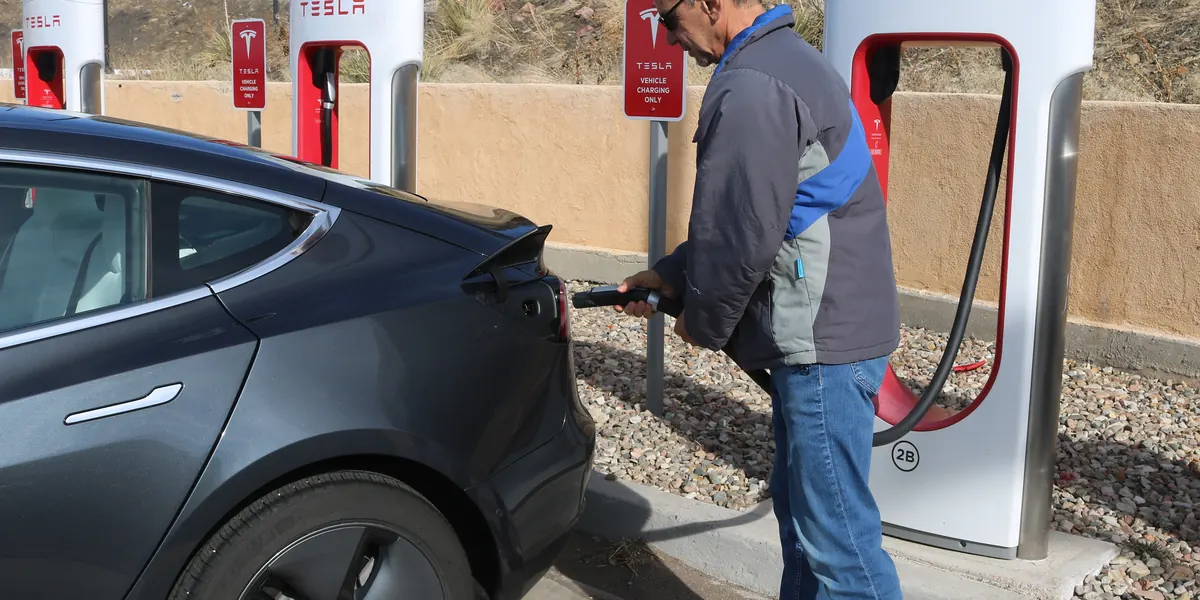
The daily limit is a real habit; it is also brand-specific, because it follows chemistry. Nickel-based packs (NMC/NCA) age faster the higher they sit, so most makers pick a daily ceiling below full. Iron-based LFP packs barely care about sitting full — and actually need regular full charges so the car can calibrate its range estimate against LFP’s flat voltage curve. The per-brand guidance, from the manuals and official support pages:
Brand / pack | Daily guidance | The full-charge rule |
|---|---|---|
Tesla (nickel packs) | ~80% for daily use | 100% for trips; drive soon after |
Tesla (LFP cars) | Keep the limit at 100%, even daily | Fully charge at least once a week (manual wording — it calibrates the gauge) |
Ford (nickel packs) | 90% daily target | 100% when you need the range |
Ford (LFP, e.g. Mach-E Standard Range from 2023.5) | 100% | A full charge about monthly |
Volkswagen (ID.4 manual) | 80% daily | After a full charge, “drive off immediately” — don’t let it sit full |
GM (Ultium cars) | 80% target | 100% for trips |
Hyundai | Prefer AC charging; don’t let the gauge sit below 10% | One full charge from ≤20% about monthly (keeps cells balanced and the estimate honest) |
Two corrections worth making loudly, because the internet gets them wrong: the Chevy Equinox EV is not an LFP car — it is a nickel-based Ultium (NCMA) pack, and GM’s 80% guidance applies to it; GM’s LFP Chevy is the upcoming Bolt. And the Tesla LFP rule is not “charging to 100% is harmless” — it is an instruction with a reason: the weekly full charge exists so the battery computer can find the top of a very flat voltage curve. Why LFP plays by different rules is a chemistry story, told properly in our LFP battery chemistry guide.
Charge Little and Often
Shallow cycles are gentler than deep ones, and the kindest charger is the slow one at home.
A battery cycled between 30% and 70% does far less work per mile than one swung between 5% and 100% — shallower cycles mean less mechanical and chemical stress per cycle, which is why the cycle-life numbers in our charge cycles guide assume partial cycling. In practice the habit is simple: plug in when you get home, let the limit do the thinking, and top up in small sips rather than running the pack down to fumes weekly.
Owner culture calls this “ABC — Always Be Charging.” The phrase is slang, not a manual quote, but the substance is in Tesla’s manual: leave the vehicle plugged in when not in use, so the car can maintain itself from the wall instead of the pack. Plugged-in does not mean charging around the clock — with a limit set, the car sips only what it needs. And the low end matters less than folklore says: the displayed 0% is not the cells’ true zero — every maker hides a protective buffer below it — so an occasional low arrival is an inconvenience, not an injury. What you avoid is living down there.
Heat, Cold, and the Charger
Shade is a battery habit; preconditioning is a speed habit with one lifespan exception.
Heat is the accelerant in almost every degradation story — it speeds the chemistry of aging at any state of charge, and it is why the “sitting full” habit is worst in a Phoenix summer. The practical habits are unglamorous: park in shade or a garage in hot weather when you can, and if the car will sit for days in a heatwave, leave it nearer 50–60% than 100%.
Cold works the other way. A cold-soaked pack accepts charge slowly and, pushed hard, can plate lithium — the one charging stress cold genuinely adds. This is where preconditioning earns its place: navigating to a fast charger so the car warms the pack en route gets you full charging speed, and spares a frozen pack a full-power blast.
Be clear about the order of benefits, though: Tesla’s own manual frames preconditioning as minimising charge time. It is a speed habit first; its lifespan benefit is the cold case above. The full mechanics live in our preconditioning guide — here it is habit, not homework. Scheduling helps quietly too: most cars can finish charging near your departure time, so a full battery spends minutes, not days, at 100% — the needle-mover from the first section, automated.
Storing the Car: The Habit Almost Nobody Lists
A car parked for weeks wants a half-full battery, a plugged-in cable, and no drama.
Every top guide that covers storage agrees, because the manuals do: for a car parked longer than about a month, Ford’s manual says store it at around 50% charge; Volkswagen’s window is 40–70%. Leave it plugged in if the manual allows (Tesla’s does), so maintenance draws come from the wall. Not full — the sitting-full problem, stretched over weeks. Not empty — self-discharge plus vampire loads walk the gauge down toward the buffer you are supposed never to test. If a long park is coming, the whole routine takes one minute: set the limit to 50–60%, plug in, walk away.
What These Habits Actually Buy You
Perspective, because the honest answer is “a few points of capacity, over years” — and that is worth having.
Strip the folklore away and the fleet picture is calm: average degradation ~2.3%/yr, gentler patterns around 1.5%/yr, the harshest around 3.0%/yr. Compounded over eight years that is the difference between keeping roughly 88% of your range and keeping roughly 76% — real money and real range, earned entirely by defaults you set once. No habit on this page will save a pack that was going to fail, and no single fast charge will kill one that wasn’t. The science underneath — what degradation actually is — is covered in our battery degradation guide; this page is the behaviour layer on top of it.
If you charge away from home often, one more distinction is worth a line: whether to plug in every night at all is its own question, answered in Should you charge your EV every night?
Frequently Asked Questions
Should I charge my EV to 80% or 100%?
It depends on the chemistry, and your car knows which it has. Nickel-based packs (most EVs): 80–90% daily per the brand table above, 100% for trips. LFP packs (standard-range Tesla Model 3, Mach-E Standard Range from 2023.5, and others): the limit stays at 100% and the manual asks for a full charge at least weekly — that full charge calibrates the range estimate.
Is it bad to fast charge my EV regularly?
As a pattern, yes — measurably. Fleet data ties degradation to the share of fast charging and the power level: keeping DC fast charging under roughly an eighth of your sessions tracks with about 1.5%/yr degradation; heavy, high-power use runs to about 3.0%/yr. A fixed “twice a week” limit has no study behind it — share is the number that matters.
Should I plug my EV in every night?
If you have home charging, yes — with the limit set. Small top-ups are shallow cycles, the car maintains itself from wall power, and you never live at the bottom of the gauge. Plugged in is not the same as charging to full: the limit stops the session where you told it to.
Can I leave my EV plugged in all the time?
Yes — Tesla’s manual explicitly advises leaving the vehicle plugged in when not in use, and other makers design for it. The car draws only what it needs for its own systems. The habit to avoid is not the plug; it is a full battery sitting in heat, which the charge limit prevents on its own.
What charge should I store my EV at for a month or more?
Around half. Ford’s manual specifies ~50% for storage over 30 days; Volkswagen gives 40–70%. Leave the car plugged in where the manual allows, and don’t store it full or near-empty — weeks of sitting at an extreme is precisely the pattern fleet data punishes.
Does preconditioning really extend battery life?
Mostly it buys you speed: a warmed pack accepts a fast charge at full rate instead of a throttled one. Its lifespan role is narrower — avoiding a full-power charge into a cold-soaked pack. Worth doing on every winter fast-charge stop; not a daily ritual your battery is silently begging for.
Is it OK to charge to 100% before a road trip?
Yes — this is what 100% is for. The harm pattern is sitting at 100%, especially in heat. Charge full, ideally timed to finish near departure (most cars can schedule exactly that), and drive. An occasional full charge on a nickel pack also helps the car balance its cells.
How low can I safely let the battery go?
Occasionally arriving at 5–10% harms nothing — the gauge’s zero hides a protective buffer the car keeps in reserve. The habit to avoid is routinely running to near-empty and leaving the car there. Hyundai’s manual puts its floor plainly: don’t let the gauge sit below 10%. Charge when you get home, not when the warning light writes the schedule.
Conclusion
EV battery care is mostly three defaults and a parking choice: a daily limit matched to your chemistry, fast charging kept as the exception rather than the routine, no long sits at full or empty — and shade in the summer. Set them once and the car does the rest. The pack will still age; everything does. It will just age at the gentle end of what 22,700 real cars say is possible.
