
How Many Charge Cycles Does an EV Battery Have?

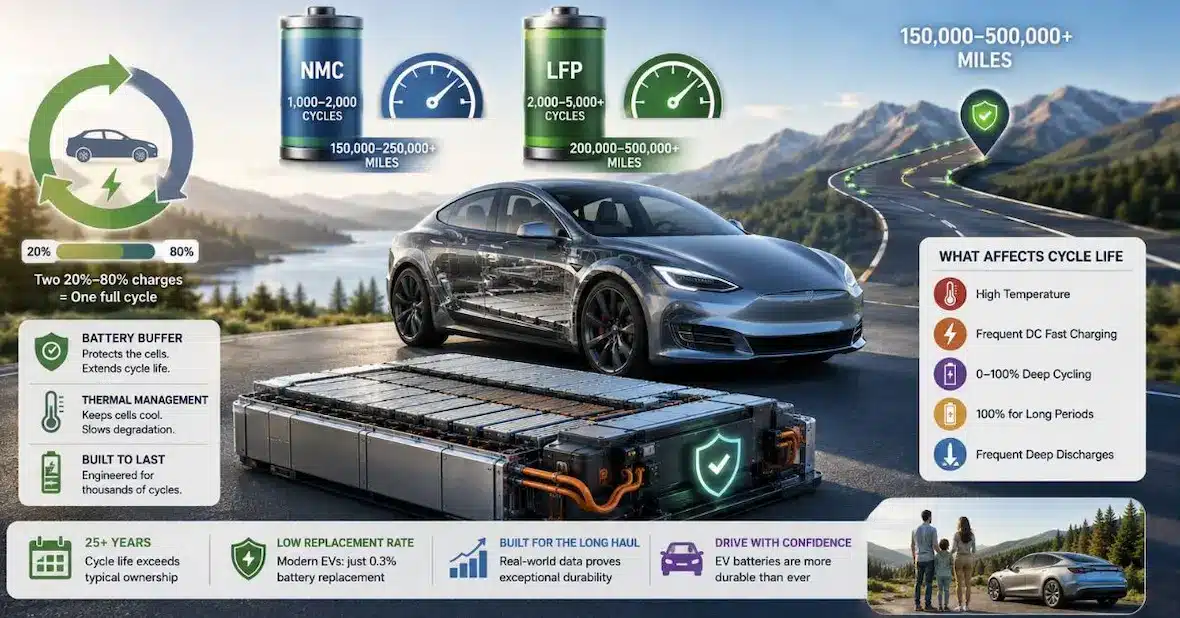
An EV battery’s charge cycle count is one of the clearest indicators of its lifespan. Modern NMC lithium-ion packs deliver roughly 1,000–1,500 full charge cycles before falling to 80% capacity. LFP batteries reach 2,000–5,000+ cycles. In real driving terms, that translates to 150,000–300,000+ miles before meaningful range loss — far more than most drivers ever put on a vehicle.
What Is a Charge Cycle?
A charge cycle is one complete discharge and recharge of a battery’s capacity. However, EV batteries are almost never discharged and charged 0–100% in a single session. Partial cycles count proportionally.
Example: Charging from 20% to 80% twice equals one complete cycle (60% × 2 = 120%). A driver who charges from 30% to 90% every evening uses one cycle every approximately 1.7 days, or about 215 cycles per year.
Battery cycle life is measured as the number of cycles before the pack drops to 80% of its original capacity — the industry standard threshold for “end of useful EV life.”
Charge Cycles by EV Battery Chemistry
Chemistry | Typical Cycle Life (to 80% capacity) | Real-World Miles | Examples |
|---|---|---|---|
NMC (Nickel Manganese Cobalt) | 1,000–2,000 cycles | ~150,000–250,000 miles | Tesla Model 3/S LR, Hyundai Ioniq 5 |
NCA (Nickel Cobalt Aluminum) | 1,000–1,500 cycles | ~150,000–200,000 miles | Tesla Model S/X (older) |
LFP (Lithium Iron Phosphate) | 2,000–5,000 cycles | ~200,000–500,000 miles | Tesla Model 3/Y Standard, BYD all models |
BYD Blade Battery (LFP) | 5,000+ cycles | 500,000+ miles (theoretical) | BYD Han, Atto 3, Seal |
For a detailed LFP vs NMC cycle life comparison, see how these battery chemistries differ in longevity, degradation rates, charging habits, and long-term EV performance.
Why EV Batteries Last So Much Longer Than Phone Batteries
A smartphone lithium-ion battery lasts roughly 300–500 charge cycles before significant degradation — that’s why phones feel noticeably slower and shorter-lived after 2–3 years. Your EV battery lasts far longer for three reasons:
- The battery buffer: EV packs never fully charge or discharge to true 0% or 100%. The BMS reserves 5–10% at each end — thereby reducing the effective depth of discharge and dramatically extending cycle life.
- Active thermal management: Liquid cooling keeps cells within the optimal 20–35°C operating window. Heat is the primary accelerant of cycle degradation.
- Larger cells, designed for cycling: EV cells are engineered specifically for thousands of cycles. Consumer electronics cells are optimized for energy density at a lower cost.
How Many Cycles Does a Typical Driver Use Per Year?
The average American drives about 14,000 miles per year. In a 75 kWh EV averaging 3.5 miles/kWh with ~73 kWh usable capacity, that’s:
- Energy used per year: 14,000 ÷ 3.5 = 4,000 kWh
- Cycles used per year: 4,000 kWh ÷ 73 kWh per cycle = ~55 full cycles per year
At 55 cycles per year:
- NMC at 1,500 cycles: 1,500 ÷ 55 = ~27 years to 80% capacity
- LFP at 3,000 cycles: 3,000 ÷ 55 = ~55 years to 80% capacity
In practice, calendar aging (degradation over time, even without cycling) limits real-world lifespan more than cycle count for most drivers. Modern EVs are projected to last 15–20 years under normal use.
What Reduces Charge Cycle Life?
- Deep cycling (0–100%): More chemical stress per cycle. Staying within 20–80% significantly extends cycle life.
- High-power DC fast charging: Generates more heat, accelerates SEI growth, and can cause lithium plating.
- Heat: Every 10°C above the optimal temperature roughly doubles the rate of chemical aging.
- Extended storage at high SoC: Keeping an NMC battery at 100% for days or weeks accelerates calendar degradation.
- Frequent deep discharges: Repeatedly draining below 10–15% stresses the anode structure.
Charge Cycle Maximization: Best Practices
- NMC vehicles: Charge to 80–90% daily; 100% for road trips
- LFP vehicles: Charge to 100% is fine and often recommended
- Primary charging method: Level 2 AC at home (gentler on cells)
- DC fast charging: Use as a road-trip tool, not a daily habit
- Avoid regular 0% discharges: Aim to plug in above 10–15%
- Keep the battery in moderate temperatures: Park in shade or garage during summer
Conclusion
EV battery charge cycle life has advanced enormously. NMC packs deliver 1,000–2,000 cycles, and LFP packs reach 2,000–5,000+ cycles, translating to 150,000–500,000+ miles in real-world use. At typical American driving rates of ~55 cycles per year, most EV batteries will mathematically outlast the vehicle by cycle count alone. The real constraint is calendar aging — chemical degradation over time. But even with both factors included, Recurrent Auto’s data show that modern EVs have a battery replacement rate of just 0.3%. EV batteries are, by any measure, far more durable than the early skeptics predicted.
