
EV Battery vs Hybrid Battery: Key Differences Explained

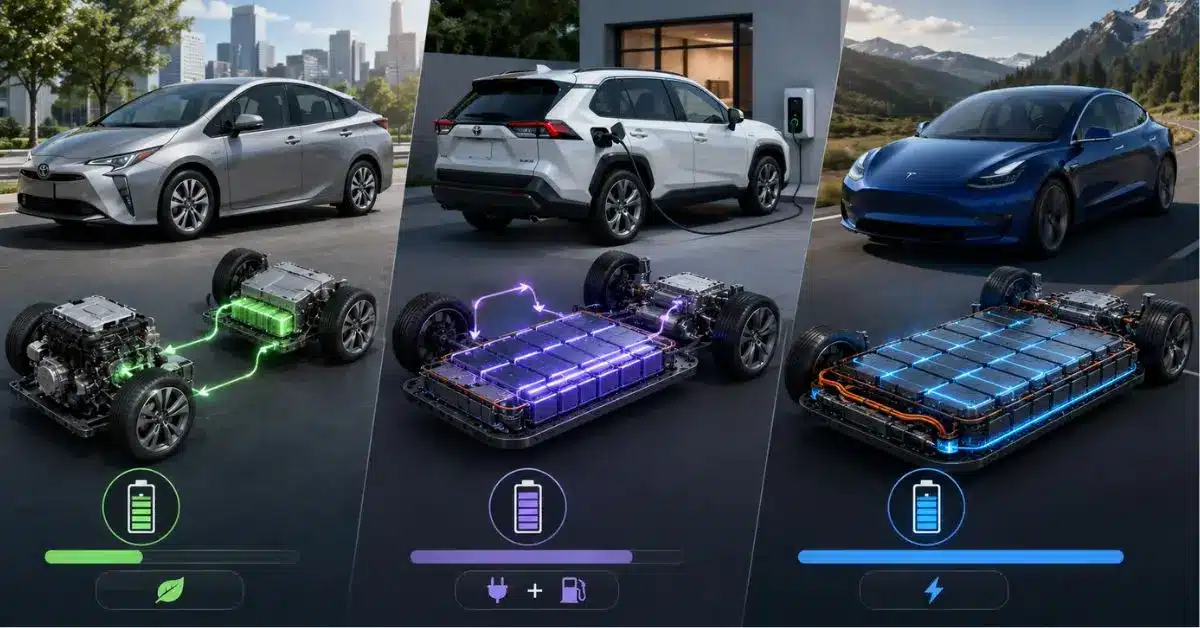
EV batteries and hybrid batteries serve different purposes and are built very differently. A full EV battery (BEV) is the sole power source — large, heavy, and designed for hundreds of miles. A hybrid battery is much smaller and designed to assist the combustion engine briefly, not to replace it. Understanding the difference helps you choose the right powertrain for your driving needs.
EV Battery vs Hybrid Battery: At a Glance
Feature | BEV Battery (Full EV) | HEV Battery (Regular Hybrid) | PHEV Battery (Plug-in Hybrid) |
|---|---|---|---|
Primary purpose | Sole propulsion source | Assist the gas engine, recover braking energy | Electric-first with gas backup |
Typical capacity | 40–200 kWh | 1–2 kWh | 7–25 kWh |
Electric-only range | 150–500+ miles | 0–2 miles (brief) | 15–60 miles |
Charges from external power? | Yes | No — only regenerative braking | Yes + regenerative braking |
Chemistry | NMC, LFP, NCA | NiMH (most), some Li-ion | NMC or LFP |
Weight | 300–900 kg | 30–100 kg | 100–300 kg |
Cost | $8,000–$20,000+ | $1,000–$4,000 | $3,000–$10,000 |
Replacement frequency | Very rare (<1% of modern EVs) | Every 8–10 years, typical | Moderate |
HEV Hybrid Batteries: Small and Self-Sufficient
Traditional hybrid vehicles (like the Toyota Prius) use a small battery — typically 1–2 kWh — that captures energy from regenerative braking and uses it to assist the gasoline engine during acceleration, reducing fuel consumption. The battery never needs external charging.
Most HEV batteries use nickel-metal hydride (NiMH) chemistry — not lithium-ion. NiMH is less energy-dense than lithium-ion but highly durable and proven in hybrid duty cycles over 15+ years. The Toyota Prius has used NiMH successfully since 1997. Some newer hybrids (Lexus, Honda) use small lithium-ion packs.
HEV batteries operate in a narrow state-of-charge window (typically 40–60% SoC) to maximize cycle life — never fully charging or discharging, which is why they rarely need replacement.
Read is an EV battery, the same as a phone battery, to compare battery chemistry and design differences.
PHEV Batteries: The Middle Ground
Plug-in hybrids (PHEVs) bridge the gap. They use a medium-sized battery — typically 7–25 kWh — that can be charged from a household outlet or public charger, providing 15–60 miles of electric-only range. Once depleted, the gasoline engine takes over, and the car operates like a regular hybrid.
PHEV batteries use lithium-ion chemistry (NMC or LFP), similar to BEV batteries but smaller. Examples: Ford Escape PHEV (14.4 kWh, ~37 miles EV range), Toyota RAV4 Prime (18.1 kWh, ~42 miles EV range).
Want to understand LFP and NMC use in hybrid vs EV packs? This comparison explains why different battery chemistries are chosen for HEVs, PHEVs, and full battery electric vehicles.
BEV Batteries: Engineered for Maximum Energy Storage
Full EV (BEV) batteries are in a completely different category. A typical mid-size EV battery holds 60–100 kWh — 50–100 times more energy than a hybrid battery. They are designed for:
- Deep daily cycling (regular use of 20–80% of capacity)
- Fast charging capability (50–350+ kW)
- Active liquid thermal management to handle charging/discharging heat
- 8–10+ year service life under heavy use
Explore how thermal management works in EV batteries to understand temperature control during charging and driving.
Which Is Better: EV or Hybrid Battery?
Neither is universally “better” — it depends on your driving profile:
- For most daily commuters (<50 miles/day) with home charging: A BEV or PHEV dramatically reduces fuel costs and emissions compared to an HEV
- For high-mileage highway drivers without charging access: A conventional HEV like a Prius may be the most practical choice
- For frequent long trips with occasional city use: A PHEV or long-range BEV with fast-charging access
- For commercial fleet use: BEV or PHEV — depending on route distance and charging infrastructure
Conclusion
EV batteries and hybrid batteries are engineered for fundamentally different purposes. A hybrid battery is a compact energy buffer — a few kWh that helps the gas engine and never needs external charging. An EV battery is the entire powertrain’s energy source — dozens of kWh of lithium-ion cells capable of daily 0–300+ mile trips. PHEV batteries bridge the two worlds.
Choosing between them isn’t about one being “better” — it’s about matching the technology to your actual driving pattern, charging access, and budget.
Also, read about the differences between liquid cooling and air cooling in EV battery packs.
