
Is an EV Battery the Same as a Phone Battery?

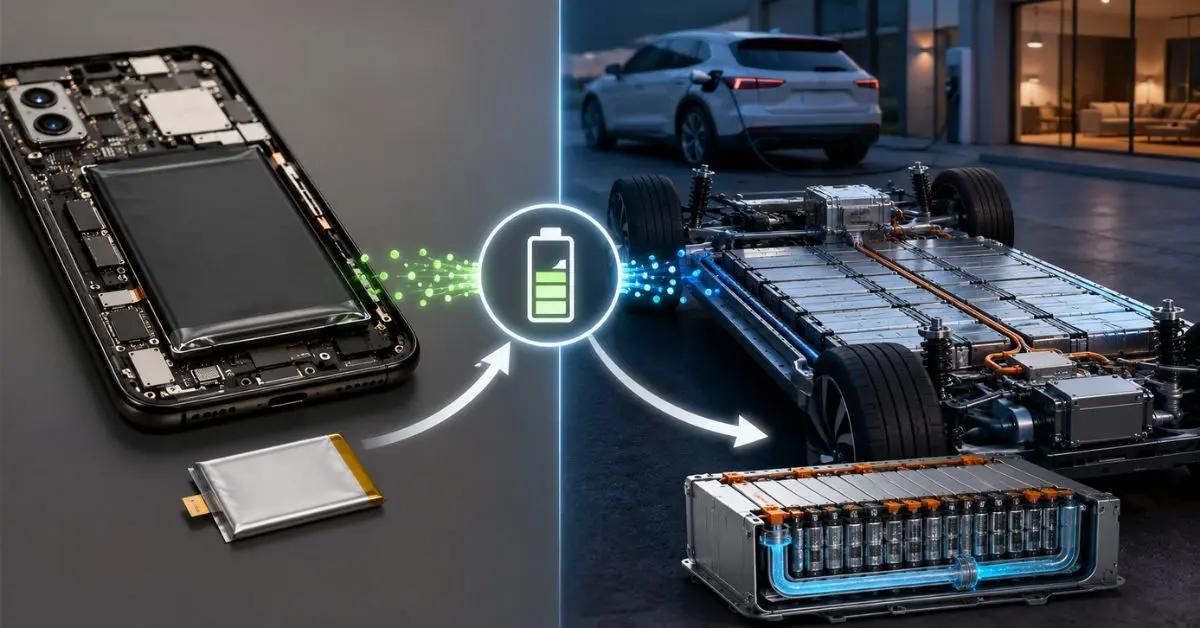
No — an EV battery and a phone battery are both lithium-ion, but they are completely different in almost every other way. Size, capacity, design priorities, voltage, cycle life, and safety requirements are worlds apart. A phone battery holds roughly 0.01 kWh. A Tesla Model Y battery holds about 77 kWh — 7,700 times more energy than a typical 12-volt battery.
Learn more: how does thermal management work in EV batteries
What They Have in Common
The fundamental electrochemistry is the same. Both phone and EV batteries:
- Use lithium ions moving between an anode (graphite) and a cathode to store and release energy
- Use a liquid electrolyte with a lithium salt solution
- Degrade over charge cycles through SEI layer growth and cathode structural changes
- Need a Battery Management System (BMS) to prevent overcharge and over-discharge
- Are rechargeable and have a finite lifespan measured in cycles
EV Battery vs Phone Battery: Full Comparison
Feature | Phone Battery | EV Battery (mid-size) |
|---|---|---|
Capacity | ~10–15 Wh (0.01–0.015 kWh) | ~75 kWh (75,000 Wh) |
Voltage | ~3.7–4.2V (single cell) | ~350–800V (hundreds of cells in series) |
Weight | ~50–60 grams | ~450–600 kg (1,000+ lbs) |
Cell format | Pouch or cylindrical | Cylindrical, prismatic, or pouch |
Chemistry | NMC or NCA (high energy density) | NMC, NCA, LFP (varies) |
Cycle life (to 80%) | ~300–500 full cycles | 1,000–5,000+ cycles |
Thermal management | Passive (no active cooling) | Active liquid cooling system |
Battery buffer | Minimal | 5–10% reserved at top and bottom |
Replacement cost | $50–$150 | $5,000–$20,000+ |
Designed lifetime | 2–4 years | 10–20 years |
Compare: EV battery vs hybrid battery: what’s the difference
Why EV Batteries Last So Much Longer Than Phone Batteries
If EV and phone batteries use the same chemistry, why does your phone battery feel dead in 2 years while an EV battery lasts 10–20 years? Three key reasons:
1. The Battery Buffer
EV batteries are software-limited, so drivers can never use 100% of the physical capacity. A 5–10% buffer at each end means the battery never fully charges or fully discharges at the cell level. Phone batteries typically reach their physical limits, which dramatically accelerates aging.
2. Active Thermal Management
EV batteries have liquid cooling circuits that maintain pack temperature between 20–35°C during charging and driving. Phone batteries have no active cooling — they rely on passive heat dissipation through the phone casing. Heat is the primary accelerant of lithium-ion degradation. See: what is liquid cooling vs air cooling in EV battery packs
3. Deeper Engineering for Durability
Phone batteries are optimized for energy density and thinness at the lowest possible cost — longevity is secondary. EV batteries are engineered first for durability, safety, and cycle life — energy density is balanced against these priorities. This is reflected in the cell chemistry (lower-nickel ratios), electrode design, and electrolyte formulations used in automotive cells vs. consumer electronics cells.
For a closer look at LFP vs NMC battery chemistry, compare how these two lithium-ion technologies differ in safety, lifespan, energy density, and EV performance.
Could You Power a Phone From an EV Battery?
Technically, yes — many EVs with bidirectional charging capability (Vehicle-to-Load, or V2L) can power devices from the battery. The Ford F-150 Lightning, Hyundai Ioniq 5, and Kia EV6 all offer V2L at standard 120V or 240V outlets. Some camping-focused EVs advertise 9+ kW of V2L output — enough to power a home for days or charge thousands of phones.
However, using V2L to charge a phone slightly discharges the EV battery — typically, each mile of EV range can power a phone for tens of hours. The energy ratio makes EV phone charging have a trivially small impact.
Conclusion
An EV battery and a phone battery share the same fundamental electrochemistry — but they are engineered for entirely different performance envelopes. The phone battery prioritizes thinness and energy density at minimum cost. The EV battery prioritizes durability, safety, and cycle life over a 10–20 year vehicle lifetime. Active liquid cooling, software buffers, and purpose-designed cells are why a modern EV battery outlasts your smartphone by a decade or more — despite using the same ion-moving chemistry at its core.
