
What Is the Difference Between BEV, PHEV, and HEV Batteries?

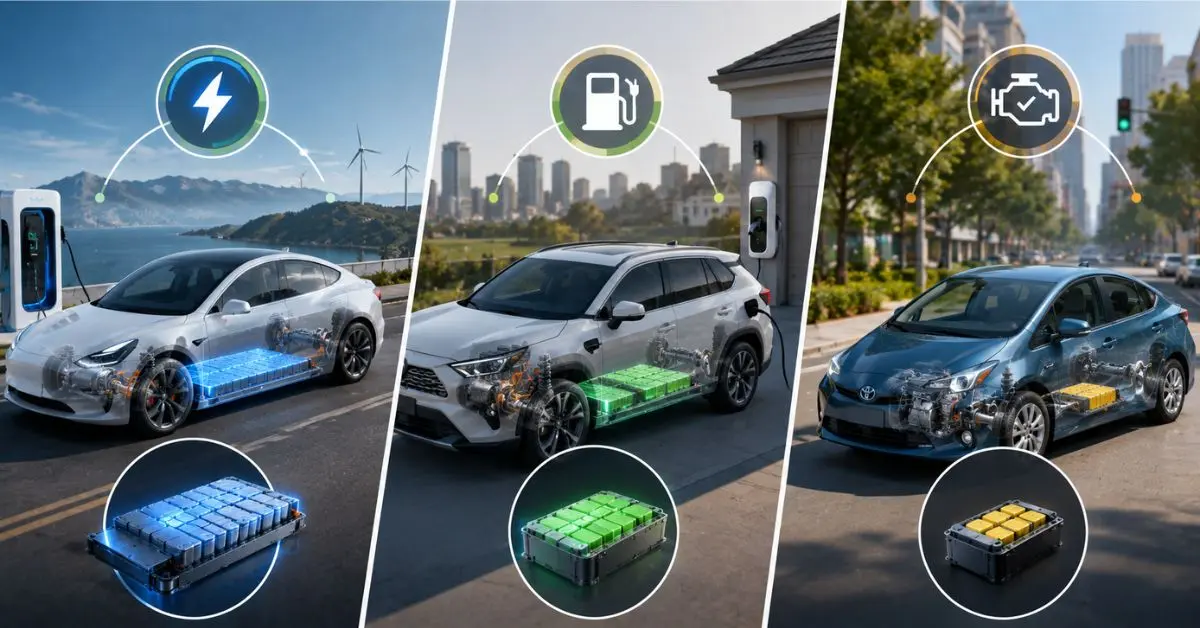
BEV, PHEV, and HEV all use battery technology — but the batteries differ radically in size, purpose, and interaction with the drivetrain. Understanding the difference between these three vehicle types helps you choose the right one for your lifestyle and makes the EV battery landscape far easier to navigate.
BEV vs PHEV vs HEV: Quick Definitions
- BEV (Battery Electric Vehicle): Runs entirely on electricity. No gas engine. The battery is the sole energy source. Examples: Tesla Model 3, Ford Mustang Mach-E, Hyundai Ioniq 6, Rivian R1T.
- PHEV (Plug-in Hybrid Electric Vehicle): Has both a battery (chargeable from external power) and a gasoline engine. Can run electric-only for 15–60 miles, then switches to hybrid mode. Examples: Toyota RAV4 Prime, Ford Escape PHEV, Jeep Wrangler 4xe.
- HEV (Hybrid Electric Vehicle): Has a small battery that charges only through regenerative braking — never from an external charger. The gas engine is the primary power source; the battery assists briefly. Examples: Toyota Prius, Honda Accord Hybrid, Toyota Camry Hybrid.
Battery Differences: BEV vs PHEV vs HEV
| Feature | BEV | PHEV | HEV |
|---|---|---|---|
| Battery capacity | 40–200 kWh | 7–25 kWh | 1–2 kWh |
| Chemistry | NMC, LFP, NCA | NMC or LFP | NiMH (most) or small Li-ion |
| Electric-only range | Full range (150–500+ miles) | 15–60 miles | 0–2 miles (brief bursts only) |
| Charges from external power? | Yes — essential | Yes — important for EV range | No — only regenerative braking |
| Gas engine? | No | Yes (backup) | Yes (primary) |
| Tailpipe emissions | Zero | Zero on electricity; some on gas | Reduced vs conventional car |
| Battery weight | 300–900 kg | 100–300 kg | 30–100 kg |
| Typical battery cost | $8,000–$20,000+ | $3,000–$10,000 | $1,500–$4,000 |
BEV Battery: Full Replacement for Gas
The BEV battery is the entire powertrain’s energy source. It must store enough energy for 150–500+ miles of range, accept fast charging at 50–350+ kW, and survive 10–20 years of daily use. BEV batteries use advanced liquid cooling, large-format cells, and sophisticated BMS systems to meet these demands.
What is liquid cooling vs air cooling in EV battery packs explains why most long-range BEVs rely on liquid cooling.
BEV batteries use NMC for long-range premium models and LFP for more affordable, everyday vehicles. The median 2024 BEV battery holds approximately 75–82 kWh of usable capacity.
For a deeper LFP vs NMC across BEV and PHEV platforms comparison, see how these battery chemistries differ in energy density, safety, cost, and why automakers choose them for different vehicle types.
PHEV Battery: Electric First, Gas Backup
PHEV batteries are designed for a specific use case: providing enough electric range for most daily driving (typically 20–50 miles), then switching to hybrid gas operation for longer trips. PHEV batteries undergo the same deep cycling as BEV batteries but in a smaller package.
PHEVs are most effective when charged daily. If a PHEV is never plugged in, it functions as a conventional hybrid — the extra battery weight becomes a disadvantage. Studies show that PHEVs driven and charged regularly achieve real-world emissions close to those of a BEV; those never charged deliver emissions worse than those of a conventional hybrid.
HEV Battery: Efficiency Booster, Not Replacement
The HEV battery is tiny by BEV standards — typically 1–2 kWh of NiMH chemistry. It serves one purpose: capturing kinetic energy during braking (regenerative braking) and using it to assist the gas engine during acceleration, improving fuel economy by 30–50% compared to a comparable non-hybrid.
The Toyota Prius HEV battery never needs external charging. It operates in a very narrow state-of-charge window (40–60%) to maximize longevity. This disciplined cycling is why Prius batteries commonly last 200,000+ miles with minimal degradation.
EV battery vs hybrid battery: what’s the difference provides a closer look at the design and performance differences between EV and hybrid batteries.
Which Is Right for You?
Driver Profile | Best Match | Why |
|---|---|---|
Home charging, daily <150 miles | BEV | Lowest running cost, zero tailpipe emissions |
Mix of city/highway, can charge at home | PHEV or BEV | PHEV gives gas backup for long trips; BEV if charging is accessible |
High-mileage highway, no home charging | HEV | Best fuel economy without charging infrastructure dependence |
Fleet/commercial, long daily routes | BEV or PHEV | BEV if depot charging is available; PHEV if range is uncertain |
Urban driver, tight parking, no charging | HEV | No charging needed; delivers real fuel savings in city driving |
Conclusion
BEV, PHEV, and HEV batteries serve fundamentally different roles in their respective powertrains. BEVs use large, deep-cycling packs as their sole energy source — optimized for range, charging speed, and longevity. PHEVs use medium packs to deliver electric-only range while retaining a gas engine for flexibility. HEVs use tiny NiMH or lithium packs purely to recover braking energy and assist the combustion engine. Choosing between them depends on your charging access, daily mileage, and how often you take long trips — not which battery chemistry sounds most impressive on paper.
Read about “How does thermal management work in EV batteries?” to learn how these cooling systems protect battery performance.
