
What Is Liquid Cooling vs Air Cooling in EV Battery Packs?

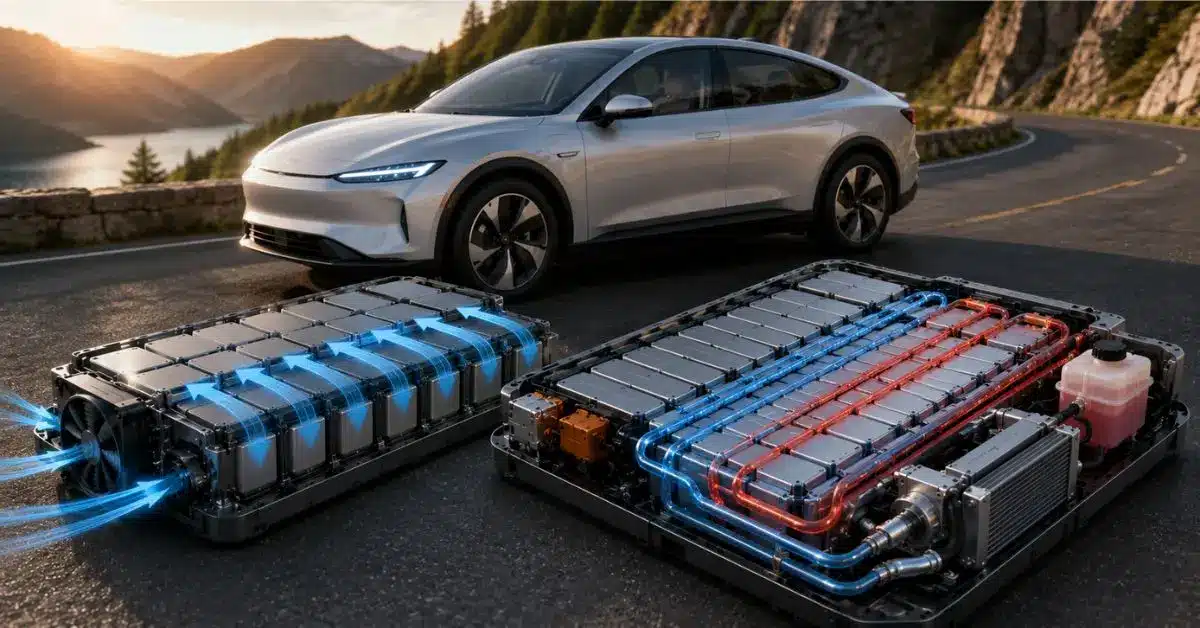
Battery temperature is one of the most critical factors in EV performance, range, and longevity. Lithium-ion cells operate best between 20°C and 35°C (68°F–95°F). Too hot, they degrade rapidly. Too cold, range drops. EV makers choose between liquid cooling and air cooling to manage this — and the choice has major real-world consequences for fast charging, battery life, and reliability in extreme climates.
Why Battery Thermal Management Matters
Heat is the primary enemy of battery longevity. Operating consistently at 40°C (104°F) can cut a lithium-ion battery’s lifespan by roughly 40% compared to operation at 20°C. Keeping cells at 20°C instead of 30°C extends battery life by approximately 20%.
Temperature affects more than lifespan:
- Overheating during fast charging forces the BMS to throttle charge rate — extending charge time
- Uneven cell temperatures cause some cells to age faster than others, degrading pack reliability
- Cold packs have higher internal resistance — reducing range and charging speed
The Battery Thermal Management System (BTMS) keeps the pack as close as possible to its ideal temperature range, as evenly as possible, using as little energy as possible.
Air Cooling in EV Battery Packs
Air cooling uses fans and ducting to blow air across battery cells or modules. It comes in two forms:
- Passive air cooling: Natural convection — no fans. Relies entirely on airflow from vehicle motion and natural heat dissipation. Used in very early, low-power EVs.
- Active air cooling: Fans force air through ducts across module surfaces. Can borrow cabin HVAC air. Used in the original Nissan Leaf and VW e-Golf.
Air Cooling Pros
- Simple design — no pumps, coolant lines, or fluid management
- Lower cost to manufacture
- Lighter than liquid cooling systems
- Easier to maintain — no risk of coolant leaks
Air Cooling Cons
- Poor thermal uniformity — outer cells cool faster than inner cells, creating hot spots
- Temperature variation across pack: up to ±5°C between cells
- Cannot handle high DC fast charging rates without overheating
- Poor performance in hot climates — accelerates degradation
- Uses 2–3x more energy than liquid cooling for comparable temperature control
The original Nissan Leaf (air-cooled) became famous for faster-than-expected battery degradation in hot climates like Arizona and Texas. Owners in hot states reported losing 20–30% battery capacity within 3–5 years. This directly led Nissan to add liquid cooling in later Leaf models.
Liquid Cooling in EV Battery Packs
Liquid cooling circulates coolant — typically a 50/50 ethylene glycol-water mix — through cooling plates, channels, or ribbons in contact with the battery cells. Almost all high-performance and long-range EVs today use liquid cooling.
There are several liquid cooling configurations:
- Bottom cooling plates: Coolant flows under the cells. Simple and widely used (GM Ultium, early Tesla Model S).
- Side cooling plates: Coolant plates between cell groups. Good thermal contact across a larger surface area.
- Ribbon cooling (Tesla): A serpentine coolant ribbon weaves between individual cylindrical cells. Extremely precise — contacts every cell directly. Used in Tesla Model S/3/Y.
- Between-cell plates (CATL Kirin): Cooling plates placed between every pair of cells — quadruples heat-transfer area vs traditional designs.
- Immersion cooling: Cells are immersed directly in dielectric fluid. Highest cooling density. Used in specialty and high-performance applications.
Liquid Cooling Pros
- Maintains temperature variation to ≤3°C across the pack (vs ≤5°C for air)
- Supports DC fast charging at 150–350+ kW without overheating
- Better performance in hot climates — dramatically slower cell degradation
- Can also heat the battery in cold weather by running warm coolant through the same circuit
- Up to 3,500x more thermally effective than air per unit volume (industry research)
Liquid Cooling Cons
- Higher cost — pumps, coolant lines, heat exchangers, sensors
- More weight from plumbing and coolant
- Risk of coolant leaks — can cause corrosion or electrical hazards if glycol contacts cells
- More complex manufacturing and maintenance
- Requires periodic coolant checks and replacement
Battery chemistry also influences cooling system design. If you want to understand why different lithium-ion chemistries require different cooling strategies, read our LFP vs NMC thermal management needs guide for a detailed comparison.
Liquid vs Air Cooling: Full Comparison
Feature | Liquid Cooling | Air Cooling |
|---|---|---|
Temperature uniformity | ≤3°C variation | ≤5°C variation |
Heat removal capacity | Excellent | Limited |
DC fast charging support | Yes (150–350+ kW) | Limited (<50 kW) |
Cold weather preconditioning | Yes (dual-direction) | No (or limited) |
Cost | Higher | Lower |
Weight | Heavier | Lighter |
Complexity | Higher | Lower |
Maintenance | Coolant checks needed | Minimal |
Battery longevity in hot climates | Excellent | Poor |
Current mainstream use | All premium/long-range EVs | Legacy, budget, low-power EVs |
Real-World Examples
- Tesla: Serpentine coolant ribbon between cylindrical cells. Extremely precise thermal management. Used in all current models.
- BYD Blade Battery: Liquid cooling plate above each cell. Temperature differences were kept to ~1°C across the pack.
- CATL Kirin Battery: Cooling plates between every pair of cells — quadruples heat-transfer area, halves thermal management time.
- Nissan Leaf (original, air-cooled): Passive air cooling. Significant degradation in hot climates — later updated to liquid cooling.
- Porsche Taycan: Sophisticated liquid cooling system supporting 800V architecture and 270 kW DC charging.
Conclusion
Liquid cooling has become the dominant choice for EV battery thermal management — and for good reason. It maintains tighter temperature uniformity, supports fast charging rates that air cooling cannot handle, dramatically reduces degradation in hot climates, and can preheat batteries in winter. Air cooling remains viable only for low-power, budget EVs or mild-climate applications where DC fast charging is rare. For any EV buyer considering a vehicle for use in hot U.S. climates or who plans to regularly fast charge on road trips, liquid cooling is not a luxury feature — it is a fundamental requirement for long-term battery health.
