
What Is Thermal Runaway in an EV Battery?

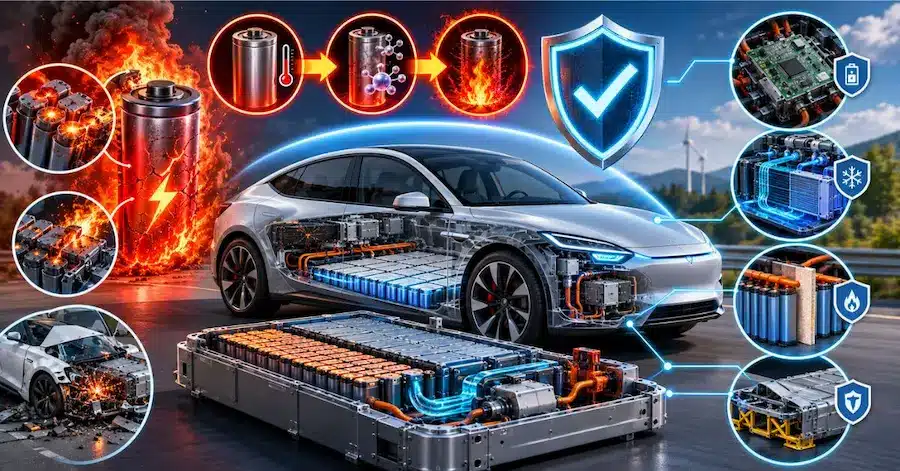
Thermal runaway is one of the most serious safety events that can occur in an EV battery. It’s a self-accelerating chain reaction in which rising temperatures trigger chemical reactions that generate even more heat — potentially leading to fire, explosion, and the release of toxic gases. Understanding what causes it, how rare it is, and how EV makers prevent it puts the real risk in proper perspective.
What Is Thermal Runaway?
Thermal runaway is a dangerous, self-reinforcing cycle inside a lithium-ion battery cell:
- The cell temperature rises abnormally due to an internal or external trigger
- Rising temperature causes the electrolyte to decompose — releasing heat and flammable gases
- The heat release accelerates further chemical breakdown
- The SEI (solid electrolyte interface) layer on the anode destabilizes, releasing more heat
- If temperatures exceed 150–200°C, the reaction becomes self-sustaining and uncontrollable
- In severe cases, venting of hot gases, fire, and potentially an explosion follows
The key dangers of thermal runaway are its speed and its propagation. A single cell entering thermal runaway can trigger adjacent cells, cascading through an entire module or pack within minutes. Gases produced — including hydrogen fluoride (HF), carbon monoxide, and flammable hydrocarbons — are both toxic and highly flammable.
What Causes Thermal Runaway in EV Batteries?
Thermal runaway has several potential triggers. They fall into three categories:
1. Thermal Causes (External Heat)
- Exposure to extreme external heat (fires near the vehicle, direct sun on a damaged pack)
- Inadequate cooling allows the pack to overheat during high-power operation
- Failure of the thermal management system
2. Electrical Causes (Over/Under Voltage)
- Overcharging: Forcing cells above their maximum safe voltage causes lithium plating and electrolyte decomposition
- Over-discharging: Deep discharge causes copper current collector dissolution — creating internal short circuit conditions
- External short circuit: If positive and negative terminals are connected directly, massive current flow rapidly heats the cell
- Internal short circuit: Cell manufacturing defects, contamination, or lithium dendrite growth that bridges the separator
3. Mechanical Causes (Physical Damage)
- Crash damage that physically deforms or punctures cells
- Vibration damage to cell connections or the separator
- Manufacturing defects (contamination, misaligned electrodes)
- Nail penetration (the industry’s most extreme safety test)
Thermal Runaway Temperature Thresholds by Chemistry
Chemistry | Thermal Runaway Onset Temp | Fire Risk |
|---|---|---|
NMC (Nickel Manganese Cobalt) | ~210°C (410°F) | High — releases oxygen, fuels fire |
NCA (Nickel Cobalt Aluminum) | ~180°C (356°F) | High |
LFP (Lithium Iron Phosphate) | ~270°C (518°F) | Low — olivine structure doesn’t release oxygen |
LFP’s 60°C higher thermal runaway threshold is why it is considered the safest mainstream EV battery chemistry. In BYD’s nail penetration test, the blade battery’s surface temperature reached only 30–60°C, compared with 500°C+ for NMC cells under the same conditions.
For a detailed LFP vs NMC thermal runaway risk comparison, see how these battery chemistries differ in thermal stability, fire behavior, and overall EV safety.
How EV Makers Prevent Thermal Runaway
Modern EVs have multiple layers of thermal runaway protection:
- Battery Management System (BMS): Monitors every cell’s voltage, temperature, and current in real time. Shuts down charging or limits power delivery if any cell exceeds safe parameters.
- Liquid thermal management: Coolant circuits maintain pack temperature within 20–35°C during charging and driving. Active cooling removes heat before it can cascade.
- Cell-level fusing: Individual cell fuses (in cylindrical designs) can isolate a failing cell before it triggers adjacent cells.
- Thermal barriers between cells: Fire-resistant materials between cells prevent a runaway event from occurring in a single cell or a small group.
- Venting systems: Controlled venting pathways allow gases to escape without triggering secondary ignition inside the pack.
- Crash-resistant enclosures: Reinforced aluminum pack housings protect cells from physical deformation in collisions.
- Chemistry selection: Automakers choosing LFP chemistry inherit a significantly lower risk of thermal runaway by default.
How Rare Is Thermal Runaway in EVs?
Thermal runaway gets enormous media coverage, but EV fires are rarer than gas car fires. Multiple studies — including data from Sweden, Australia, and the U.S. — consistently show that EVs catch fire at significantly lower rates than gasoline vehicles per vehicle-mile traveled.
Key context:
- Gas cars have a fuel-filled tank that can ignite in any collision. EV cells require specific failure conditions.
- Modern EV BMS systems are extraordinarily effective at preventing the electrical triggers (overcharge, over-discharge) that historically caused most battery incidents.
- The largest EV fires have typically occurred from crash damage or improper storage of damaged packs — not from normal driving or charging.
Conclusion
Thermal runaway is a real and serious risk in EV batteries — but it is also a well-understood phenomenon that modern battery design, thermal management, and BMS technology address comprehensively. LFP chemistry offers a significant safety advantage. NMC and NCA packs are protected by multiple independent systems, making thermal runaway under normal conditions extremely unlikely. For EV drivers, the risk is not zero — but it is far smaller than popularly believed, and smaller than the equivalent fire risk in a gasoline-powered vehicle.
