
What Is a 400V vs 800V EV Battery Architecture?

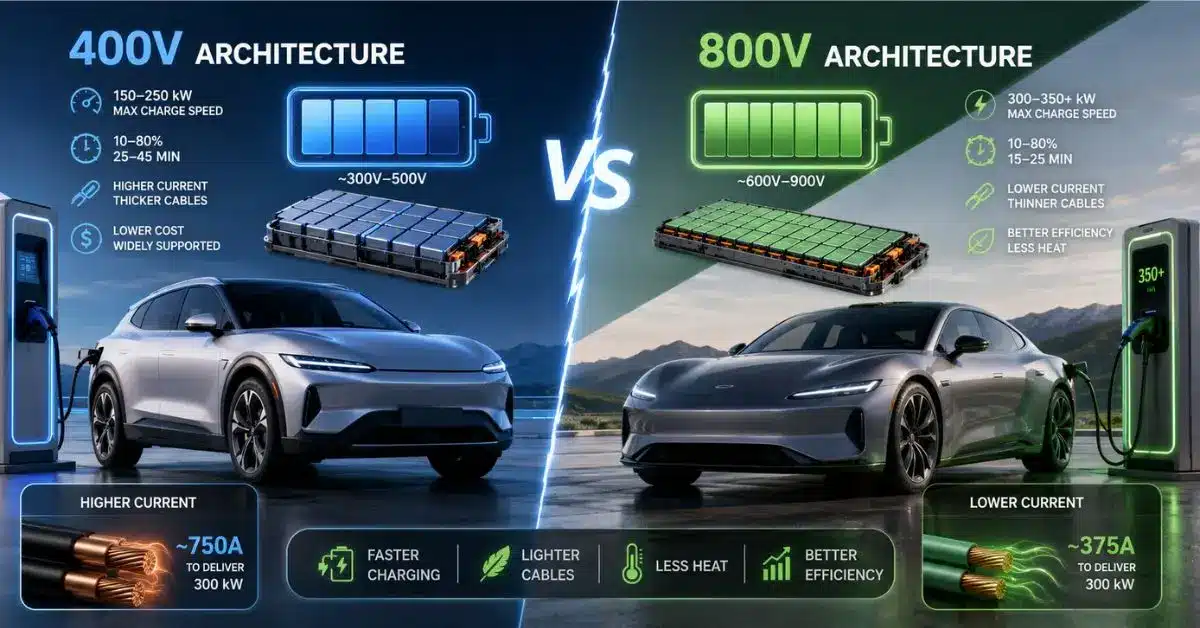
The voltage of an EV battery pack determines how fast it charges, how efficiently it runs, and how heavy its wiring needs to be. 400V architecture is the current industry standard — affordable, widely supported, and used in most EVs on the road today. 800V architecture is the next generation — faster charging, lighter cables, and better efficiency. Understanding the difference helps you choose the right EV and know what to expect at a fast charger.
What Do “400V” and “800V” Actually Mean?
These numbers refer to the nominal operating voltage of the EV’s high-voltage battery pack — the voltage at which the cells are configured to run.
Neither is a fixed number. Battery voltage fluctuates with state of charge, temperature, and load:
- 400V architecture: actual voltage range is ~300V–500V
- 800V architecture: actual voltage range is ~600V–900V
The Lucid Air pushes this further with a 900V architecture — currently the highest-voltage production EV.
To reach 400V, a pack needs roughly 96–108 lithium-ion cells in series (at ~3.7V each). An 800V system requires approximately 198 cells in series.
Battery chemistry also affects pack voltage and charging behavior. Our NMC vs LFP battery voltage characteristics guide explains how these two chemistries differ in nominal voltage, discharge curves, and real-world EV performance.
The Physics: Why Higher Voltage Matters
Electric power is calculated as: Power (W) = Voltage (V) × Current (A)
To deliver the same charging power, a higher-voltage system needs less current. Less current means less heat in the cables, connectors, and electronics. Heat is the enemy of fast charging — thermal limits are what force chargers to throttle down.
Example: To deliver 300 kW of charging power:
- 400V system: needs 750 amps of current
- 800V system: needs only 375 amps of current
Most public DC fast charger cables are limited to around 500 amps. A 400V EV hitting that current cap can only accept ~200 kW. An 800V EV at the same current capacity can accept ~400 kW. This is the core reason 800V vehicles charge faster.
400V vs 800V: Full Comparison
| Feature | 400V Architecture | 800V Architecture |
|---|---|---|
| Voltage range | ~300V–500V | ~600V–900V |
| Cells in series | ~96–108 | ~198 |
| Max DC fast charge speed | 150–250 kW (typical) | 300–350 kW+ |
| 10–80% charge time | ~25–45 minutes | ~15–25 minutes |
| Cable thickness | Thicker (higher current) | Thinner (lower current) |
| Heat generation | Higher (I²R losses) | Lower (less current) |
| Drivetrain efficiency | Good | Better (reduced losses) |
| Component cost | Lower (mature supply chain) | Higher (newer tech) |
| Charger compatibility | Works on all DC fast chargers | Needs 800V-capable charger for full speed |
| Best for | Most everyday drivers | Road-trippers, performance vehicles |
Charging Speed: The Real-World Difference
The charging advantage of 800V is significant — but only when paired with a compatible ultra-fast charger.
- A 400V EV (e.g., Tesla Model 3 Long Range) on a 250 kW charger: 10–80% in ~25 minutes
- An 800V EV (e.g., Hyundai Ioniq 6 Long Range) on a 350 kW charger: 10–80% in ~18 minutes
BYD’s second-generation blade battery with its new FLASH charging technology claims even faster speeds — 10% to 70% in 5 minutes, and 10% to 97% in just 9 minutes.
However, the real-world gap depends on charger availability. Most public DC fast chargers in the U.S. today are 150–250 kW — enough for 400V vehicles but not enough to fully unlock 800V capability. Electrify America, Tesla Supercharger V4, and Ionity in Europe are expanding 350 kW+ coverage, but these remain concentrated in major corridors.
What Happens When an 800V EV Uses a 400V Charger?
Most 800V EVs include an onboard DC-DC boost converter that steps up voltage from a 400V charger to match the 800V pack. This preserves compatibility — but charging speed is limited to roughly what a 400V system would achieve (~50–100 kW), far below the vehicle’s 300+ kW capability.
The Hyundai Ioniq 5 and Kia EV6 handle this particularly well. They use Hyundai’s E-GMP platform with a built-in 400V-to-800V converter, so they charge at full speed on 800V chargers and still work efficiently on standard 400V infrastructure.
Which EVs Use 400V vs 800V Architecture?
| 400V EVs | 800V EVs |
|---|---|
| Tesla Model 3 (~350V) | Porsche Taycan (~800V) |
| Tesla Model Y (~400V) | Audi e-tron GT (~800V) |
| Volkswagen ID.4 (~400V) | Hyundai Ioniq 5 (~800V) |
| Chevrolet Equinox EV (~400V) | Hyundai Ioniq 6 (~800V) |
| Ford Mustang Mach-E (~400V) | Kia EV6 (~800V) |
| Nissan Ariya (~400V) | Kia EV9 (~800V) |
| BMW iX3 (~400V) | Lucid Air (~900V) |
| Rivian R1T (~400V) | Mercedes EQS (800V in AMG variants) |
Benefits of 800V Beyond Charging Speed
Charging speed gets the headlines — but 800V architecture has other advantages:
- Thinner, lighter cables: Lower current means smaller-gauge wiring throughout the vehicle. This saves weight and improves packaging.
- Better drivetrain efficiency: Lower current reduces resistive losses in the motor, inverter, and wiring — improving range.
- Improved regenerative braking: Higher voltage enables more efficient energy recovery during deceleration.
- Better thermal performance: Lower current means less heat, reducing the cooling burden on the battery and electronics.
- Enables SiC (silicon carbide) inverters: 800V systems pair naturally with SiC power electronics, which are more efficient than traditional silicon inverters.
Why Does 400V Still Dominate the Market?
Despite 800V’s advantages, the majority of EVs on the road today — and most new models launching through 2026 — still use 400V architecture. The reasons:
- Lower cost: 400V components (inverters, onboard chargers, cables) have a mature, high-volume supply chain. 800V components still carry a cost premium.
- Infrastructure match: Most existing DC fast chargers are 150–250 kW — well-suited for 400V EVs.
- Sufficient for most drivers: If you charge at home 80% of the time (the DOE estimates most EV owners do), charging speed differences are irrelevant for daily use.
- Simpler engineering: 400V systems require fewer design changes to established vehicle platforms.
The Future: Is 800V Becoming the New Standard?
Yes — gradually. Volkswagen’s PPE platform, BMW’s Gen6 architecture, and GM’s next-generation Ultium platform are all moving toward 800V. As 350 kW+ charging infrastructure expands and component costs fall, 800V will become the mainstream choice for mid-range and premium EVs by the end of the decade.
Some manufacturers are already eyeing 900V+ for ultra-performance models. The Lucid Air already operates at ~900V. The direction is clear: higher voltage, lower current, faster charging, less heat.
Conclusion
The 400V vs 800V EV battery architecture debate comes down to a simple physics advantage: higher voltage means lower current for the same power, which means less heat, faster charging, and more efficient operation. For most everyday drivers charging at home, 400V is perfectly adequate. For road-trippers and performance EV buyers, 800V architecture delivers meaningfully faster charging stops and better long-term efficiency. As ultra-fast chargers expand and 800V component costs fall, higher-voltage architecture will become the new normal — but 400V will remain the practical choice for mainstream buyers through the mid-2020s.
