
Regenerative Braking in EVs: How It Works

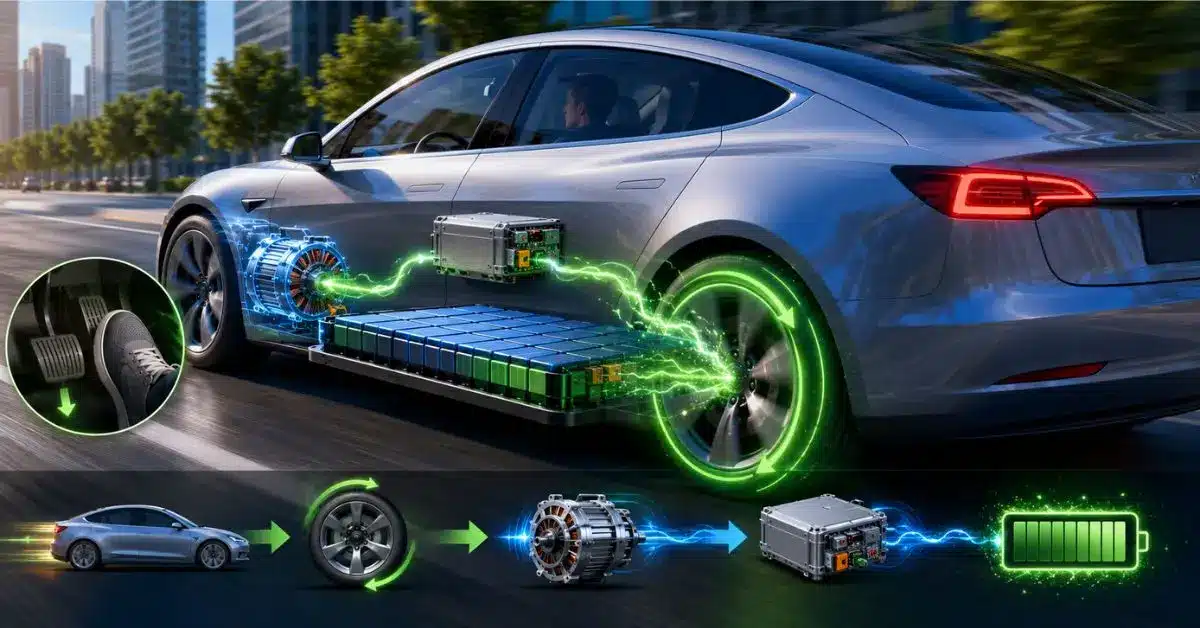
Regenerative braking turns your EV’s electric motor into a generator every time you slow down. Instead of dissipating kinetic energy as heat in the brake pads, regenerative braking converts that motion back into electricity and sends it to the battery. It adds real range — and it’s one reason EVs outperform their rated efficiency in stop-and-go city driving.
What Is Regenerative Braking?
Regenerative braking is an energy recovery system found in all modern EVs and most hybrids. When a conventional car brakes, friction between brake pads and rotors converts the car’s forward momentum into heat energy that disappears into the air. Every stop is pure waste.
In an EV, the electric motor can run in reverse. When you lift off the accelerator or press the brake, the motor switches to generator mode:
- The car’s forward momentum spins the motor
- The spinning motor generates electricity instead of consuming it
- That electricity flows back into the battery pack via the inverter
- The resistance from the generation slows the wheels, braking the car
Mechanical (friction) brakes still engage for hard stops and at very low speeds, but regenerative braking handles most day-to-day deceleration.
The Physics: How a Motor Becomes a Generator
Electric motors and generators operate on the same electromagnetic principle. When current flows through a coil in a magnetic field, the coil rotates (motor mode). Reverse the process — rotate the coil mechanically — and it generates current (generator mode).
In an EV, the inverter controls this switch. During braking:
- The driver lifts off the accelerator or presses the brake pedal
- The inverter signals the motor to enter generator mode
- Wheel rotation drives the motor, generating an AC electrical current
- The inverter converts AC to DC (the form the battery accepts)
- The DC current feeds into the battery pack through the BMS
- The BMS determines how much charge the battery can safely accept at that moment
The energy recovery efficiency of this wheel-to-battery process is approximately 64% (80% motor efficiency × 80% inverter/battery charging efficiency). That means for every 100 units of kinetic energy available during braking, about 64 are recovered and stored.
How Much Range Does Regenerative Braking Add?
The range benefit depends heavily on driving conditions:
| Driving Scenario | Regen Benefit | Why |
|---|---|---|
| City stop-and-go traffic | High (10–25% range gain) | Frequent braking = frequent energy recovery |
| Highway cruising | Low (2–5% range gain) | Few stops, minimal deceleration |
| Downhill driving | High (depends on grade) | Sustained energy recovery on descents |
| One-pedal driving mode | Maximum available | Strong regen on any lift-off |
City driving is where EVs excel, often exceeding their rated EPA range. High-speed highway driving — where aerodynamic drag dominates, and regen opportunities are rare — is where EVs typically fall short of their rated range.
One-Pedal Driving: Maximum Regeneration
Most modern EVs offer a one-pedal driving mode. In this setting, releasing the accelerator triggers strong regenerative braking — enough to bring the car to a complete stop in many situations without touching the brake pedal.
Benefits of one-pedal driving:
- Maximizes energy recovery on every deceleration
- Reduces wear on mechanical brake pads and rotors — extending service intervals significantly
- Makes stop-and-go traffic smoother and less tiring
- Predictable, intuitive control once drivers adapt (usually within a few days)
Nissan popularized one-pedal driving with its “e-Pedal” system in the Leaf. Tesla’s autopilot and manual modes both offer strong regen. The Hyundai Ioniq 5 and Kia EV6 have adjustable regen paddles on the steering wheel — a middle ground between full one-pedal and coasting modes.
When Does Regenerative Braking Stop Working?
Regenerative braking has limits. The battery cannot always accept recovered energy:
- Battery at 100% charge: No room to store energy — regen is reduced or disabled. Vehicles display a “regenerative braking reduced” warning. This is why charging to 80–90% before descending a mountain pass is good practice.
- Very cold battery: Cold packs accept charge more slowly. Regen is throttled to protect cell health.
- Very low speed: Below ~5 mph, friction brakes take over entirely. Motor efficiency drops too low at very slow speeds to make regen worthwhile.
- Overheating: If the battery is near thermal limits, the BMS reduces charge acceptance rate.
The amount of energy recovered during regenerative braking also depends on battery chemistry. Our LFP vs NMC charging behavior guide explains how LFP and NMC batteries differ in charge acceptance, cold-weather performance, and regenerative charging.
Regenerative Braking vs Conventional Brakes: What Gets Used When
| Braking Situation | Regen Braking | Friction Brakes |
|---|---|---|
| Gentle deceleration (coasting) | Primary | Off |
| Normal brake pedal application | Primary at first | Blend in progressively |
| Hard/emergency braking | Partial | Primary (full ABS) |
| Speeds below ~5 mph | Reduced/off | Primary |
| Battery at 100% SoC | Reduced/off | Primary |
Does Regenerative Braking Reduce Brake Pad Wear?
Yes — significantly. In normal EV driving, regenerative braking handles 70–90% of all deceleration. Friction brakes engage far less often. Many EV owners report that their brake pads last 2–3 times longer than those of equivalent ICE vehicles. Some high-mileage EV drivers have gone 100,000+ miles on original brake pads.
There is one watch-out: brake rotors can develop light surface rust if friction brakes are rarely used, especially in humid climates. Most modern EVs automatically apply a small amount of friction braking periodically to keep rotors clean.
Conclusion
Regenerative braking is one of the most practically important features of any EV. Converting kinetic energy back into electricity during deceleration adds real range, dramatically extends brake pad life, and makes city driving significantly more efficient.
The system works seamlessly with the motor, inverter, and BMS to maximize energy recovery without compromising safety. Understanding how regenerative braking charges the battery helps explain why EVs often beat their EPA range estimates in city driving — and why they can be genuinely cheaper to maintain than comparable gas vehicles.
