
What Is a Cell-to-Pack Battery Design?

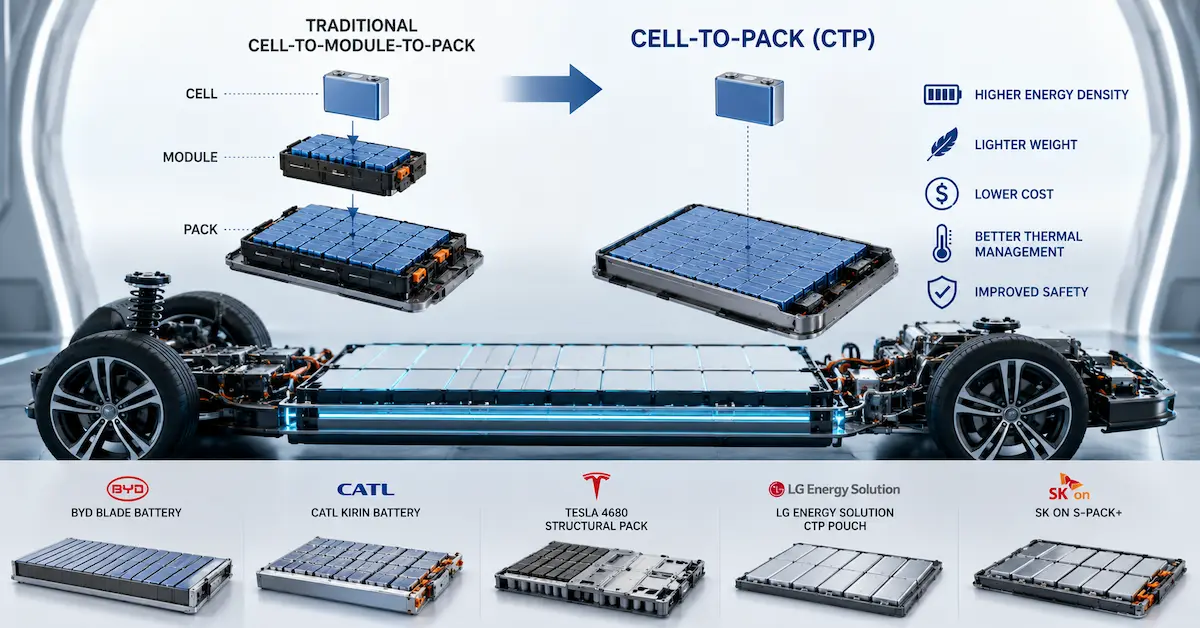
Cell-to-Pack (CTP) is a battery design that removes the module layer entirely — cells go straight into the pack. No module housings. No extra connectors. Just cells, a BMS, thermal management, and an enclosure. The result is a lighter, denser, cheaper battery. BYD, CATL, and Tesla are leading the shift to this architecture, and it’s changing how EV batteries are built worldwide.
What Is the Traditional Battery Design?
Before CTP, every EV battery followed a three-level hierarchy:
- Cell — individual electrochemical unit (3.2V–3.7V)
- Module — grouped cells in a housing with local BMS and thermal interface
- Pack — multiple modules assembled with full BMS, cooling, and enclosure
This is called Cell-to-Module-to-Pack (CTM). It works well — but it comes with weight, cost, and space penalties. Module housings add dead weight. The space between modules is wasted. Hardware costs at the module level account for roughly 15% of total battery cost.
In the traditional CTM design, battery cells fill only about 40% of the total pack volume — meaning 60% of the pack’s physical space is taken up by structure, wiring, and air gaps.
What Is Cell-to-Pack Battery Design?
Cell-to-Pack (CTP) eliminates the intermediate module. Cells are assembled directly inside the battery pack structure, without first being grouped into modules.
The result:
- More cells fit in the same physical space
- Pack weight drops because module housings are removed
- Fewer parts mean simpler manufacturing and lower cost
- Energy density increases — CATL’s third-generation CTP (Kirin battery) achieves 255 Wh/kg and a volume utilization efficiency of 72%
CTP vs CTM: Side-by-Side Comparison
| Feature | Cell-to-Module (CTM) | Cell-to-Pack (CTP) |
|---|---|---|
| Module layer | Yes | No |
| Cell volume utilization | ~40% of pack | Up to 72% of the pack |
| Module hardware cost | ~15% of total battery cost | Eliminated |
| Energy density | Moderate | Higher (up to 255 Wh/kg) |
| Pack weight | Heavier | Lighter |
| Repairability | Module-level replacement possible | Full pack replacement usually needed |
| Manufacturing complexity | Higher (module + pack assembly) | Lower (direct cell-to-pack) |
| Key users | Tesla (older), Nissan, Audi | BYD (blade), CATL (Kirin), Tesla (4680) |
Who Pioneered Cell-to-Pack Technology?
CATL introduced CTP technology with its first-generation design around 2019. Each generation has pushed energy density and volume efficiency higher:
- CTP Gen 1: Reduced module count, not fully module-free
- CTP Gen 2: Further simplified structure, improved density
- CTP Gen 3 (Kirin Battery): 255 Wh/kg, 72% volume utilization, claimed 1,000+ km range capability on a single charge
BYD’s Blade Battery is arguably the most commercially successful CTP implementation. The blade cell is a long, thin prismatic cell — up to 2.5 meters in length — that spans the full width of the battery pack. There are no modules. Blade cells slot directly into a honeycomb-style pack structure.
BYD’s blade design passed a nail-penetration test without fire or explosion — a benchmark that most NMC battery cells fail. This makes it one of the safest CTP designs in mass production.
Tesla’s structural battery pack (used in Model Y with 4680 cells) takes CTP further. The cells themselves become structural members of the vehicle floor — a concept called Cell-to-Chassis (CTC). This eliminates both the module layer and the separate pack enclosure.
Many of today’s Cell-to-Pack designs are built around LFP chemistry. Our LFP battery cell-to-pack advantages guide explains why LFP cells are especially well-suited for module-free battery architectures.
What Is Cell-to-Chassis (CTC)?
CTC is the next evolution beyond CTP. The battery cells are integrated directly into the vehicle’s chassis — the pack floor becomes part of the car’s body structure.
- CTP: Cells → Pack (no modules, but pack is separate from chassis)
- CTC: Cells → Chassis (pack and car body are one structure)
Tesla’s Model Y 4680 pack uses this approach. It reduces overall vehicle weight and improves torsional rigidity. The tradeoff is that collision repair becomes more complex and expensive.
Advantages of Cell-to-Pack Design
- Higher energy density: More active battery material fits in the same space. This directly improves range without increasing pack size.
- Lower weight: Removing module housings, extra busbars, and inter-module wiring significantly reduces pack mass.
- Lower cost: Fewer parts, simpler assembly, and the elimination of module hardware reduce manufacturing costs.
- Improved thermal management: Direct cell-to-pack designs allow cooling systems to contact cells more efficiently.
- Better structural integrity: In CTC designs, the battery contributes to vehicle rigidity.
Disadvantages of Cell-to-Pack Design
- Harder to repair: Without modules, a single faulty cell may require replacing the entire pack. This significantly increases repair costs after accidents or cell failures.
- Fault isolation is more difficult: Traditional module-based packs can electrically isolate a failing module. CTP packs have fewer natural boundaries for fault containment.
- Higher manufacturing precision required: Cells must meet tighter tolerances since there is no module-level buffer.
- Thermal runaway propagation risk: Without module walls as firebreaks, manufacturers must use advanced thermal barrier materials between cells.
Which EVs Use Cell-to-Pack Technology?
| Automaker / Battery | CTP Design | Cell Type | Key Claim |
|---|---|---|---|
| BYD Blade Battery | Yes — full CTP | LFP Prismatic | Nail test safe, 2,000+ cycle life |
| CATL Kirin Battery (Gen 3) | Yes — full CTP | NMC/LFP | 255 Wh/kg, 72% volume utilization |
| Tesla 4680 Structural Pack | Yes — CTC | 4680 Cylindrical | Cells are structural members |
| LG Energy Solution (CTP pouch) | Yes — CTP pouch | LFP Pouch | ~5% higher energy density vs prismatic CTP |
| SK On S-Pack+ | Yes — CTP | Pouch | Reduced part count for mainstream EVs |
Is Cell-to-Pack the Future of EV Batteries?
CTP is already mainstream in China and spreading globally. BYD and CATL — the world’s two largest battery makers — have made CTP their primary architecture. European automakers are adopting CTP through partnerships with these suppliers.
LG Energy Solution is mass-producing CTP-based LFP pouch batteries for Renault’s Ampere brand starting in 2025. SK On showcased its S-Pack+ CTP format at InterBattery 2025.
The trend is clear: the module layer is shrinking. The question is not whether CTP becomes the standard — it’s how fast.
Conclusion
Cell-to-Pack battery design is one of the most important structural shifts in EV battery engineering. By eliminating the module layer, CTP increases energy density, reduces weight and cost, and simplifies manufacturing. BYD’s blade battery and CATL’s Kirin battery have proven the technology at scale. Tesla’s structural pack takes it a step further with Cell-to-Chassis integration. As the EV industry scales globally, CTP is quickly becoming the default architecture for new battery designs — making understanding this technology essential for anyone following the electric vehicle market.
