
EV Battery vs Gas Tank: What’s the Difference?

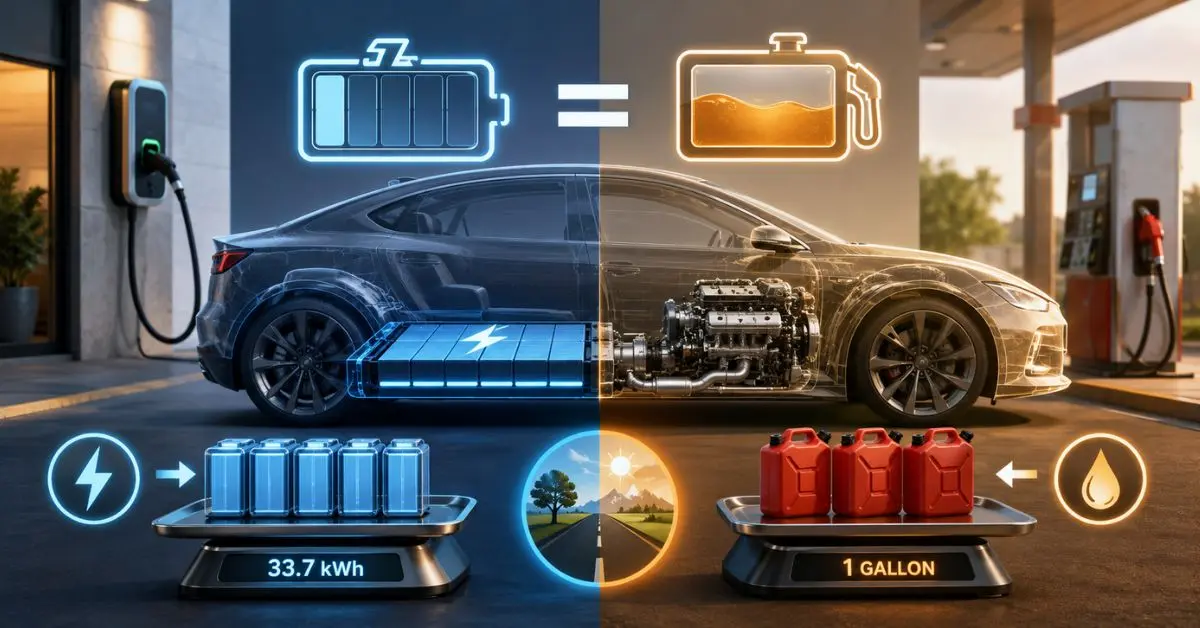
An EV battery doesn’t hold gallons — it holds kilowatt-hours (kWh). But the EPA has a direct conversion: 1 gallon of gasoline equals 33.7 kWh of electricity. A typical 75 kWh EV battery is roughly equivalent to 2.2 gallons of gas in terms of raw energy — yet it drives 250+ miles because electric motors are 3–4x more efficient than combustion engines. Here’s what that really means for your wallet and your range.
Why You Can’t Directly Compare a Battery to a Gas Tank
A gas tank and an EV battery both store energy — but they work very differently. A gas tank stores liquid fuel measured in gallons. An EV battery stores electrical energy measured in kilowatt-hours (kWh).
The comparison gets tricky because the two energy sources are not equally efficient at moving a car. A gasoline engine converts only 20–30% of fuel energy into motion. The rest escapes as engine heat, exhaust, and drivetrain friction. An electric motor converts 70–85% of stored battery energy into motion. That efficiency gap changes everything.
So while a gallon of gas contains more raw energy than most EV batteries can hold at once, the EV uses that energy far more effectively.
The EPA’s Official Conversion: 1 Gallon = 33.7 kWh
The U.S. Environmental Protection Agency (EPA) established a standard benchmark for comparing electric and gasoline vehicles. According to the EPA, one gallon of gasoline contains the energy equivalent of 33.7 kWh of electricity.
This conversion is the basis for MPGe (miles per gallon equivalent) — the metric you see on EV window stickers. It tells you how many miles an EV could travel if it used 33.7 kWh, compared to how far a gas car goes on one gallon.
Model Year 2024 EVs range from 53 to 140 MPGe, according to the U.S. Department of Energy. Most mainstream gas cars achieve 24–35 MPG. The most efficient EVs are 3 to 4 times more energy-efficient than comparable gasoline vehicles.
EV Battery Size vs. Gas Tank Size: A Direct Comparison
Here’s how popular EV batteries stack up against common gas tank sizes in energy terms:
Vehicle | Energy Storage | EPA Range | Gas Tank Equivalent (Raw Energy) |
|---|---|---|---|
Tesla Model Y Long Range | 82 kWh battery | ~330 miles | ~2.4 gallons |
Chevrolet Equinox EV | 85 kWh battery | ~319 miles | ~2.5 gallons |
Ford F-150 Lightning | 98 kWh battery | ~320 miles | ~2.9 gallons |
Nissan Leaf (40 kWh) | 40 kWh battery | ~149 miles | ~1.2 gallons |
Toyota Camry (gas) | 14.5-gallon tank | ~580 miles (highway) | 14.5 gallons |
Ford F-150 (gas) | 23-gallon tank | ~483 miles | 23 gallons |
The raw energy numbers make EVs look small. But because they convert so much more energy into actual motion, the real-world range is competitive — and in city driving, often superior.
Battery capacity also varies by chemistry, not just pack size. Our LFP and NMC battery capacity comparison guide explains how these two battery types differ in usable capacity, energy density, and driving range.
What Is MPGe and How Does It Work?
MPGe is the EV equivalent of miles per gallon. The EPA calculates it like this:
- Measure how many kWh the EV uses to travel 100 miles.
- Convert kWh into a “gallon equivalent” using the 33.7 kWh benchmark.
- Calculate miles per gallon equivalent.
Example: If an EV uses 25 kWh to drive 100 miles, that’s 25 ÷ 33.7 = 0.74 gallons equivalent, giving a rating of 100 ÷ 0.74 = 135 MPGe.
For comparison, a 30 MPG gas sedan would need 3.3 gallons to cover 100 miles. That same 100 miles costs the EV just 0.74 gallons of equivalent. The EV uses roughly 4.5 times less energy per mile.
2024 MPGe Ratings for Popular EVs
EV Model | MPGe (Combined) | Miles per kWh |
|---|---|---|
Tesla Model 3 RWD | ~132 MPGe | ~3.9 mi/kWh |
Tesla Model Y AWD | ~120 MPGe | ~3.6 mi/kWh |
Chevy Equinox EV (FWD) | ~121 MPGe | ~3.6 mi/kWh |
Hyundai Ioniq 6 RWD | ~140 MPGe | ~4.2 mi/kWh |
Ford F-150 Lightning | ~72 MPGe | ~2.1 mi/kWh |
Rivian R1T | ~70 MPGe | ~2.1 mi/kWh |
Cost Per Mile: EV Battery vs. Gas Tank
Energy efficiency translates directly into cost. Here’s a real-world comparison using 2025 average U.S. prices:
- Average U.S. gasoline price: ~$3.15 per gallon
- Average U.S. home electricity rate: ~$0.17 per kWh
- DC fast charger rate: ~$0.30–$0.48 per kWh
Scenario | Cost Per Mile | Annual Cost (12,000 miles) |
|---|---|---|
Gas car at 30 MPG | ~$0.105/mile | ~$1,260 |
EV at home charging (3.5 mi/kWh) | ~$0.049/mile | ~$588 |
EV at DC fast charger (3.5 mi/kWh) | ~$0.086–$0.137/mile | ~$1,032–$1,644 |
Home charging delivers the biggest savings — roughly $600–$700 per year compared to a 30 MPG gas car. Relying primarily on DC fast chargers narrows that gap significantly.
Energy Density: Why Gas Still Wins on Paper
Gasoline has a major physical advantage: energy density. One gallon of gasoline weighs about 6 lbs and contains roughly 33.7 kWh of energy. A lithium-ion battery storing the same amount of energy weighs approximately 400–500 lbs.
This is why EV batteries are so heavy. A 100 kWh EV battery pack can weigh 900–1,200 lbs. The equivalent energy in gasoline — about 3 gallons — weighs around 18 lbs.
However, energy density only tells half the story. Because EVs convert so much more of their stored energy into motion, a 100 kWh battery driving 350 miles effectively performs like a much larger gas tank in a much less efficient car.
Refueling Time: The Biggest Practical Difference
Gas tanks win on refueling speed — and this is a real difference, not just a talking point.
- Gas station fill-up: 3–5 minutes for a full tank
- Level 1 home charging (120V): 40–50 hours for a full charge
- Level 2 home charging (240V): 8–12 hours for a full charge
- DC fast charging (Level 3): 20–45 minutes to reach 80%
For most EV owners, this isn’t a daily problem. The U.S. Department of Energy estimates that 80% of EV charging happens at home overnight. You wake up to a “full tank” every morning without stopping at a station. The inconvenience mostly applies to long road trips.
What the Energy Comparison Means for the Environment
Burning one gallon of gasoline releases about 8.89 kg (19.6 lbs) of CO₂. An EV produces zero direct emissions. However, electricity generation is not zero-emission everywhere in the U.S.
Even accounting for power plant emissions, EVs sold in the U.S. today typically emit 30–60% less CO₂ per mile than comparable gasoline vehicles. As the U.S. grid adds more renewable energy — solar, wind, and hydroelectric — that advantage grows over time.
The Tesla Model Y, for instance, produced about 63 lbs of greenhouse gas emissions on a simulated 408-mile road trip. A comparable gasoline SUV produced more than 300 lbs on the same route.
EV Battery vs. Gas Tank: Side-by-Side Summary
Factor | EV Battery | Gas Tank |
|---|---|---|
Energy unit | Kilowatt-hours (kWh) | Gallons |
Typical capacity | 40–130 kWh | 10–30 gallons |
EPA energy equivalence | 33.7 kWh = 1 gallon | 1 gallon = 33.7 kWh |
Drivetrain efficiency | 70–85% | 20–30% |
Typical range | 150–400 miles | 300–600 miles |
Refuel/recharge time | 20 min–12 hrs | 3–5 minutes |
Cost per mile (avg US) | $0.05–$0.09 | $0.10–$0.15 |
Direct emissions | Zero | ~8.89 kg CO₂/gallon |
Weight of energy storage | 900–1,200 lbs (100 kWh pack) | ~120 lbs (15 gallons + tank) |
Conclusion
An EV battery vs. gas tank comparison comes down to this: gas wins on raw energy density and refueling speed, while the EV battery wins on efficiency, cost per mile, and emissions. The EPA conversion of 33.7 kWh per gallon helps bridge the language gap — but what really matters is that electric motors convert 3–4x more of that stored energy into motion. For most American drivers charging at home, that efficiency advantage translates into real dollar savings every month, even if the battery holds far less raw energy than a full tank of gas.
