
Can an EV Jump-Start Another Car?

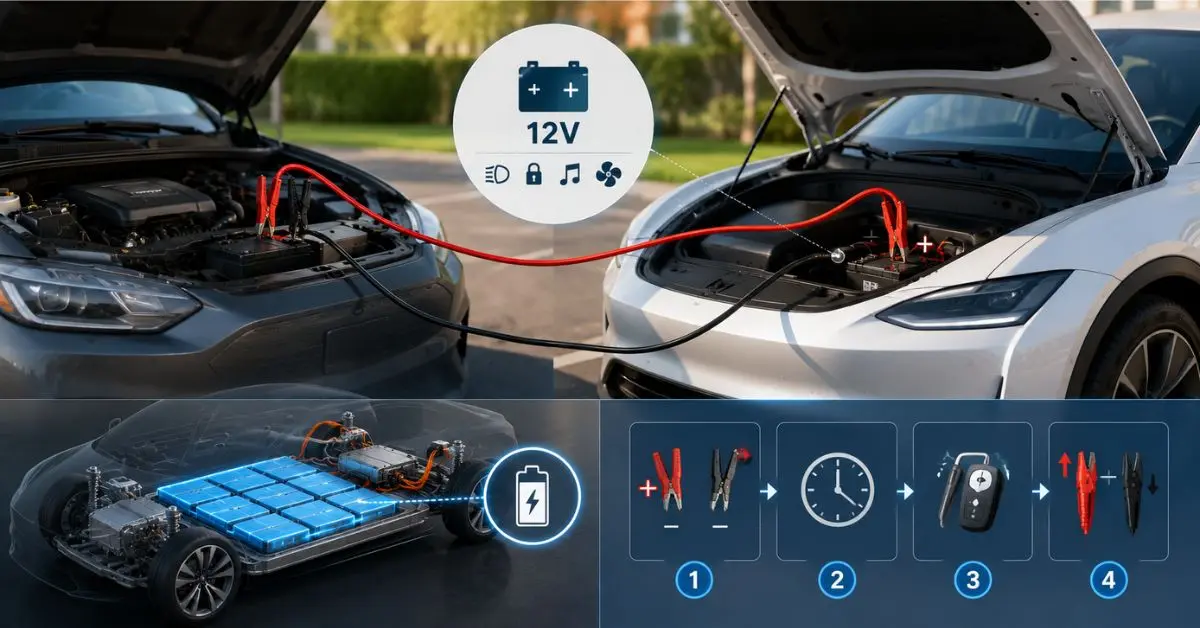
No, you cannot jump-start a gas car using an EV’s main traction battery. But you can use the 12V auxiliary battery that all EVs carry to jump-start another car, just like any car. The two battery systems in an EV serve completely different purposes, and understanding both is important for roadside situations.
Learn more: Do EVs have a 12V battery too
Two Batteries in Every EV
Every EV actually has two battery systems:
- High-voltage traction battery: The main battery pack (40–200 kWh, 300–900V). Powers the electric motor and all high-voltage systems. This is what charges at public stations and Level 2 chargers.
- 12V auxiliary battery: A small 12V lead-acid or lithium battery (identical to a traditional car’s battery). Powers low-voltage accessories — lights, door locks, infotainment, HVAC controls, horn, and the BMS itself. This is what has to be working for the EV to turn on.
Choosing between battery chemistries matters. See our LFP vs NMC battery guide for a detailed comparison.
Can You Jump-Start a Gas Car With an EV?
Yes — but only using the EV’s 12V auxiliary battery. The process is identical to jump-starting any car:
- Locate the EV’s 12V jump-start terminals (usually under the hood, sometimes under a cover)
- Connect jumper cables: positive to positive, negative to negative (or negative to ground on the dead car)
- Allow the dead car to charge for a few minutes
- Attempt to start the dead car
- Remove cables in reverse order
This works because the EV’s 12V auxiliary battery is a standard 12V supply — exactly what a dead car needs to start its engine.
Can You Jump-Start an EV With Another Car?
If an EV won’t turn on, it is almost always because the 12V auxiliary battery is dead — not the high-voltage traction battery. The 12V battery powers the systems needed to initiate the high-voltage system. Without it, the EV cannot “wake up.”
In this case, yes — you can jump-start an EV’s 12V auxiliary battery using another car (gas or EV), exactly like jump-starting any vehicle. Connect cables to the EV’s 12V terminals, provide charge for 2–3 minutes, then attempt to start/power on the EV. Once the 12V is restored, the BMS can reconnect the high-voltage traction battery.
Check your owner’s manual first — some EVs have specific jump-starting instructions, and a few (particularly some Teslas) advise against receiving a jump from another vehicle in certain situations.
Why You Cannot Use the EV’s Main Battery to Jump-Start
The traction battery operates at 300–900V. A dead gas car needs 12V to start. You cannot safely or usefully connect a 400V EV battery pack to a car that needs 12V.
There is no safe way for consumers to tap the EV’s high-voltage traction battery to jump-start. This would require disconnecting the pack from its BMS safety isolation — extremely dangerous and not something available at any standard terminal.
Using V2L (Vehicle-to-Load) to Power a Charger for Another EV
EVs with bidirectional charging (V2L — Vehicle-to-Load) can export AC power through a standard outlet. Models like the Ford F-150 Lightning, Hyundai Ioniq 5, and Kia EV6 offer V2L at up to 3.6–7.2 kW. In theory, you could use this to power a Level 1 (120V) portable EV charger for another EV in an emergency — slowly adding range to a stranded EV. This is not a standard “jump start” but can rescue a stranded EV with a few kWh of added range.
EV 12V Battery: The Overlooked Weak Point
Many EV owners are surprised to learn their 12V auxiliary battery can die — just like in a gas car. In fact, some early EV models (Tesla, Chevy Bolt) had issues with 12V batteries dying prematurely. Signs of a dying 12V in an EV:
- App shows vehicle offline / can’t remote connect
- EV won’t respond when you approach or press the door handle
- EV turns on but immediately goes into a reduced power fault mode
- Infotainment glitches or repeatedly restarts
The 12V in most EVs should be replaced every 3–5 years, just like in a gas car. Some automakers have moved to 12V lithium batteries (lighter, longer-lasting) in newer models.
Also read: How do cold temperatures affect EV battery performance
Conclusion
You can jump-start a gas car with an EV — using the EV’s standard 12V auxiliary battery, not the high-voltage traction pack. The process is identical to using any vehicle. EVs themselves can also be jump-started if their 12V auxiliary battery dies. The key insight is that every EV has two separate battery systems: the big traction pack that powers the motor, and a small 12V battery that powers everything else — including the ability to turn on in the first place.
Find out: what is regenerative braking, and how does it charge the battery
