
Do EVs Have a 12V Battery Too?

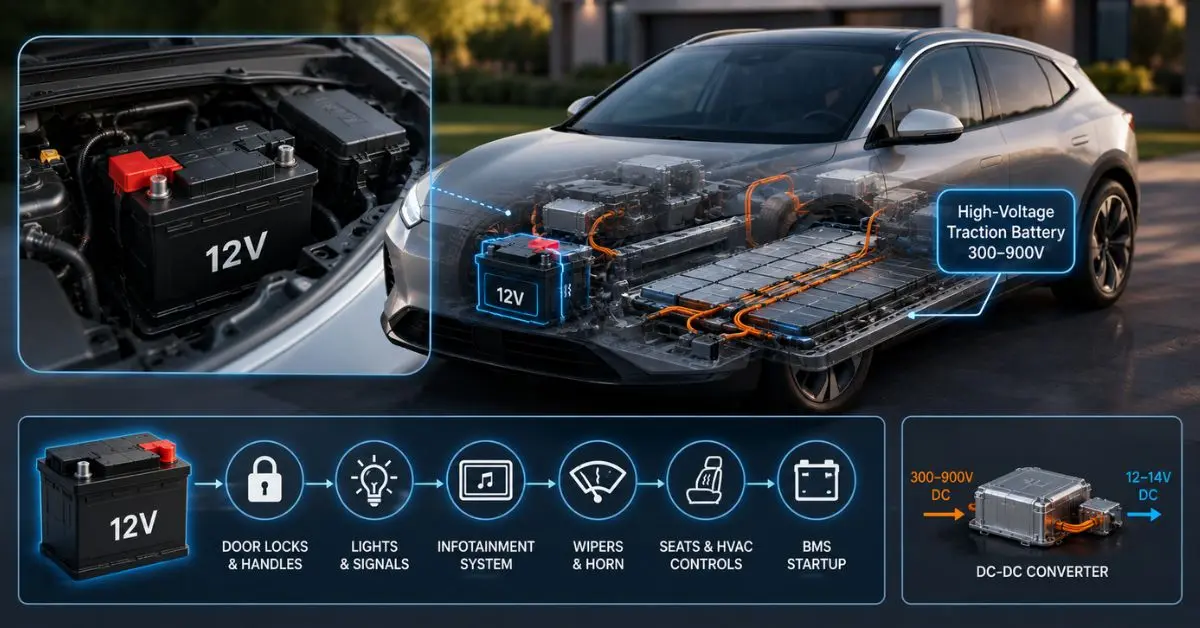
Yes — every electric vehicle has a 12V auxiliary battery in addition to its large high-voltage traction pack. This 12V battery is nearly identical to the battery in a gasoline car. It powers accessories, door systems, interior electronics, and the BMS startup sequence. Without it, your EV won’t turn on — even if the main battery pack is fully charged.
Why Do EVs Need a 12V Battery?
You might think an EV’s massive high-voltage pack could power everything — but it can’t power low-voltage 12V accessories safely or efficiently. The high-voltage traction battery operates at 300–900V. Standard automotive electronics — door locks, lights, infotainment, wipers, horn, power windows — all run on 12V. Connecting them directly to a 400V source would instantly destroy them.
The 12V battery also has a critical startup function: it powers the BMS and contactors that connect the high-voltage traction battery to the rest of the vehicle. If the 12V is dead, the car cannot “wake up,” and the traction battery remains isolated — even if it’s fully charged.
Can you jump-start a car with an EV battery? Explain your available options.
Two Battery Systems in Every EV
Feature | High-Voltage Traction Battery | 12V Auxiliary Battery |
|---|---|---|
Voltage | 300–900V | 12V (some systems use 48V) |
Capacity | 40–200 kWh | ~45–60 Ah (tiny by comparison) |
Purpose | Powers the electric motor and high-voltage systems | Powers accessories, BMS startup, door handles, lights |
Chemistry | Lithium-ion (NMC, LFP, NCA) | Lead-acid (most EVs) or lithium (newer models) |
Charged by | External charger (Level 1/2/DC fast) | DC-DC converter from a traction battery, or regenerative braking |
Replacement cost | $5,000–$20,000+ | $100–$300 |
Replacement interval | Rarely needed (15–20 year lifespan) | Every 3–5 years (like a gas car battery) |
What is regenerative braking, and how does it charge the battery explains this charging process.
How the 12V Battery Is Kept Charged in an EV
In a gas car, the alternator charges the 12V battery while the engine runs. In an EV, there’s no engine or alternator. Instead, a DC-DC converter steps down the high-voltage traction battery (300–900V) to 12–14V and continuously keeps the auxiliary battery topped up whenever the vehicle is operating.
The issue: if an EV sits unused for extended periods, the 12V battery can still slowly self-discharge — just like any lead-acid battery. This is a common cause of EVs that won’t power on after sitting for months.
The high-voltage traction battery may use different chemistries. Our LFP vs NMC batteries guide compares their performance, lifespan, charging, and safety.
The Transition to 12V Lithium in EVs
Many newer EVs are replacing the traditional lead-acid 12V battery with a small lithium-ion 12V battery:
- Advantages: Lighter (often 5–8 lbs vs 30–40 lbs for lead-acid), longer lifespan, better performance in cold weather, faster charging
- Examples: Tesla moved to 12V lithium in the Model S/X refresh (2021), and some Model 3/Y variants. Ford uses a 12V lithium battery in the Mustang Mach-E.
- Disadvantage: More expensive to replace when it does eventually fail
Common 12V Battery Problems in EVs
The 12V auxiliary battery is one of the most common sources of EV “won’t start” calls. Signs of a failing 12V in an EV:
- The vehicle won’t respond to the key fob or the door handle
- EV app shows vehicle offline or unavailable
- The infotainment system keeps restarting
- EV powers on but shows unusual fault codes
- Charging doesn’t initiate properly
The Chevy Bolt EV had a known issue with 12V premature failure in early models. Tesla has issued software updates to better manage 12V battery health over time. The general advice: treat the 12V like a gas car battery and replace it proactively around 4–5 years.
Some EVs Are Moving to 48V
The industry is beginning to shift from 12V to 48V mild-hybrid auxiliary systems. A 48V system carries 4x more power-handling capacity — important as EVs add more high-draw accessories (larger displays, heated and cooled seats, advanced driver assistance systems). GM, Mercedes, and others are integrating 48V auxiliary systems into next-generation platforms, with a DC-DC converter stepping down the high-voltage traction battery voltage to 48V rather than 12V.
Conclusion
Every EV has a 12V battery, and it’s more important than most drivers realize. This small auxiliary battery powers all low-voltage accessories and the startup systems that bring the high-voltage traction battery online. Without a healthy 12V, even a fully charged EV sits dead in the driveway. The 12V needs the same periodic attention as in any gas car — replacement every 3–5 years for lead-acid, or 6–10 years for lithium variants. It’s one of the most overlooked but most practical maintenance items for any EV owner.
Understanding car battery voltage too high: causes, symptoms & how to fix it helps explain charging system issues.
