
Can EV Batteries Explode?

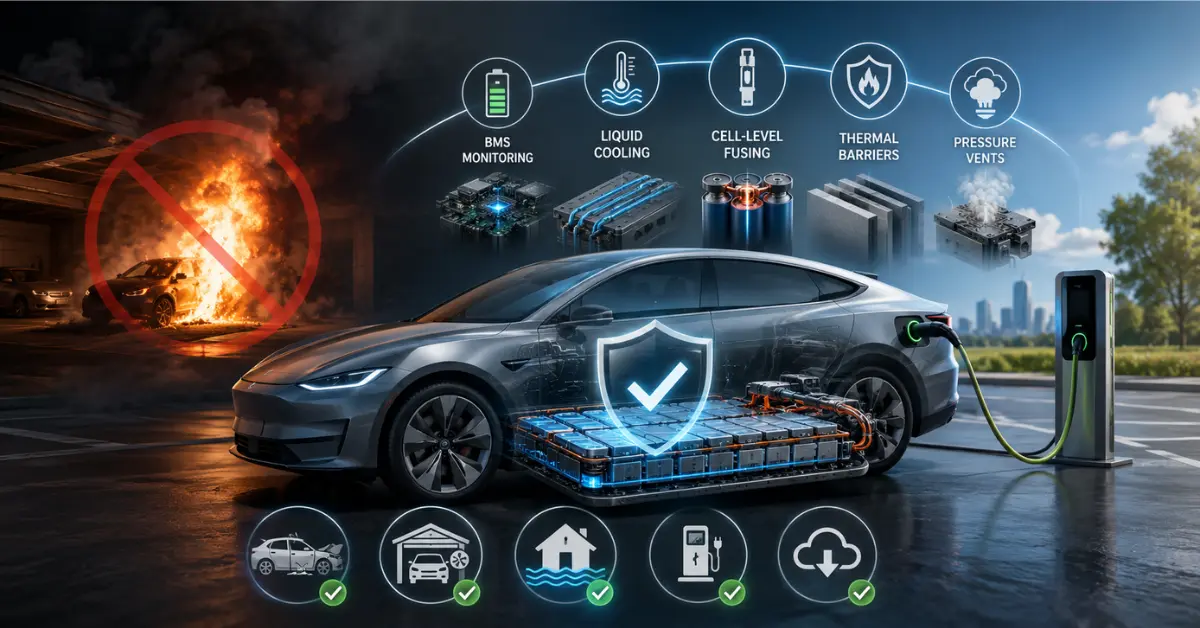
Yes — EV batteries can explode, but it is extremely rare. What people call an “explosion” is almost always a vapor cloud explosion (VCE) — flammable gases released during thermal runaway igniting in an enclosed space. EV FireSafe researchers identified just 14 verified EV explosion incidents globally from 2010 through 2020, across a fleet of 10 million vehicles. For context, Tesla reports just 5 car fires per billion miles driven, compared with 55 per billion miles for gas-powered vehicles.
What Does “EV Battery Explosion” Actually Mean?
The word “explosion” is often used loosely. In the context of EV batteries, what actually occurs is:
- Thermal runaway: A self-accelerating chemical chain reaction inside cells that releases intense heat, flammable gases, and toxic fumes
- Gas venting: Approximately 700 liters of flammable gases (hydrogen, methane, ethylene, CO) are released per kWh of battery capacity. A 75 kWh Tesla battery can release ~52,500 liters of gas.
- Vapor cloud explosion (VCE): When those gases accumulate in an enclosed space (garage, tunnel, underground parking) and ignite, the result can be an explosive pressure wave — more like a rapid gas explosion than a bomb
Explosive events occur in only about 10.77% of EV battery fire incidents, according to EV FireSafe research. The majority of EV thermal events are fires, not explosions.
What Causes an EV Battery to Explode?
| Cause | How It Triggers Explosion Risk |
|---|---|
| Crash damage | Mechanical deformation shorts cells; deformed packs may smolder for hours before igniting |
| Manufacturing defect | Internal contamination or a separator defect creates an internal short circuit |
| Overcharging | Excessive voltage decomposes electrolyte, generating flammable gases |
| Enclosed space storage | Gases from venting cells accumulate; any ignition source triggers VCE |
| External fire | External heat source drives pack temperature into thermal runaway |
| Flooding with saltwater | Saltwater can create electrochemical reactions triggering runaway (post-hurricane risk) |
EVs vs Gas Cars: Which Is More Likely to Catch Fire?
Data consistently shows EVs catch fire less often than gas vehicles:
- Tesla: 5 fires per billion miles driven
- Gasoline vehicles: 55 fires per billion miles driven (NHTSA data)
- Hybrid vehicles: ~14 fires per billion miles driven
Gas cars carry a fuel tank full of highly flammable liquid that ignites easily in a collision. EV cells require specific failure conditions to reach thermal runaway. Modern BMS systems, liquid thermal management, and cell-level fusing make normal driving and charging extremely safe.
Why EV Battery Fires Are Harder to Fight
While EV fires are rarer, they present unique challenges for firefighters:
- Reignition risk: A battery pack that appears extinguished can reignite hours or even days later as damaged cells continue to thermally react. Firefighters sometimes submerge entire EVs in water tanks.
- Water volume: Some battery fires require tens of thousands of gallons of water to cool sufficiently
- Toxic gases: Hydrogen fluoride (HF) and other toxic compounds require specialized firefighter gear
- Access: Heavily armored pack enclosures make it difficult to direct suppression directly at cells
Fire departments worldwide have developed EV-specific protocols. The risk is manageable — but very different from a gasoline fire.
Which EV Chemistry Is Safest?
Chemistry | Thermal Runaway Onset | Oxygen Release | Explosion Risk |
|---|---|---|---|
NMC (Nickel Manganese Cobalt) | ~210°C | Yes — fuels fire | Higher |
NCA (Nickel Cobalt Aluminum) | ~180°C | Yes | Higher |
LFP (Lithium Iron Phosphate) | ~270°C | No — olivine structure stable | Significantly lower |
LFP’s iron-phosphate structure does not release oxygen during thermal events. No oxygen means no self-feeding fire. This is why BYD’s blade battery survived nail penetration at only 30–60°C surface temperature, whereas NMC cells in the same test exceeded 500°C and burned.
If you’re interested in a deeper LFP battery safety vs NMC comparison, you’ll find how these two lithium-ion chemistries differ in thermal stability, fire resistance, and real-world EV safety.
How Modern EVs Prevent Battery Explosions
- BMS monitoring: Watches every cell in real time; disconnects the pack if any cell exceeds voltage or temperature limits
- Liquid cooling: Keeps pack temperature in a safe range during charging and heavy use
- Cell-level fusing: Individual cells fuse in cylindrical packs, isolating a failing cell before it triggers adjacent cells
- Thermal barriers: Fire-resistant materials between cell groups contain runaway propagation
- Pressure vents: Direct gas buildup away from ignition sources and out of the passenger compartment
- Reinforced enclosures: Crash-tested aluminum housings prevent deformation and separator breach in most collision scenarios
- Software cutoffs: Charging automatically stops if overcharge conditions are detected
Practical Safety Tips for EV Owners
- Never charge a physically damaged EV without having it inspected first — post-crash thermal events are the most common cause of serious EV fires
- Don’t charge in an enclosed, unventilated space if you have any battery concerns — gas accumulation risk in garages
- After flooding with saltwater (hurricane, flood), do not attempt to charge the vehicle — saltwater contact can trigger unexpected electrochemical reactions
- Use manufacturer-approved chargers and avoid third-party chargers with unknown quality controls
- Keep software updated — many safety-critical BMS improvements are delivered via over-the-air updates
Conclusion
EV batteries can technically explode under specific failure conditions — but the probability of that happening under normal driving and charging is extremely low, and lower than the equivalent fire risk in a gasoline vehicle. Tesla reports 5 fires per billion miles vs 55 for gas cars. Multiple independent safety systems in modern EVs — BMS, liquid cooling, thermal barriers, cell fusing — work together to prevent the conditions that trigger thermal runaway. LFP chemistry offers the best inherent safety. Understanding the real risk and the real precautions allows EV owners to drive with confidence while remaining appropriately informed.
