
How Much Does EV Battery Size Affect Range?

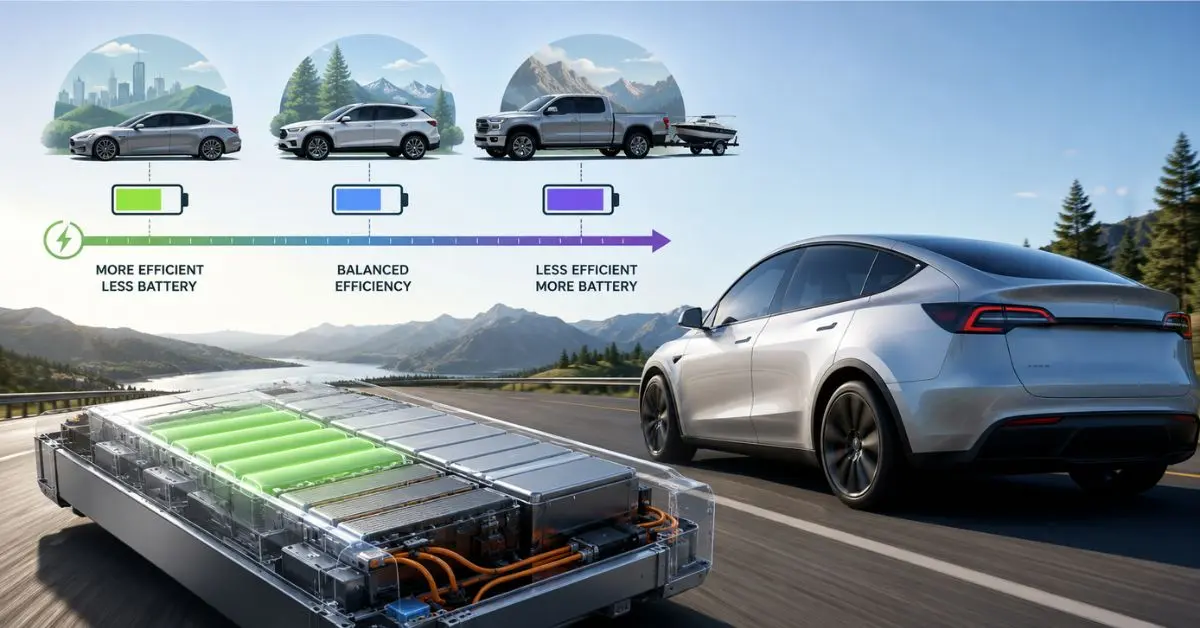
Battery size affects EV range — but it’s not the only factor. Range = usable battery capacity (kWh) × efficiency (miles per kWh). A 77-kWh battery in a sleek sedan delivers 308 miles of range. The same 77 kWh in a heavy SUV might deliver just 200 miles. Understanding how battery size, efficiency, and real-world conditions interact is the key to choosing the right EV for your life.
The Range Formula: How Battery Size Translates to Miles
EV range comes down to two numbers:
- Battery capacity (kWh) — the size of the energy tank
- Efficiency (miles per kWh) — how far the car travels per unit of energy
Range = Usable kWh × miles per kWh
Every 1 kWh of usable battery capacity delivers roughly 2–4 miles of range, depending on the vehicle’s efficiency. Compact sedans and hatchbacks typically achieve 3.5–4.5 mi/kWh. Crossovers and SUVs fall in the 2.5–3.5 mi/kWh range. Large trucks and performance EVs can drop below 2.5 mi/kWh at highway speeds.
Battery Size vs Efficiency: Two EVs, Same Range
This is the key insight most buyers miss:
Vehicle | Battery | Efficiency | Estimated Range |
|---|---|---|---|
Efficient compact sedan | 60 kWh | 4.0 mi/kWh | 240 miles |
Boxy SUV | 80 kWh | 3.0 mi/kWh | 240 miles |
Large truck | 130 kWh | 1.8 mi/kWh | 234 miles |
Three very different battery sizes — nearly identical range. The truck needs over twice the battery energy of the sedan to travel the same distance. More kWh = more cost, more weight, and longer charge times.
Battery chemistry also affects pack weight, which influences efficiency and driving range. Our LFP vs NMC battery weight comparison explains why two batteries with similar capacity can have different weights and real-world performance.
How Bigger Batteries Improve Range
All else equal, a larger battery directly extends range. For a given vehicle with fixed efficiency, range scales proportionally:
- Tesla Model Y Standard Range (62 kWh): ~260 miles EPA
- Tesla Model Y Long Range (82 kWh): ~330 miles EPA
- Tesla Model Y Performance (82 kWh): ~303 miles EPA (slightly less due to power tune)
The Long Range model’s ~32% larger battery delivers approximately 27% more range — efficiency varies slightly between trims due to motor tuning and software.
Real EV Battery Sizes and Their Typical Ranges
Battery Size | Vehicle Type | Typical EPA Range | Examples |
|---|---|---|---|
~30–45 kWh | Compact city EV | 120–180 miles | Mini Electric, Fiat 500e |
~50–65 kWh | Compact crossover/sedan | 200–260 miles | Nissan Leaf (plus), Chevy Bolt |
~70–85 kWh | Mid-size crossover | 270–330 miles | Tesla Model Y LR, Hyundai Ioniq 5 |
~90–110 kWh | Large SUV / luxury sedan | 320–400+ miles | Mercedes EQS, BMW iX xDrive50 |
~130–200 kWh | Electric truck/van | 250–400 miles | Ford F-150 Lightning (max), GMC Hummer EV |
What Hurts Range Beyond Battery Size
Battery size sets the ceiling. Real-world driving conditions determine how much of that ceiling you actually get:
- High speed: Aerodynamic drag rises with the square of speed. Going 80 mph instead of 65 mph typically cuts range 15–25%.
- Cold weather: Cold slows lithium-ion chemistry and forces the cabin heater to work hard. Winter driving can cut range 20–40% in very cold conditions (below 0°F).
- Towing and payload: Towing dramatically reduces EV range — some trucks lose 50–60% of their range while towing at rated capacity.
- Large wheels and all-terrain tires: Add rolling resistance and weight. Can reduce range 5–10%.
- HVAC use: Air conditioning and especially cabin heating consume 1–5 kWh per hour from the battery.
- Battery degradation: Older batteries hold less capacity — a 5-year-old EV with 10% degradation delivers ~10% less range than when new.
How Much Battery Do You Actually Need?
The median EV sold in the U.S. for model year 2024 offers about 283 miles of EPA range — four times more than early mass-market EVs from 2011. For most Americans who drive under 40 miles per day, a 200–250-mile real-world range is comfortably sufficient for all daily needs.
A useful guide by use case:
- City commuter (under 40 miles/day): 45–60 kWh is sufficient. Focus on charging access, not range.
- Family crossover / suburban use: 60–80 kWh. 230–300 miles of range handles weekend trips comfortably.
- Frequent road tripper: 75–100 kWh. A wider range reduces the frequency of charging stops and stress.
- Truck buyers/towing use: 130+ kWh. Range drops dramatically while towing — a larger pack is essential.
Usable vs Total Battery Capacity: The Hidden Difference
EV batteries have a buffer zone — a small amount of capacity held in reserve at the top and bottom to protect cell health. A car advertised with a “77 kWh battery” typically makes only ~73–75 kWh usable. The remaining 2–4 kWh is permanently reserved by the BMS.
Always use usable (net) capacity — not gross (total) capacity — when calculating real-world range.
Conclusion
EV battery size has a direct and significant effect on range — but it’s only half the story. Efficiency, vehicle aerodynamics, driving speed, temperature, and payload all determine how far a given battery will take you. For most American drivers, a 60–80 kWh battery with good efficiency delivers more than enough range for daily life.
The median 2024 EV offers 283 miles of EPA range — and real-world range continues to improve as battery chemistry, thermal management, and vehicle efficiency advance. Matching battery size to your actual driving needs, rather than chasing the biggest pack available, leads to a better overall EV experience at a lower cost.
