
What Is Usable vs Total Battery Capacity in an EV?

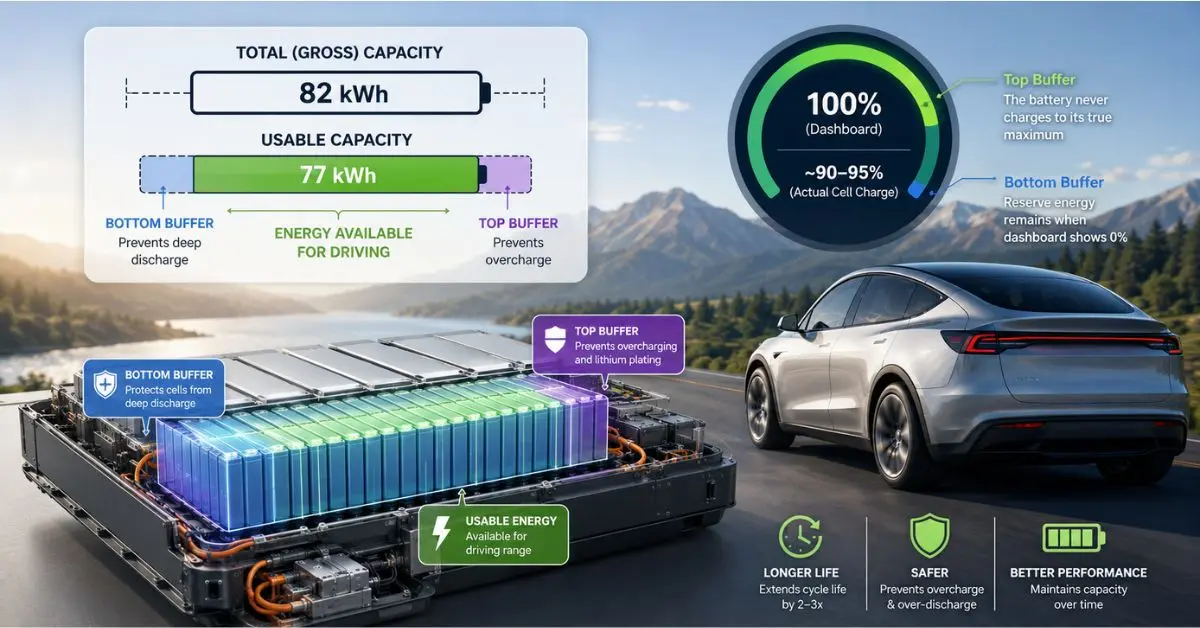
Every EV battery has two capacity numbers: the total (gross) capacity and the usable capacity. When an automaker says “77 kWh battery,” they mean the total. You might only access 73–75 kWh of it. The difference is a protective buffer built into the Battery Management System to prevent overcharging and deep discharge — both of which permanently damage lithium-ion cells. Understanding this distinction is essential for accurately predicting real-world range.
What Is Total (Gross) Battery Capacity?
Total capacity — also called gross capacity — is the battery pack’s full physical energy storage potential. It is the maximum amount of energy the cells can theoretically store if fully charged and discharged.
This is the number most automakers use in marketing. When you see “82 kWh” on a spec sheet, that’s typically the gross capacity.
What Is Usable Battery Capacity?
Usable capacity is the portion of the total energy the car’s software actually allows you to use to drive. The BMS reserves a buffer at both ends:
- Top buffer: The battery never charges to 100% of its physical maximum. When your dashboard reads “100%,” the cells are actually at ~90–95% of their true maximum. This prevents overcharging and lithium plating — a major source of degradation and safety risks.
- Bottom buffer: When the dashboard reads “0%,” there is still energy in reserve in the cells. You might travel a few more miles on reserve, but the BMS prevents you from drawing the cells down to true zero, which causes permanent capacity loss.
The usable capacity is usually between 90–99% of the total capacity, varying by manufacturer and chemistry.
Why Do EV Makers Reserve a Buffer?
Three key reasons drive the buffer design:
- Cycle life extension: Lithium-ion batteries last dramatically longer when never fully charged or discharged. Research shows that reducing the depth of discharge from 100% to 80% can increase cycle life from ~1,000 cycles to over 3,000 cycles. The buffer enforces this automatically.
- Overcharge protection: Charging beyond the maximum safe voltage causes lithium plating on the anode—metallic lithium deposits that reduce capacity and increase the risk of internal short-circuiting. The BMS caps charge before this happens.
- Over-discharge protection: Discharging too deeply causes copper dissolution from the current collector, which permanently damages the cell chemistry. The bottom buffer prevents this even if you drain to “0%.”
Usable vs Total Capacity: Real EV Examples
Vehicle | Total (Gross) Capacity | Usable Capacity | Buffer |
|---|---|---|---|
Tesla Model Y Long Range | ~82 kWh | ~77–78 kWh | ~4–5 kWh (5–6%) |
Hyundai Ioniq 5 Long Range | 77.4 kWh | 74 kWh | 3.4 kWh (4.4%) |
Volkswagen ID.4 Pro | 82 kWh | 77 kWh | 5 kWh (6.1%) |
Ford Mustang Mach-E Extended | 91 kWh | 88 kWh | 3 kWh (3.3%) |
Chevrolet Bolt EV | 66 kWh | 65 kWh | 1 kWh (1.5%) |
BMW i7 xDrive60 | 105.7 kWh | 101.7 kWh | 4 kWh (3.8%) |
Nissan Leaf (40 kWh) | 40 kWh | 36 kWh | 4 kWh (10%) |
Buffer size varies significantly by manufacturer. LFP chemistry tolerates daily 100% charging better than NMC — so LFP EVs (like the Tesla Model 3 Standard Range) often have smaller buffers and allow routine 100% charging without damage. NMC vehicles typically recommend charging to 80% daily to preserve pack health.
Buffer size varies by manufacturer. LFP EVs often have smaller buffers and allow routine 100% charging. Learn how LFP batteries allow 100% usable charge to understand why this chemistry handles full charging better than NMC batteries.
How Does the Buffer Affect Range Calculations?
Range should always be calculated using usable capacity, not gross capacity. Using gross capacity overestimates real-world range.
Example: Tesla Model Y Long Range
- Gross: 82 kWh × 3.5 mi/kWh = 287 miles (misleading)
- Usable: 77 kWh × 3.5 mi/kWh = 270 miles (accurate baseline)
The EPA range test uses usable capacity and real-world energy consumption, which is why EPA estimates are the better starting point for range planning.
Can Manufacturers Change the Buffer Over Time?
Yes — via software updates. Some automakers have used over-the-air (OTA) updates to adjust the usable window. Tesla famously unlocked additional capacity in some vehicles after the battery had “proven” itself over time. The BMS controls the pack’s operating limits, so adjusting the usable range is technically straightforward.
A common consumer claim is that manufacturers use hidden buffer capacity to mask battery degradation — unlocking reserve capacity as cells age to maintain displayed range. This practice has not been widely adopted as a mainstream strategy, and changing the SOC window would alter charging behavior in ways that are typically detectable by measuring cell voltages.
LFP vs NMC: Different Buffer Needs
- LFP (lithium iron phosphate): Tolerates regular full charges. Many LFP EVs allow, and even recommend, daily charging to 100%. Tesla recommends daily 100% charging for its LFP-equipped vehicles.
- NMC (lithium nickel manganese cobalt): More sensitive to high voltage. Most automakers recommend limiting daily charging to 80% and reserving 100% for long trips. The buffer reserves especially protect the top end.
Conclusion
The distinction between usable and total battery capacity matters to every EV buyer and owner. When automakers advertise an “82 kWh battery,” they’re quoting gross capacity — the real energy you’ll use for driving is 5–10% less. The buffer is not wasted space; it is essential protection that extends battery life from hundreds to thousands of cycles. Understanding this system helps you accurately plan real-world range, make smart charging decisions, and evaluate EV battery warranties with confidence.
