
How Much Does an EV Battery Weigh?

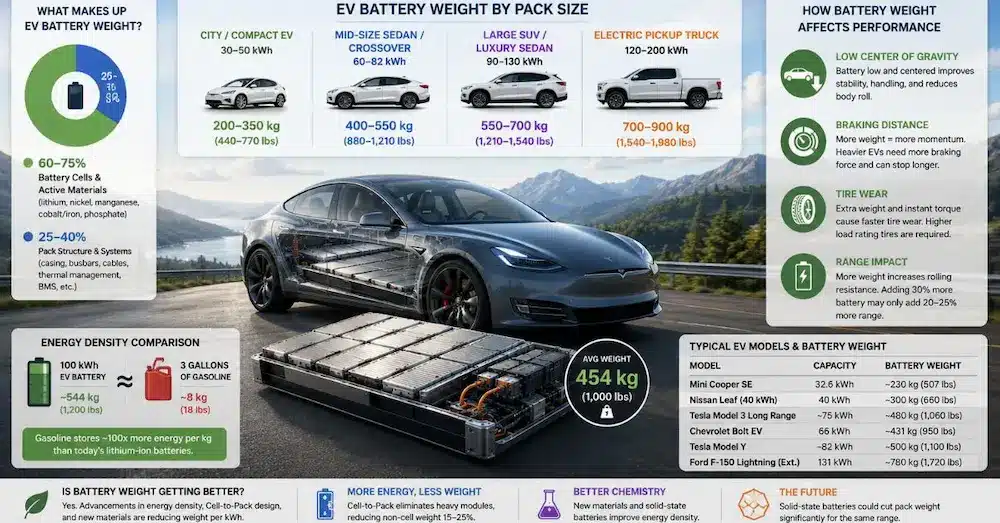
The average EV battery pack weighs around 454 kg (1,000 lbs) — more than the cells required to store the same amount of energy, and 20 times the weight of a typical gas car’s 12V battery. EV battery weight varies significantly by pack size and chemistry, from around 250 kg in small city cars to over 900 kg in large electric trucks. This weight affects range, handling, efficiency, and tire wear in ways every EV owner should understand.
How Much Does an EV Battery Weigh?
EV battery weight depends directly on pack size (kWh) and chemistry. A practical rule of thumb: most mainstream EV packs weigh roughly 5–8 kg per kWh of total capacity at the pack level.
EV Model | Battery Capacity | Battery Pack Weight |
|---|---|---|
Mini Cooper SE | 32.6 kWh | ~230 kg (507 lbs) |
Nissan Leaf (40 kWh) | 40 kWh | ~300 kg (660 lbs) |
Hyundai Ioniq Electric | 38 kWh | ~320 kg (705 lbs) |
Tesla Model 3 Long Range | ~75 kWh | ~480 kg (1,060 lbs) |
Chevrolet Bolt EV | 66 kWh | ~431 kg (950 lbs) |
Ford Mustang Mach-E (Extended) | 88 kWh | ~500 kg (1,100 lbs) |
Tesla Model S (100 kWh) | ~100 kWh | ~544 kg (1,200 lbs) |
Tesla Model Y | ~82 kWh | ~500 kg (1,100 lbs) |
Ford F-150 Lightning (Extended) | 131 kWh | ~780 kg (1,720 lbs) |
What Makes Up EV Battery Weight?
The battery pack is more than just cells. Its weight breaks down roughly as:
- 60–75%: Battery cells and their active materials (lithium, nickel, manganese, cobalt, or iron, phosphate)
- 25–40%: Pack structure — metal casing, busbars, cables, thermal management system (TMS), and battery management system (BMS)
For context, a typical EV battery contains approximately:
- ~8 kg of lithium (up to 62.6 kg in a Tesla Model S)
- ~14 kg of cobalt (NMC packs only; LFP contains none)
- ~20 kg of manganese (NMC chemistry)
- Plus nickel, aluminum, copper, graphite, and electrolyte
Battery chemistry also affects pack weight. For a detailed LFP vs NMC battery weight comparison, see how each battery chemistry influences energy density and overall EV battery weight.
EV Battery Weight by Vehicle Class
Vehicle Class | Typical Battery Weight | Typical Capacity |
|---|---|---|
City/compact EV | 200–350 kg (440–770 lbs) | 30–50 kWh |
Mid-size sedan/crossover | 400–550 kg (880–1,210 lbs) | 60–82 kWh |
Large SUV/luxury sedan | 550–700 kg (1,210–1,540 lbs) | 90–130 kWh |
Electric pickup truck | 700–900 kg (1,540–1,980 lbs) | 120–200 kWh |
How Battery Weight Affects EV Performance
EV battery packs typically account for 20–25% of total vehicle weight. This matters in several ways:
Handling and Center of Gravity
Battery packs are positioned flat under the vehicle floor. This low, central placement creates a very low center of gravity — lower than any gas car. Lower CoG improves cornering stability and significantly reduces body roll. Many drivers notice EVs feel “planted” through corners despite their extra weight. Tesla’s “skateboard” pack design is specifically optimized for this effect.
Braking Distance
More weight means more momentum to stop. Heavier EVs require more braking force and can have longer stopping distances than lighter gas cars, particularly at high speeds. Manufacturers compensate with larger brake systems and aggressive regenerative braking calibration.
Tire Wear
Heavy EVs wear tires faster than lighter gas equivalents. The combination of battery weight and instant torque creates higher stress on tires. Many EVs require tires with a higher load index rating. Some owners report tires lasting only 15,000–25,000 miles on heavy EVs like the Hummer EV or Ford F-150 Lightning.
Range Impact
A heavier battery stores more energy — but also requires more energy to move. This creates a diminishing return. Adding 30% more battery capacity might only add 20–25% more range because the extra weight increases rolling resistance. Engineers must balance energy density, pack weight, and vehicle weight to find the optimal point.
How Does EV Battery Weight Compare to a Gas Car’s Fuel Tank?
The energy density gap between batteries and gasoline is striking:
- A 100 kWh EV battery weighs ~544 kg (1,200 lbs)
- The equivalent energy in gasoline (100 kWh ÷ 33.7 kWh/gallon = ~3 gallons) weighs about 18 lbs (8 kg)
Gasoline stores roughly 100x as much energy per kilogram as today’s best lithium-ion batteries. This is the fundamental physics challenge EV engineers work against — and why improving battery energy density (Wh/kg) is one of the most important goals in EV research. Solid-state batteries are expected to roughly double the energy density of current lithium-ion batteries, thereby significantly reducing pack weight for the same range.
Is Battery Weight Getting Better?
Yes — steadily. Energy density improvements, Cell-to-Pack design (eliminating heavy module structures), and new materials are all reducing weight per kWh:
- CATL’s Kirin Battery achieves 255 Wh/kg at the cell level — significantly better than typical 150–200 Wh/kg packs from 5 years ago
- Toyota has announced solid-state battery prototypes weighing ~262 kg for 90 kWh — vs current estimates of ~360 kg for equivalent lithium-ion packs
- CTP designs eliminate module casings, reducing the non-cell weight component from 25–40% toward 15–25% of total pack weight
Conclusion
EV battery packs weigh 300–900 kg, depending on vehicle size and capacity. This weight is a fundamental consequence of lithium-ion chemistry’s energy density — currently far below that of gasoline. Despite the added weight, strategically placed floor-mounted packs give EVs a handling advantage by lowering the center of gravity. As solid-state batteries and Cell-to-Pack designs mature, pack weight for a given range will continue to fall — making future EVs both lighter and longer-ranged than today’s models.
