
What Happens to an EV Battery in a Crash?

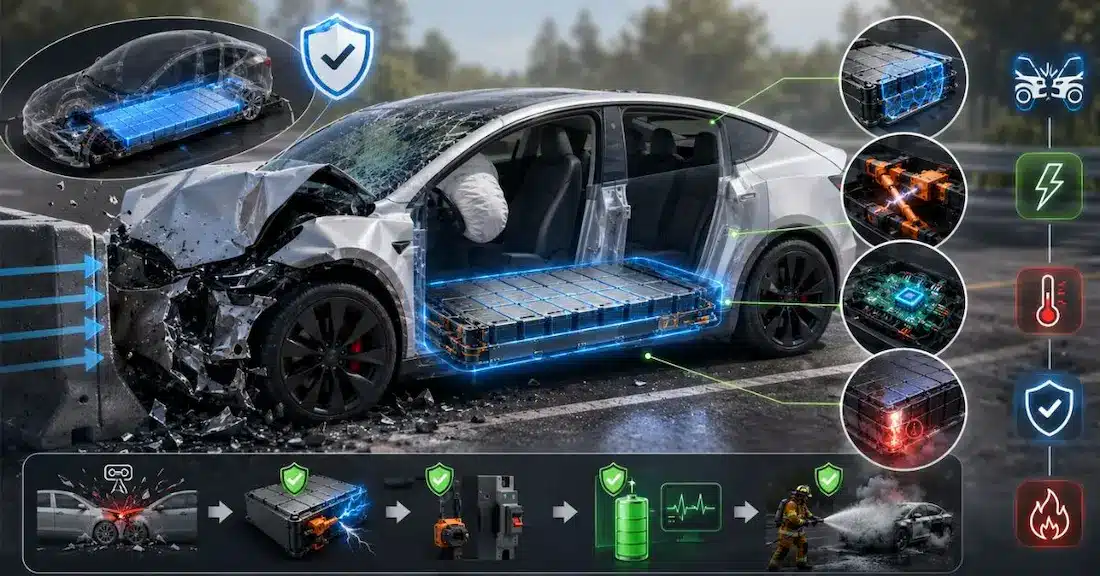
When an EV crashes, the battery pack is protected by multiple layers of engineering designed specifically to prevent cell damage, electrical hazards, and thermal runaway. Modern EVs regularly earn top crash safety ratings — The overall best performer across all vehicle types in major crash assessments was an electric model.
Understanding what happens to an EV battery in a crash explains why EVs are among the safest vehicles ever built.
How EV Battery Packs Are Designed for Crash Protection
EV battery packs sit under the vehicle floor in a reinforced aluminum or steel enclosure — the “skateboard” layout. This position gives engineers key advantages:
- No combustion engine in front: EVs can have much larger front crumple zones than gas cars because there’s no engine block to manage. The crumple zone absorbs crash energy before it reaches the battery.
- Low center of gravity: The low, flat battery pack positions the center of gravity below that of a gas car, making rollovers less likely in EVs than in comparably sized ICE vehicles.
- Structural reinforcement: The pack enclosure is engineered to withstand crash forces. Impact forces during collisions can reach 50g — packs are tested to survive these forces without cell deformation.
- Side protection: Rocker panels along the battery are reinforced to deflect side-impact energy away from the pack — one of the most critical areas of protection.
If the battery is beyond repair, understanding EV battery recycling cost, challenges, and future trends helps explain the next steps.
What Happens Automatically When the BMS Detects a Crash?
When crash sensors detect a significant impact, the vehicle’s systems react in milliseconds:
High-Voltage Interlock Loop (HVIL) activates
The BMS automatically disconnects the high-voltage battery from the drivetrain and charging system — eliminating shock risk for occupants and first responders
Pyrotechnic disconnect fires
In many EVs, a pyrotechnic (explosive) battery disconnect physically severs the high-voltage circuit in milliseconds — much faster than any relay or switch
Contactor opens
The main battery contactors (high-voltage relays) open, isolating the pack
Cell monitoring continues
The BMS keeps monitoring cell temperatures even after electrical isolation — alerting if any cells begin to heat toward thermal runaway
What is thermal runaway in an EV battery explains why continuous temperature monitoring is critical after a crash.
What Are the Real Risks to the Battery in a Crash?
Despite all protections, severe crashes can still create hazards:
Cell deformation
If crash forces are severe enough to breach the pack enclosure, cells can be mechanically compressed or punctured — triggering internal short circuits
Delayed thermal runaway
Damaged cells may not ignite immediately. They can smolder internally for hours before temperatures reach thermal runaway threshold — which is why fire departments monitor post-crash EVs for 24–48 hours
High-voltage shock
Before the HVIL disconnects (or if it fails), the high-voltage system presents a shock hazard to first responders — hence the importance of trained firefighter protocols
Electrolyte leak
Severe pack breach can release electrolytes, which react with water to release hydrofluoric acid (HF) — extremely toxic
Do EVs Catch Fire More Often in Crashes Than Gas Cars?
No. Multiple data sources confirm EVs are less likely to catch fire in crashes:
- Tesla reports 5 fires per billion miles driven — gasoline vehicles average 55 fires per billion miles (NHTSA data)
- EV batteries require specific failure conditions to reach thermal runaway; gas tanks ignite from a simple spill + spark
- Multiple independent safety studies from the U.S., Sweden, and Australia confirm EVs have lower fire rates per vehicle mile than ICE vehicles
Understanding the crash safety performance of LFP vs NMC batteries can help explain why some EV batteries are considered more resistant to fire propagation after severe impacts.
What Safety Standards Govern EV Battery Crash Protection?
In March 2025, NHTSA announced an update to Federal Motor Vehicle Safety Standard (FMVSS) No. 305a, which covers all EVs sold in the U.S. The new standards require protection against:
- Harmful electrical shock during and after a crash
- Fire and explosion risk post-collision
- Toxic gas venting
- Overcharge, over-discharge, overcurrent, over-temperature, and short-circuit protection
NHTSA crash tests and Euro NCAP tests both include EV-specific battery integrity assessments. Modern EVs from major brands consistently earn 4–5 star crash safety ratings.
What to Do After an EV Is in a Crash
- Exit the vehicle and keep a distance of at least 100 feet if any smoke or unusual heat is observed
- Do not charge a post-crash EV until a certified technician inspects the battery for hidden damage. Battery health after a severe crash can also affect how long do EV batteries last.
- Inform first responders that it is an EV — they need this for proper safety protocols
- Contact the automaker. Most EV makers (Tesla, GM, Hyundai, etc.) have 24/7 emergency response lines for first responders dealing with damaged EVs
- Monitor for 24–48 hours. Even if the car looks fine, schedule a professional inspection — delayed thermal events, though rare, can occur
EV Crash Safety: Advantages vs Gas Cars
Safety Factor | EV | Gas Car |
|---|---|---|
Crumple zone size | Larger (no engine block) | Smaller (engine limits space) |
Center of gravity | Lower (floor-mounted battery) | Higher |
Rollover risk | Lower | Higher for the same body style |
Fire rate per billion miles | ~5 (Tesla data) | ~55 (NHTSA data) |
Post-crash ignition risk | Delayed (hours), rare | Immediate (fuel spill + spark) |
High-voltage shock risk | Yes (mitigated by HVIL) | No (12V system only) |
Conclusion
EV battery packs are engineered with multiple independent crash protection systems — reinforced enclosures, pyrotechnic disconnects, automatic HVIL isolation, and continuous BMS monitoring. When an EV is in a crash, these systems activate automatically within milliseconds to protect occupants and minimize battery risk.
EVs are statistically less likely to catch fire in crashes than gasoline vehicles. The unique risks — delayed thermal events and high-voltage hazards — are real but manageable with trained protocols. Understanding what happens to an EV battery in a crash should give buyers confidence rather than concern.
