
What Is EPA Range vs Real-World Range in EVs?

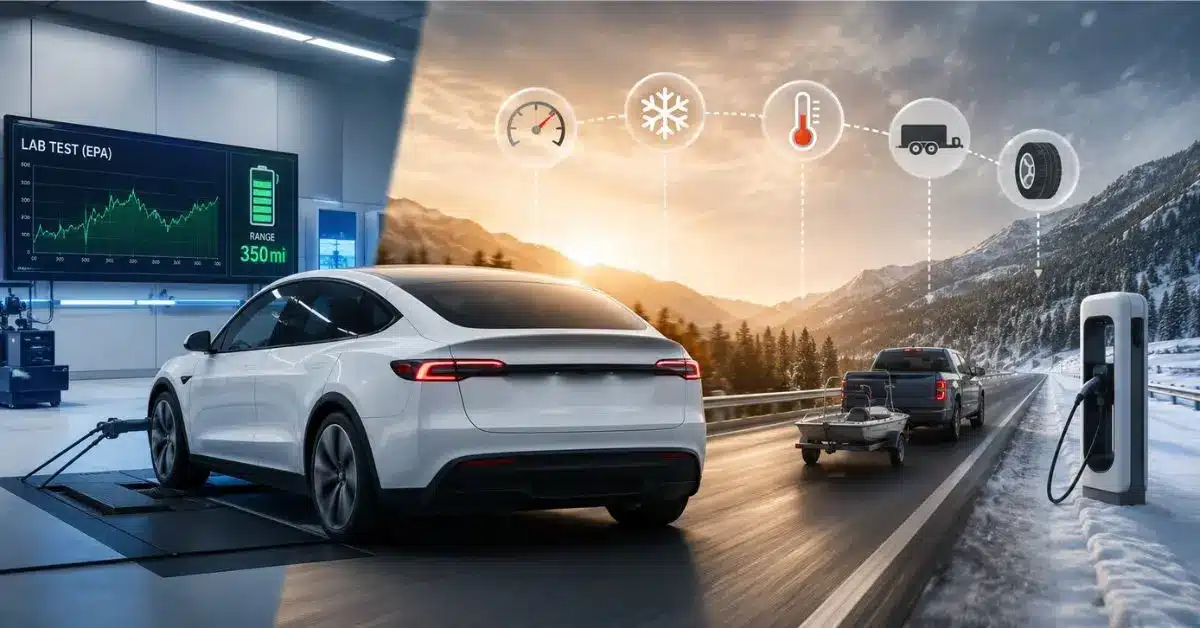
The EPA range on a window sticker is the most widely used benchmark for EV range — but it’s a lab-tested estimate under ideal conditions, not a promise. Most EVs deliver 10–25% less range in real-world highway driving.
Understanding the difference between EPA range and real-world range helps you shop smarter, plan trips more accurately, and avoid disappointment behind the wheel.
What Is EPA Range?
EPA range is the official fuel economy range rating published by the U.S. Environmental Protection Agency. Every EV sold in the United States must display an EPA range figure on its Monroney window sticker.
How the EPA test works:
- Engineers drive the vehicle on a dynamometer (an indoor treadmill for cars) through standardized city and highway drive cycles
- The test runs at moderate speeds and temperatures (~68–86°F) with climate control set to 72°F
- City and highway results are combined (55% city / 45% highway) into a single number
- The EPA applies an adjustment factor — commonly around 0.7 — to better reflect real-world conditions
- The result is the combined EPA range printed on the window sticker
The median EPA-rated range for model year 2024 EVs sold in the U.S. is approximately 283 miles per charge — more than four times higher than early modern EVs in 2011.
EPA Range vs Real-World Range: How Big Is the Gap?
Consumer Reports tested 26 current EVs and found that half fell short of their EPA-estimated ranges at highway speeds. Real-world range is typically 10–25% below EPA figures under normal driving conditions.
Condition | Gap vs EPA Range | Why |
|---|---|---|
City driving, mild weather | At or above EPA range | Regenerative braking recovers energy; less aerodynamic drag |
Highway at 65–70 mph | ~5–15% below EPA | More aerodynamic drag than test cycle |
Highway at 75–80 mph | ~15–25% below EPA | Drag increases sharply; more energy lost |
Cold weather (below 32°F) | ~20–40% below EPA | Battery chemistry slows; heater uses battery energy |
Towing | ~40–60% below EPA | Added weight and aerodynamic drag are extreme |
Tires deflated, large wheels | ~5–10% below EPA | Higher rolling resistance |
Notable real-world test gaps from Consumer Reports testing:
- Ford F-150 Lightning: 50 miles short of EPA at highway speeds
- Rivian R1S (2025): 52 miles short of its 410-mile EPA estimate
- Several BMW and Mercedes-Benz models: Beat EPA estimates by 40+ miles (conservative EPA claims)
Battery chemistry can also influence efficiency under different driving conditions. Factors such as temperature sensitivity, charging behavior, and energy density all contribute to LFP vs NMC real-world performance, helping explain why some EVs maintain their range better than others in everyday use.
Why Does City Driving Beat the EPA Estimate?
EVs perform better in city driving than on the highway — the opposite of most gas cars. In stop-and-go traffic:
- Regenerative braking recovers energy every time you slow down
- Lower speeds mean minimal aerodynamic drag
- Frequent stops create regen opportunities that add up significantly
Many city-driving EV owners regularly exceed their EPA estimate by 10–20% in mild weather with smooth traffic flow.
The Biggest Real-World Range Killers
1. High speed
Aerodynamic drag rises with the square of velocity. Going 80 mph instead of 65 mph can cut range 20–30%. At 80 mph, a 350-mile EPA EV might deliver just 245–280 miles.
2. Cold weather
Below 32°F, lithium-ion chemistry slows down, and the cabin heater draws 1–5 kWh per hour from the battery. On a very cold Minnesota morning, a 350-mile EV might deliver just 210–245 miles.
3. Heating vs air conditioning
Electric resistance heaters (common in cheaper EVs) are major energy consumers. Heat pumps (Tesla, Hyundai, BMW) are 3–4x more efficient and significantly reduce winter range loss.
4. Towing
A 5,000-lb trailer can cut EV range by 50–60%. Electric trucks rated for 300+ miles often deliver just 100–150 miles while towing at rated capacity.
EPA vs WLTP: Why European Numbers Look Higher
European EVs display WLTP (Worldwide harmonized Light vehicles Test Procedure) range — a different test cycle that typically produces 10–20% higher numbers than EPA for the same vehicle. If you see a European EV marketed with “500 km range,” the EPA equivalent would be considerably lower.
Always compare EPA figures when shopping for EVs in the United States — it’s the standard benchmark that ensures apples-to-apples comparisons across brands.
How to Estimate Your Real-World Range
A practical formula for planning:
- City driving, mild weather: EPA range × 1.0–1.1
- Mixed driving, mild weather: EPA range × 0.90–0.95
- Highway at 70–75 mph: EPA range × 0.80–0.87
- Cold winter day (below 20°F): EPA range × 0.65–0.75
- Aggressive highway + cold: EPA range × 0.60–0.70
For road trip planning: multiply the EPA range by 0.70 and plan charging stops around that number. You’ll rarely be caught short.
Best Real-World Range EVs (2024–2025)
Model | EPA Range | Real-World Highway Range | Chemistry |
|---|---|---|---|
Lucid Air Grand Touring | ~512 miles | ~480+ miles | NMC |
Tesla Model 3 Long Range RWD | ~358 miles | ~310–330 miles | NMC |
Hyundai Ioniq 6 Long Range RWD | ~361 miles | ~315–340 miles | NMC |
Tesla Model Y Long Range | ~330 miles | ~280–310 miles | NMC |
BMW i7 xDrive60 | ~324 miles | ~340–360 miles | NMC (conservative EPA) |
Conclusion
EPA range is the best available standardized benchmark for comparing EVs — but it’s not a real-world guarantee. Most EVs deliver 10–25% less range at highway speeds and up to 40% less in extreme cold. City driving often meets or beats EPA estimates.
For practical range planning, multiply EPA figures by 0.70–0.85 for highway travel and adjust further for temperature. Understanding the gap between EPA and real-world EV range helps you choose the right vehicle for your actual driving patterns — not just the best number on a spec sheet.
