How Much Lithium Is Really Inside an EV Battery?

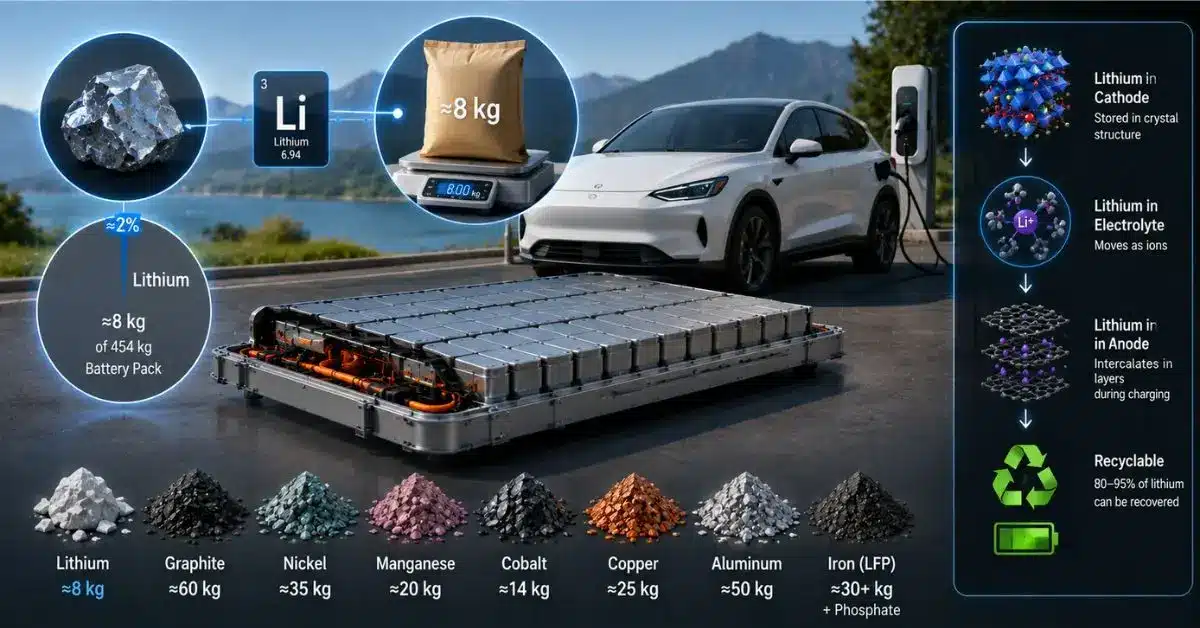
A typical EV battery contains approximately 8 kg (17.6 lbs) of lithium for a mid-size pack — about the weight of a large bag of dog food. Despite its name, lithium is a surprisingly small fraction of the total battery weight. A 454 kg (1,000 lb) battery pack contains just 8 kg of lithium metal — less than 2% by mass. Understanding how much lithium is actually in an EV battery puts supply chain concerns and resource concerns in their proper context.
How Much Lithium Is in a Typical EV Battery?
Lithium content scales with battery size. The industry rule of thumb is roughly 160 grams of lithium metal per kWh of battery capacity.
EV / Battery Size | Lithium Content (approx.) |
|---|---|
Small city EV (24 kWh) | ~3.8 kg (8.4 lbs) |
Compact EV (40–50 kWh) | ~6.4–8 kg (14–17.6 lbs) |
Mid-size crossover (75–82 kWh) | ~8–13 kg (17.6–28.7 lbs) |
Tesla Model S (100 kWh) | ~62.6 kg (138 lbs) |
Large truck (130–200 kWh) | ~20–32 kg (44–70 lbs) |
Note: The Tesla Model S figure of 62.6 kg is an outlier. Most mainstream EVs use 3–13 kg of lithium metal. The Tesla figure may reflect lithium carbonate equivalent (LCE) rather than pure lithium metal — LCE is about 5.3x as heavy as actual lithium metal per kg.
What Form Is the Lithium In?
Lithium in EV batteries is not present as a metal block. It exists in ionic form, intercalated within electrode materials:
- In the cathode: lithium is chemically bonded to the cathode material (e.g., LiNiMnCoO₂ for NMC, LiFePO₄ for LFP). This is where most lithium resides in a discharged battery.
- In the electrolyte: Lithium hexafluorophosphate (LiPF₆) dissolved in organic solvent carries ions between electrodes
- In the anode: During charging, lithium ions migrate and intercalate into graphite layers in the anode structure
This is why “lithium battery” is somewhat misleading — there’s no chunk of metallic lithium inside. The lithium moves as ions. This is also why lithium-ion batteries are much safer than older lithium metal batteries, which used reactive lithium metal electrodes.
Other Key Materials in an EV Battery
Material | Typical Amount (mid-size EV) | Where It’s Used |
|---|---|---|
Lithium | ~8 kg | Cathode, electrolyte |
Cobalt (NMC only) | ~14 kg | Cathode (0 in LFP) |
Manganese (NMC) | ~20 kg | Cathode |
Nickel (NMC/NCA) | ~30–40 kg | Cathode |
Iron + Phosphate (LFP) | Replaces above | Cathode |
Graphite | ~50–70 kg | Anode |
Copper | ~20–30 kg | Anode current collector, wiring |
Aluminum | ~40–60 kg | Cathode current collector, pack structure |
Read does an EV battery contain cobalt to understand cobalt usage across different EV battery chemistries today.
Where Does EV Lithium Come From?
Global lithium supply comes from three primary sources:
- Brine extraction (South America — the “Lithium Triangle”): Chile, Argentina, and Bolivia hold roughly 55% of global lithium reserves. Lithium brine is pumped from beneath salt flats and evaporated in large pools. Chile’s Atacama Desert is the world’s largest single lithium source.
- Hard rock mining (Australia): Spodumene ore is mined and processed. Australia is currently the world’s largest lithium producer by volume.
- Geothermal and clay extraction (emerging): The U.S. has significant lithium in Nevada’s geothermal brines and Thacker Pass clay deposits. Domestic U.S. lithium production is accelerating due to the Inflation Reduction Act’s incentives.
Lithium demand for EV batteries exceeded 700,000 tons (lithium carbonate equivalent) in 2024 and continues to grow as EV adoption accelerates globally.
Is There Enough Lithium for All EVs?
Geologists estimate global lithium reserves at approximately 98 million metric tons (USGS 2024 data) — more than enough to support a full global EV transition at current battery chemistries. The concern is not long-term depletion but short-term extraction rate and processing capacity.
Lithium recycling is also closing the supply loop. Battery recycling processes can recover 80–95% of lithium from end-of-life EV batteries. As the first generation of mass-market EVs reaches end of life, recycled lithium will increasingly supplement mined supply.
Additionally, sodium-ion batteries — which contain no lithium — are entering commercial production (CATL, BYD) for lower-range EVs and stationary storage, potentially reducing future growth in lithium demand.
Also, read what a cobalt-free EV battery to explore emerging battery technologies beyond traditional lithium-ion chemistries today is.
Conclusion
An EV battery contains approximately 8 kg of lithium for a typical mid-size pack — a surprisingly small amount given lithium’s central role in the technology. Lithium is present as ions within electrode and electrolyte materials, not as metallic chunks.
Global lithium reserves are sufficient for full EV transition, and battery recycling is building a circular supply chain. LFP chemistry’s iron-phosphate cathode doesn’t change the lithium content — all lithium-ion batteries need lithium — but sodium-ion alternatives are emerging that could reduce long-term demand growth.
Understanding lithium usage in LFP vs NMC batteries is important because both chemistries depend on lithium, but they use different cathode materials that affect energy density, cost, lifespan, and overall battery performance.
