
How Many Cells Are in an EV Battery Pack?

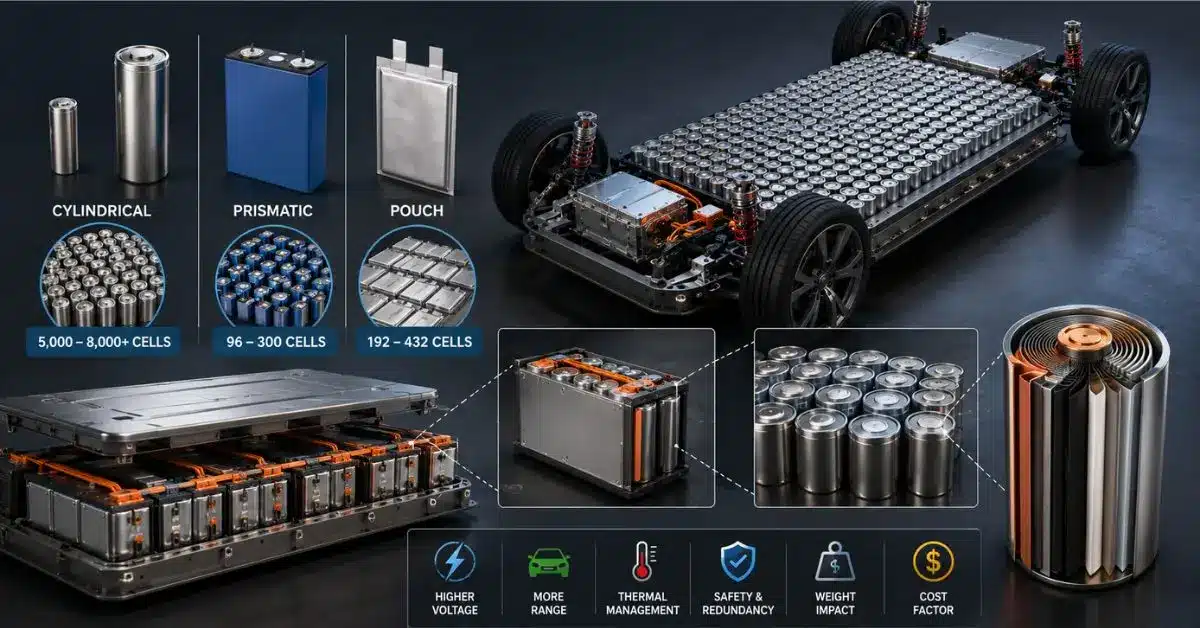
An EV battery pack holds anywhere from 96 to over 8,000 individual cells, depending on the vehicle. Cell count drives range, voltage, weight, and cost. The type of cell — cylindrical, prismatic, or pouch — determines how many a pack needs. Understanding this structure helps you make smarter EV buying decisions.
What Is a Cell in an EV Battery Pack?
A battery cell is the smallest energy unit inside a pack. It converts chemical energy into electrical energy and back again during charging.
EV battery packs follow a clear hierarchy:
- Cell → the single electrochemical unit
- Module → a group of cells connected together
- Pack → multiple modules forming the full battery system
Each cell holds a nominal voltage of around 3.2V to 3.7V, depending on chemistry. Hundreds or thousands of cells must be connected in series and parallel to reach the 400V or 800V needed to power an electric vehicle.
How Many Cells Are in an EV Battery Pack?
The answer varies widely. Cell format is the biggest factor.
| Cell Type | Cells Per Pack | Example Vehicle |
|---|---|---|
| Cylindrical (18650) | 5,000 – 8,256 | Tesla Model S |
| Cylindrical (2170) | 2,976 – 4,416 | Tesla Model 3 / Model Y |
| Prismatic | 96 – 300 | Chevy Bolt EV |
| Pouch | 192 – 432 | Nissan Leaf, Audi Q8 e-tron |
Cylindrical Cell EVs (Highest Cell Count)
Tesla uses small cylindrical cells, so its packs contain the most individual cells of any mainstream EV.
- Tesla Roadster (18650): 6,831 cells
- Tesla Model S (18650): 7,104 cells in the 85 kWh pack; up to 8,256 cells in the 100 kWh version
- Tesla Model X (18650): 7,256 cells
- Tesla Model 3 (2170): 2,976 cells (Short Range)
- Tesla Model Y Long Range (2170): 4,416 cells in a 96s46p configuration
On average, EVs using cylindrical cells carry between 5,000 and 9,000 cells per pack.
Prismatic Cell EVs (Fewer, Larger Cells)
Prismatic cells are physically larger, so fewer are needed.
- Chevrolet Bolt EV: 288 cells arranged as 96s3p across 10 modules
- BYD vehicles using blade/prismatic cells: significantly fewer cells due to larger cell size
Pouch Cell EVs (Mid-Range Cell Count)
Pouch cells fall between the two extremes.
- Nissan Leaf (early models): 192 pouch cells in 48 modules, each module holding 4 cells
- Audi Q8 e-tron 55: Modules configured as 3s4p (12 cells per module)
Why Does Cell Count Differ So Much Between EVs?
Several engineering factors drive the difference.
Cell size and energy density. Larger cells store more energy individually, so fewer are needed. Smaller cylindrical cells require more units to hit the same pack capacity.
Target voltage. Most EVs run on 400V systems, which require roughly 96–108 cells in series. An 800V system needs about 198 cells in series. Parallel groups are then added to boost capacity.
Battery capacity (kWh). A larger pack needs more cells. A 100 kWh Tesla pack uses more cells than a 40 kWh economy EV.
Battery management complexity. More cells mean more connections for the Battery Management System (BMS) to monitor. This adds cost but also increases fault tolerance. In Tesla’s case, one failing cell does not shut down the pack.
Series vs. Parallel: How Cell Configuration Works
Cells are not simply stacked. They are connected in two ways:
- Series (S): Cells are chained end-to-end. Voltage adds up. For example, 100 cells at 3.7V in series = 370V.
- Parallel (P): Cells are linked side-by-side. Capacity (Ah) adds up. Voltage stays the same.
Most packs combine both. A 96s46p configuration (Tesla Model Y Long Range) means 96 groups in series, each with 46 cells in parallel. This format raises both voltage and total energy storage at once.
A typical 400V system uses 96–108 cells in series. An 800V system needs roughly 198 cells in series to hit a 733V nominal voltage.
How Cell Count Affects Real-World EV Performance
Understanding cell count is not just technical trivia. It has direct practical effects:
- Range: More cells generally means more total energy. The Tesla Model S pack holds over 100 kWh, enabling 370+ miles of range.
- Thermal management: More smaller cells spread heat more evenly. Larger cells must be cooled more carefully to prevent hot spots.
- Charging speed: Cell chemistry and thermal design matter more than raw cell count. But a higher-voltage pack with more cells in series can handle higher charge power.
- Degradation and lifespan: A pack with thousands of small cells can tolerate the failure of one or two. Packs with fewer, larger cells have less redundancy.
- Weight: More cells add weight. Tesla’s 100 kWh Model S pack weighs approximately 540 kg (1,200 lbs).
- Cost: More cells generally mean higher manufacturing cost, though smaller cylindrical cells benefit from mass production scale.
EV Battery Cell Count by Vehicle — Quick Reference
| Vehicle | Cell Format | Total Cells | Approximate Capacity |
|---|---|---|---|
| Tesla Roadster | 18650 Cylindrical | 6,831 | ~53 kWh |
| Tesla Model S (85 kWh) | 18650 Cylindrical | 7,104 | 85 kWh |
| Tesla Model S (100 kWh) | 18650 Cylindrical | 8,256 | 100 kWh |
| Tesla Model Y LR | 2170 Cylindrical | 4,416 | ~82 kWh |
| Tesla Model 3 SR | 2170 Cylindrical | 2,976 | ~60 kWh |
| Chevrolet Bolt EV | Prismatic Pouch | 288 | ~66 kWh |
| Nissan Leaf (24 kWh) | Pouch | 192 | 24 kWh |
| Audi Q8 e-tron 55 | Prismatic | ~432 | ~114 kWh |
What About Modules — How Many Cells Are in Each One?
Cells are first grouped into modules before being assembled into a pack. A typical lithium-ion EV module contains 12 to 24 cells, though this varies.
- Tesla Model S: 16 modules × 444 cells each = 7,104 cells total
- Nissan Leaf: 48 modules × 4 cells each = 192 cells total
- Chevy Bolt EV: 10 modules (8 with 30 cells, 2 with 24 cells) = 288 cells total
Modules serve a practical purpose. They isolate faults, simplify thermal cooling, and allow partial pack replacement without replacing every cell.
The Role of the Battery Management System (BMS)
With thousands of cells in a single pack, the Battery Management System is critical. The BMS monitors every cell:
- Voltage — to prevent overcharge or over-discharge
- Temperature — to detect early signs of thermal runaway
- State of Charge (SoC) — to balance cells and protect pack longevity
In a pack with 7,000+ cylindrical cells, the BMS tracks and balances each cell group in real time. This level of monitoring is one reason high-cell-count packs are more expensive to build.
Conclusion
The number of cells in an EV battery pack ranges from under 200 to over 8,000 — and every design choice reflects a balance between energy density, cost, thermal management, and performance. Tesla’s cylindrical-cell approach requires thousands of cells per pack, while prismatic and pouch-cell designs use far fewer but larger units. Knowing how EV battery pack cells are counted and configured helps you understand what really drives range, charging speed, and long-term reliability in any electric vehicle you consider.
Learn how different battery chemistries affect EV performance, safety, and lifespan in our detailed comparison of LFP vs NMC battery technology.
