
What Are 4680 Battery Cells and Why Do They Matter?

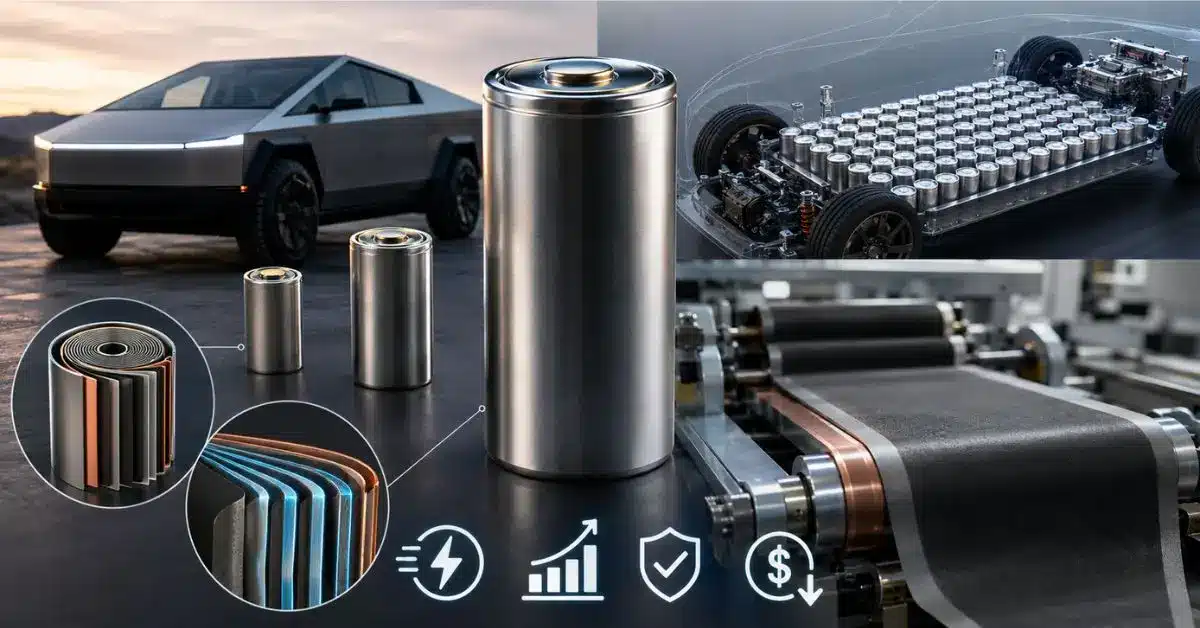
Tesla’s 4680 battery cell is a large-format cylindrical lithium-ion cell — 46 mm wide and 80 mm tall — announced at Battery Day in September 2020. It was designed to slash battery costs, increase energy density, and enable a structural vehicle pack. Six years later, the 4680 has delivered some of those promises — and missed others. Here is an honest breakdown of what the 4680 cell is, how it works, and where things stand today.
What Does “4680” Mean?
The name comes from the cell’s dimensions:
- 46 = 46 mm diameter
- 80 = 80 mm height
Compare this to Tesla’s previous cells:
| Cell Format | Diameter | Height | Volume vs 18650 | Used In |
|---|---|---|---|---|
| 18650 | 18 mm | 65 mm | Baseline | Tesla Model S, X, Roadster |
| 21700 | 21 mm | 70 mm | ~46% larger | Tesla Model 3, Model Y |
| 4680 | 46 mm | 80 mm | ~5x larger | Cybertruck, some Model Y |
The 4680 is roughly 5 times larger by volume than the 18650 cell. That size increase is intentional — fewer, larger cells mean fewer connections, simpler manufacturing, and lower assembly cost per kWh.
The Key Innovation: Tabless Electrode Design
Traditional cylindrical cells use metal tabs to connect the electrode layers to the cell terminals. These tabs create resistance and act as heat bottlenecks — especially important in large cells where heat has further to travel to escape.
The 4680 uses a tabless design. Instead of discrete tabs, the entire edge of each electrode layer becomes the electrical connection. This:
- Reduces internal resistance significantly
- Improves the current distribution across the electrode
- Allows the cell to charge and discharge at higher rates
- Reduces heat buildup — critical in a larger-format cell
The tabless design is not optional for the 4680 — without it, a cell this large would generate too much heat to charge at automotive rates.
The Dry Electrode Process: The Ambitious Manufacturing Bet
Tesla acquired Maxwell Technologies in 2019 specifically for its dry battery electrode (DBE) manufacturing process. Traditional lithium-ion cells use a wet slurry coating process — applying electrode material dissolved in solvent, then drying it in enormous ovens. It is energy-intensive and expensive.
The dry process eliminates the solvent entirely. Electrode material is pressed directly onto current collectors without drying steps. Tesla projected this would reduce manufacturing cost per kWh by over 50%.
The reality proved much harder. Elon Musk admitted at the 2025 shareholder meeting that pursuing DBE was “way harder than expected” and called it a mistake in hindsight. The cathode proved especially difficult — the materials were too abrasive for standard machinery. As of early 2026, Tesla confirmed it has now cracked fully dry electrode production for both anode and cathode at its Giga Austin facility, marking a genuine milestone after years of setbacks.
What Battery Chemistry Is Used in Tesla 4680 Cells?
The NMC chemistry used in 4680 cells has been a key part of Tesla’s strategy to balance energy density, performance, and cost. Tesla’s nickel-rich cylindrical cells are designed to store more energy in a smaller space, helping improve vehicle range while reducing battery weight. Nickel-based chemistries like NMC are commonly used in high-performance EV batteries because they provide higher energy density compared with LFP alternatives.
However, Tesla is also moving toward multiple 4680 chemistry options. LFP (lithium iron phosphate) 4680 cells are being developed for lower-cost EV models because they offer longer cycle life, better thermal stability, and lower material costs. This means the 4680 format is not limited to one chemistry — Tesla can adapt the same large cell design for different vehicles and price segments.
The Structural Battery Pack
The 4680 is designed to work in Tesla’s structural battery pack — a Cell-to-Chassis (CTC) design where the battery cells themselves become part of the vehicle’s floor structure. The pack eliminates the traditional separate module and pack enclosure layers.
This was claimed to:
- Reduce pack weight significantly
- Improve torsional rigidity
- Enable a lower vehicle floor for more interior space
Munro & Associates’ teardown found the 4680 Model Y was only about 20 pounds lighter than the equivalent 2170 Model Y — far less than Tesla originally projected. The weight savings have been more modest than promised.
4680 Real-World Performance: What the Data Shows
After years of development and real-world deployment in the Cybertruck and select Model Y variants, here is what independent testing has found:
Metric | 4680 Cell (Current) | LG 2170 Cell (Model Y 5M) |
|---|---|---|
Energy density | ~244 Wh/kg | ~253 Wh/kg |
Pack capacity (Model Y) | ~74 kWh usable | ~84 kWh usable |
10–80% charge time | ~35–40 min | ~27 min |
Cost per kWh | Lowest in the Tesla lineup by the end of 2024 | Higher (external supplier) |
Supply chain | Domestic (Austin, TX) | External (LG, Panasonic) |
The 4680’s energy density at 244 Wh/kg is slightly lower than the mature Panasonic 21700 cells (253 Wh/kg). Charging performance has also been a weak point — the larger cell format generates more heat, requiring more conservative charging curves. Independent tests showed the 4680 Model Y charges more slowly than the 2170 Model Y variant.
However, Tesla confirmed by the end of 2024 that in-house 4680 cells became its lowest cost per kWh — beating what external suppliers Panasonic and LG Energy Solution were charging. The dry electrode process, now fully operational on both electrodes, is expected to push costs another 30% lower.
Why Does the 4680 Matter for the EV Industry?
Even with its mixed performance results, the 4680 matters for several reasons:
- Industry-wide adoption of larger cells: BMW now uses 4695 cells (46 mm × 95 mm) from Eve Energy in the iX3 — achieving 10–80% charge in ~21 minutes, faster than Tesla’s 4680. The larger cylindrical format is becoming an industry standard, even if Tesla’s specific implementation has struggled.
- Domestic battery supply: Tesla’s 4680 production in Austin reduces dependence on Asian cell suppliers — increasingly important given U.S. tariff policy.
- Cost trajectory: As dry electrode manufacturing matures, the 4680 has genuine cost advantages that could flow through to lower vehicle prices.
- Structural pack design: Whether or not the 4680 becomes dominant, the structural battery concept it enabled is influencing the EV architecture industry-wide.
Where Is the 4680 Today (2026)?
As of early 2026:
- The Cybertruck uses second-generation 4680 cells (“Cybercells”)
- Tesla has reintroduced 4680 cells into select Model Y variants as a supply chain hedge against tariffs and import risks
- LFP 4680 variants are in development, targeting lower-cost models, including the rumored $25,000 vehicle and the Tesla Semi
- The dry electrode process is now operational on both electrodes at Giga Austin
- Tesla’s original 100 GWh 2023 production target was not met — but the technology is progressing
Conclusion
The 4680 battery cell is one of the most ambitious battery engineering projects in EV history. The tabless design, structural pack integration, and dry electrode manufacturing were genuinely novel ideas. Real-world results have been mixed — energy density and charging performance have lagged behind mature alternatives, but cost per kWh has improved significantly.
As Tesla continues to refine the 4680 cell and adds LFP chemistry variants, it remains an important technology for the future of affordable, domestically-produced EV batteries — even if it has not yet delivered the revolution promised at Battery Day 2020.
