
EV Battery Degradation Explained: What to Expect

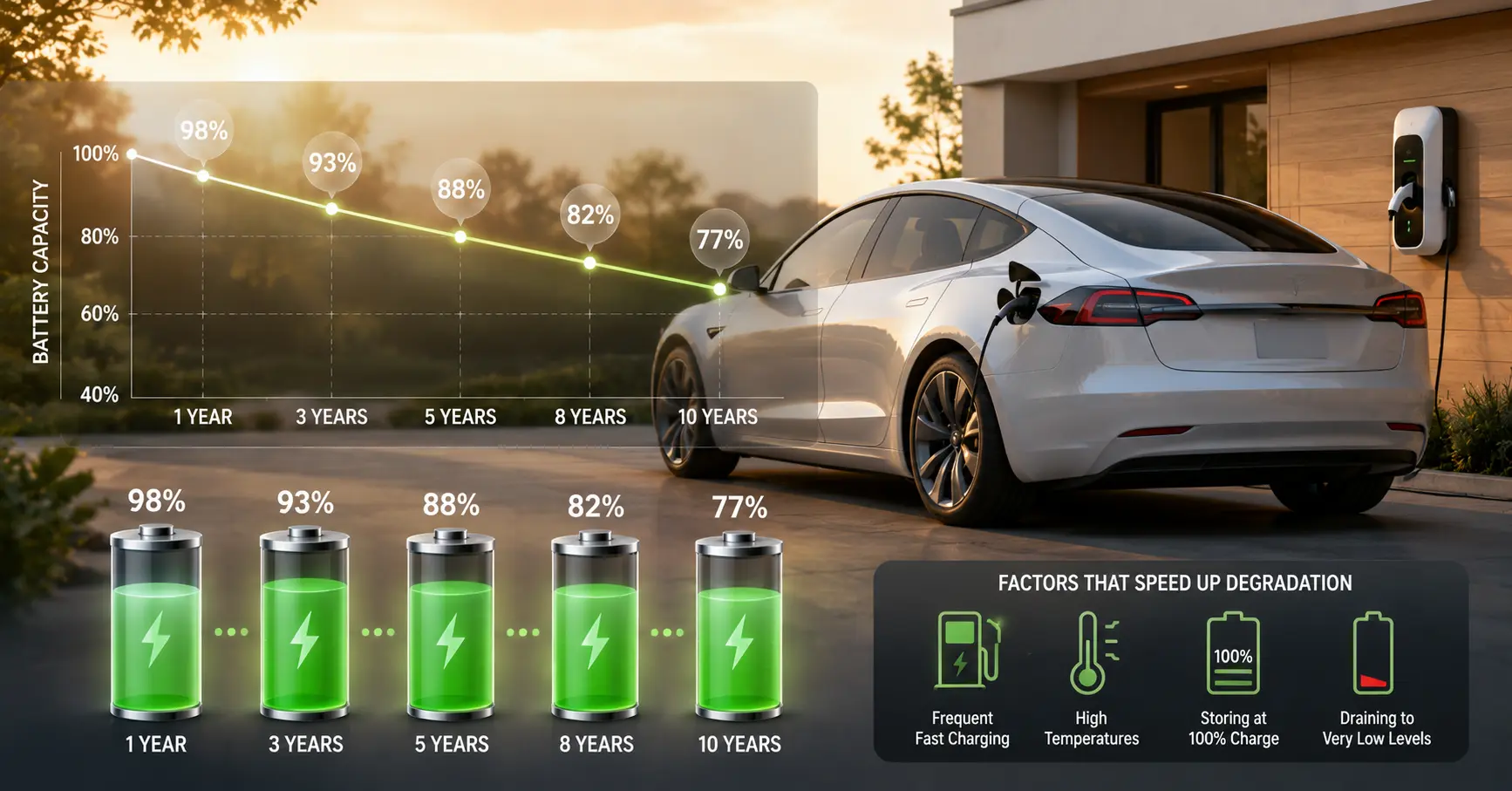
EV battery degradation is real — but far less severe than early concerns suggested. Modern liquid-cooled EVs degrade at about 2.3% per year, retaining over 80% capacity after 8 years under typical use. The biggest controllable factors are high-power DC fast charging frequency and hot-climate storage.
By following basic charging best practices — prioritizing home AC charging, avoiding extreme states of charge, and preconditioning in cold weather — most EV owners will never see meaningful degradation within their ownership period. EV batteries are proving to outlast the vehicles they power.
EV battery degradation is the gradual reduction in a battery’s ability to hold a full charge over time. Based on Geotab’s analysis of 22,700+ electric vehicles, the average annual degradation rate is 2.3% per year — meaning most modern EVs still retain over 80% of their original capacity after 8 years. It’s much slower than most people fear, and modern liquid-cooled batteries degrade far better than early EVs did.
What Is EV Battery Degradation?
Degradation is the irreversible, gradual loss of battery capacity (measured in kWh) that occurs over time and charging cycles. It happens because of permanent chemical changes inside the lithium-ion cells:
- SEI layer growth: A solid electrolyte interface forms on the anode and thickens over time, consuming lithium and reducing capacity
- Lithium plating: Fast charging at low temperatures deposits metallic lithium on the anode — permanently reducing the active lithium available
- Cathode degradation: Repeated lithium intercalation/extraction slowly degrades the cathode crystal structure
- Electrolyte decomposition: At high temperatures and voltages, the electrolyte breaks down, reducing ion mobility
You experience degradation as a reduced range. A car that once delivered 300 miles EPA-rated might deliver 270–280 miles after 5 years — still plenty for most daily driving.
How Fast Do EV Batteries Degrade? Real Data
Geotab’s 2026 study of 22,700 EVs — the most comprehensive to date — found:
- Average annual degradation: 2.3% per year
- Projected State of Health (SoH) at 8 years: 81.6%
- Projected battery lifespan: 13+ years at this rate
A 2024 study with a smaller sample found a lower 1.8% per year, the improvement over 2019’s 2.3% rate. The 2025 update returned to 2.3% primarily because of increased high-power DC fast charging in the newer fleet. Both numbers are far better than early skeptics predicted.
|
Years of Use |
Estimated SoH (at 2.3%/yr) |
Example: 75 kWh Pack |
|---|---|---|
|
Year 1 |
~97–98% |
~73–74 kWh usable |
|
Year 3 |
~93–94% |
~70 kWh usable |
|
Year 5 |
~88–90% |
~66–68 kWh usable |
|
Year 8 |
~81–82% |
~61–62 kWh usable |
|
Year 10 |
~77–78% |
~58–59 kWh usable |
Tesla’s 2023 Impact Report estimated that Model 3 and Model Y batteries retain 85% capacity at 200,000 miles, and Model S/X packs retain 88%.
What Causes Faster EV Battery Degradation?
Geotab’s analysis identified the key factors:
1. High-Power DC Fast Charging
This is the dominant stressor. Vehicles using DC fast charging above 100 kW for more than 12% of sessions degrade at up to 3.0% per year — double the rate of EV owners who primarily use AC home charging (~1.5%/yr). High-power DC charging generates internal cell heat rapidly, accelerating chemical aging.
2. Hot Climate Operation
EVs in hot climates degrade approximately 0.4% faster per year than those in mild conditions. The early Nissan Leaf (air-cooled) degraded at 4.2% per year in Arizona — nearly double the Tesla Model S rate (2.3%) with liquid cooling. Liquid thermal management is the critical protective factor in hot climates.
3. Regularly Charging to 100% (NMC Only)
NMC batteries are under more chemical stress at very high voltages. Charging to 80–90% daily and reserving 100% for road trips reduces degradation for NMC-equipped EVs. LFP batteries are tolerant of regular 100% charging — Tesla recommends daily full charges for its LFP models.
4. Regularly Discharging to Near Zero
Regularly discharging below 10–15% state of charge stresses cells. Degradation accelerates when vehicles spend more than 80% of their time at very high or very low states of charge.
5. Calendar Aging
Time itself degrades batteries — even when not being used. Storing an EV at 100% charge for extended periods accelerates calendar aging. Best practice is to store at 50–70% SoC if the vehicle won’t be used for weeks.
Degradation: EV vs Early EVs vs Gas Cars
|
Vehicle |
Degradation Rate |
Cooling Type |
|---|---|---|
|
Early Nissan Leaf (hot climate) |
~4.2% per year |
Air (passive) |
|
Average modern EV (2025 data) |
~2.3% per year |
Liquid |
|
Best-performing modern EVs |
~1.0% per year |
Liquid (advanced BMS) |
|
Tesla Model 3/Y (per Tesla 2023 data) |
~0.86% per year (to 200K mi) |
Liquid |
How to Slow EV Battery Degradation
- Charge to 80–90% daily for NMC vehicles; charge to 100% is fine for LFP. The reason for these different charging recommendations becomes clearer when comparing LFP vs NMC degradation rates, as each battery chemistry responds differently to high states of charge and long-term cycling.
- Use DC fast chargers as a road-trip tool, not a daily habit — especially at high power (150+ kW)
- Avoid storing at full charge for extended periods — keep at 50–70% during long storage
- Precondition in extreme cold before charging or driving — plugging in for preconditioning uses grid power, not battery energy
- Don’t regularly drain to 0% — keep above 10–15% SoC in daily use
- Park in shade or a garage during summer — heat is the enemy
EV Battery Warranties: Your Legal Protection
U.S. federal law requires EV battery warranties of at least 8 years / 100,000 miles. California mandates a higher minimum: 10 years / 150,000 miles. Most warranties cover replacement if the capacity drops below 70% of the original within the warranty period.
Given a 2.3%/year average degradation rate, reaching 70% takes approximately 13 years — well beyond the 8-year warranty. Battery warranty claims represent only about 2.5% of EVs, according to Recurrent Auto analysis.
Conclusion
EV battery degradation is real — but far less severe than early concerns suggested. Modern liquid-cooled EVs degrade at about 2.3% per year, retaining over 80% capacity after 8 years under typical use. The biggest controllable factors are high-power DC fast charging frequency and hot-climate storage. By following basic charging best practices — prioritizing home AC charging, avoiding extreme states of charge, and preconditioning in cold weather — most EV owners will never see meaningful degradation within their ownership period. EV batteries are proving to outlast the vehicles they power.