
Tesla Battery Range Guide: All Models Compared (2026)

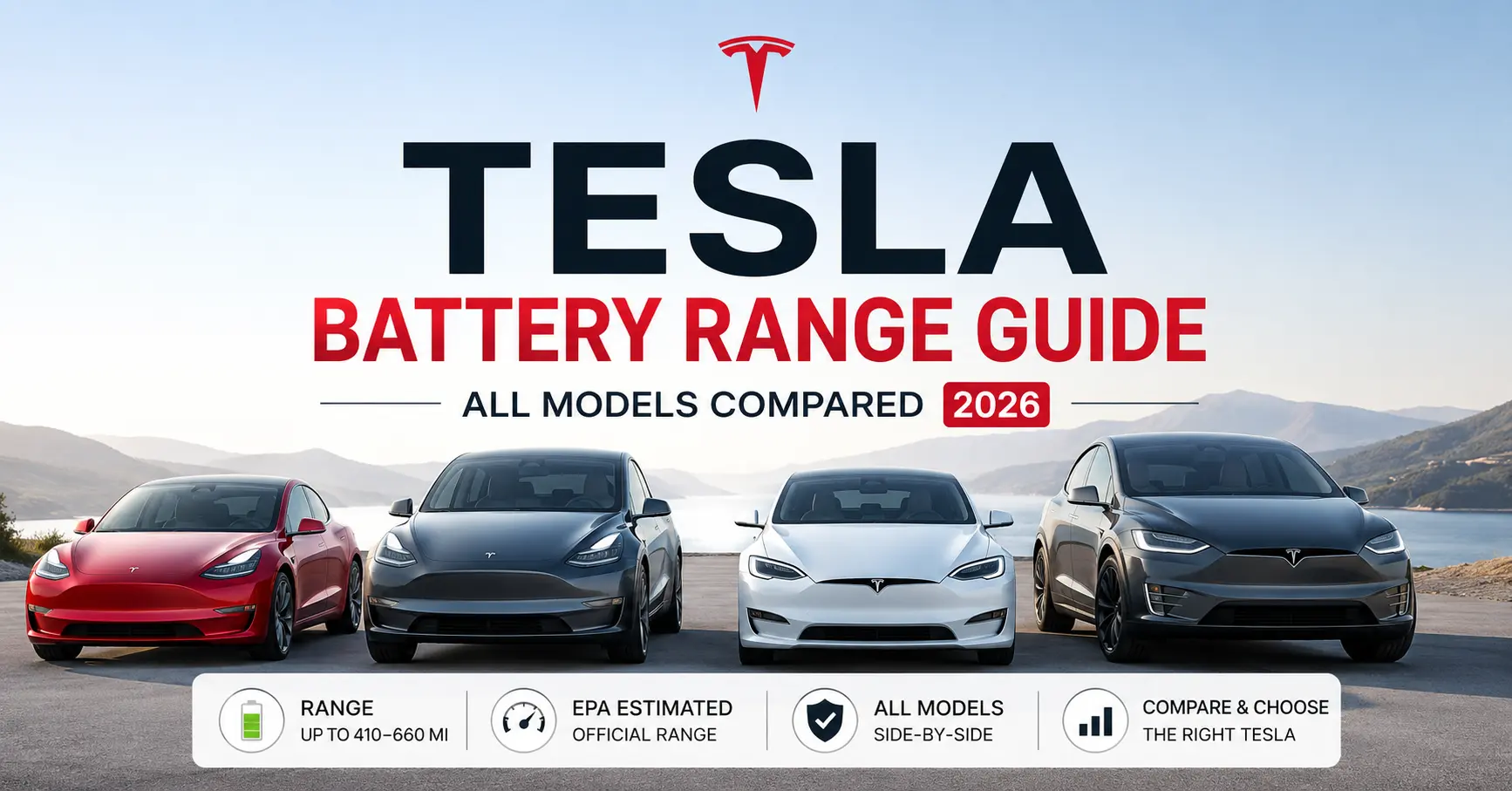
Tesla battery range is one of the first things buyers ask about — and it varies more than most people expect. Depending on the model and variant you choose, you can get anywhere from 260 miles to 405 miles of EPA-rated range on a single charge. But EPA numbers are only the starting point. Real-world range depends on how you drive, the weather, your charge habits, and even your tire pressure.
This guide compares the battery range, battery size, and chemistry for every current Tesla model — Model 3, Model S, Model Y, and Model X — and explains exactly what affects the number you actually see on your dashboard every day.
Tesla Battery Range: All Models at a Glance (2026)
Here is how every current Tesla model and variant stacks up on range, battery capacity, and chemistry as of 2026:
| Model | Variant | Battery (kWh) | EPA Range | Chemistry |
|---|---|---|---|---|
| Model 3 | Standard Range | ~60 kWh | 272 miles | LFP |
| Model 3 | Long Range | ~82 kWh | 333 miles | NMC |
| Model 3 | Performance | ~82 kWh | 315 miles | NMC |
| Model S | Long Range | ~100 kWh | 405 miles | NMC |
| Model S | Plaid | ~100 kWh | 396 miles | NMC |
| Model Y | Standard Range | ~60 kWh | 260 miles | LFP |
| Model Y | Long Range | ~82 kWh | 330 miles | NMC |
| Model X | Long Range | ~100 kWh | 348 miles | NMC |
| Model X | Plaid | ~100 kWh | 333 miles | NMC |
Which Tesla Has the Best Range?
The Model S Long Range leads all Tesla models with up to 405 miles of EPA-rated range — the highest of any Tesla ever made. If maximum range matters most and budget is less of a concern, the Model S is the clear answer.
For most everyday drivers, however, the Model 3 Long Range at 333 miles offers the best balance of range and price. It delivers nearly as much range as the Model S at a significantly lower cost. The Model Y Long Range at 330 miles is the ideal pick for families — it offers Model 3-level range in a larger SUV body with more cargo space and seating.
The Model X Long Range at 348 miles is the best option for those who need a large 6 or 7-seat SUV without sacrificing range. The Standard Range variants of the Model 3 and Model Y (both using LFP chemistry) make sense for urban drivers who rarely travel more than 150–200 miles per day.
EPA Range vs. Real-World Range: What’s the Difference?
EPA range numbers are measured under controlled test conditions — a specific speed cycle, a comfortable cabin temperature, and a fully charged battery. In real daily driving, almost no one hits the EPA number exactly. The gap is not a flaw in the car; it is a reflection of how the EPA test is designed versus how people actually drive.
Most Tesla owners report real-world range that is 10% to 20% below the EPA figure under normal mixed driving. At highway speeds above 75 mph, the gap can be 20–25%. In very cold weather, the drop can reach 30–40% because the battery uses energy to heat itself and the cabin.
As a practical rule: take the EPA number, subtract 15%, and use that as your planning range for road trips. A Model S rated at 405 miles EPA should be planned around 340–350 usable miles between charges on a highway trip.
What Affects Real-World Tesla Range?
Understanding what cuts into your range helps you plan better and avoid surprises on long trips. Here are the main factors:
1. Driving Speed
Speed is the single biggest range killer for any EV. Air resistance (drag) increases exponentially with speed — meaning driving at 80 mph uses significantly more energy per mile than driving at 60 mph. If you want maximum range on a road trip, keeping your speed at 65–70 mph can add 30–50 miles of real-world range compared to driving at 80 mph.
2. Cold Weather
Cold temperatures hurt lithium-ion batteries in two ways. First, the battery chemistry becomes less efficient in the cold, reducing the energy it can deliver. Second, the car uses battery power to heat both the battery pack and the cabin. Below 20°F (-7°C), you can expect range reductions of 25–40%. The good news is that Tesla’s thermal management system works hard to minimize this, and preconditioning while plugged in recovers a significant chunk of that lost range.
3. Climate Control
Heating the cabin in winter uses considerably more energy than cooling it in summer. An electric heater draws power directly from the battery, while the air conditioner (a heat pump on newer Tesla models) is more efficient. If you are on a range-critical trip in cold weather, using seat heaters instead of cabin heat is a simple trick that saves significant battery power — seat heaters draw much less energy than the full HVAC system.
4. Driving Style
Aggressive acceleration and hard braking both reduce range. Hard acceleration pulls high current from the battery quickly, which is less efficient than smooth, gradual acceleration. Using regenerative braking on the Standard setting helps recover energy on every deceleration and is one of the easiest ways to extend your range in city driving.
5. Tire Pressure and Wheel Size
Under-inflated tires create more rolling resistance, which forces the motor to work harder. Checking your tire pressure once a month takes two minutes and can recover 5–10 miles of real-world range. Larger wheel and tire combinations also reduce range compared to the standard wheels — bigger wheels look great but add weight and rolling resistance.
6. Charge Level
Batteries are most efficient in the middle of their charge state (roughly 20–80%). Charging to 100% and immediately draining to 0% is both less efficient and harder on the battery long term. For daily driving, keeping your charge between 20% and 80% gives you the best combination of efficiency and battery health.
LFP vs NMC: How Battery Chemistry Affects Range
Tesla uses two main battery chemistries across its lineup, and the chemistry affects not just range — it changes how you should charge the car every day.
| Chemistry | Used In | Range | Daily Charge Limit | Key Advantage |
|---|---|---|---|---|
| LFP (Lithium Iron Phosphate) | Model 3 / Y Standard Range | Lower | Charge to 100% regularly | Safer, longer cycle life, lower cost |
| NMC (Nickel Manganese Cobalt) | Long Range & Performance models | Higher | Set limit to 80–90% daily | Higher energy density, longer range |
LFP batteries are used in Standard Range models because they are cheaper to produce, safer (much lower risk of thermal runaway), and have an extremely long cycle life. One important note: LFP batteries should be charged to 100% at least once a week. This helps the Battery Management System (BMS) get an accurate reading of the battery’s true capacity and display the correct range estimate on the dashboard.
NMC batteries pack more energy into the same physical space, which is why Long Range and Performance models can achieve 330–405 miles of range. The trade-off is that NMC chemistry is slightly more sensitive to being kept at a very high charge state. For daily driving, setting the charge limit to 80–90% extends the battery’s healthy lifespan significantly. Only charge to 100% right before a long road trip, and start driving soon after reaching full charge.
Tips to Maximize Your Tesla’s Range
These tips work across all Tesla models and can meaningfully improve your real-world range and battery health over time:
1. Set the Right Charge Limit
For NMC batteries (Long Range and Performance), set your daily limit to 80–90% in the Tesla app or on the car’s charging screen. For LFP batteries (Standard Range), set the limit to 100% and aim to hit it at least once a week. This single habit is the most impactful thing you can do for long-term battery health.
2. Precondition Before Driving
Use the Tesla app to schedule cabin preconditioning while the car is still plugged in. This warms or cools the battery and cabin using wall power, not battery power — so you start every drive with a full charge and a comfortable temperature without having spent any range. This is especially valuable in cold winters.
3. Use Regenerative Braking on Standard
Keep regenerative braking set to Standard (not Low). Every time you lift off the accelerator, the motor acts as a generator and feeds energy back into the battery. In city driving with frequent stops, this can recover a meaningful amount of range throughout the day.
4. Check Tire Pressure Monthly
Tires lose about 1 PSI per month naturally. Keeping them inflated to the recommended pressure (shown on the door jamb sticker) takes two minutes and prevents unnecessary range loss from added rolling resistance.
5. Drive Smoothly at Steady Speed
Use Autopilot or cruise control on highways to maintain a steady speed. Constant speed is far more efficient than varying speed. Avoid rapid acceleration unless you need it — the efficiency hit from a hard launch is significant.
6. Keep the Car Plugged In When Parked
When parked at home, keep the car plugged in. Tesla vehicles run background processes (Sentry Mode, software updates, cabin temperature management) that draw a small amount of power continuously. When plugged in, these use wall power rather than the battery, preventing the slow overnight drain known as “vampire drain.”
Deep Dives by Model
For model-specific range data, real-world degradation stats, charging guides, and owner tips, see our dedicated pages:
- Tesla Model 3 Battery Range: All Variants (2026 Guide) — range by trim, battery specs (50–82 kWh), LFP vs NMC, charging times, and care tips specifically for Model 3 owners.
- Tesla Model S Battery Life: Real-World Longevity Data & Range Guide — real degradation curves, long-term owner data beyond 200,000 miles, and range guide for Model S owners.
- Understanding Tesla Model Y Batteries: LFP vs NCA, 2170 vs 4680 — which battery type is in your Model Y and how it changes your charging routine.
Conclusion
Tesla offers a wider range of battery sizes and range figures than any other EV brand — from 260 miles in the Model Y Standard Range to 405 miles in the Model S Long Range. The right Tesla for you depends on how far you drive daily, whether you do regular road trips, and how important upfront cost is versus long-term range.
For most drivers, the Model 3 or Model Y Long Range hits the sweet spot of real-world range, price, and daily practicality. If you regularly drive 250+ miles between charges or want the absolute best range Tesla offers, the Model S is in a class of its own. Whichever model you choose, following the charging and driving habits in this guide will ensure you get the most from your battery for years to come.