
What Is a Blade Battery? BYD’s EV Battery Explained

Based on BYD and FinDreams releases, the RWTH Aachen University cell teardown (2025), Chinese MIIT filings as reported, and Chinese and US regulator records.
The Blade Battery is the idea that made BYD a battery supplier to the world — and its real innovation is packaging, not chemistry.
When BYD launched the Blade Battery in March 2020, the chemistry inside it was the oldest in the EV business: lithium iron phosphate, the safe, cheap, cobalt-free cathode the industry had largely set aside for its low energy density. What BYD changed was the shape. By stretching the cell into a blade almost a metre long and building the pack out of the cells themselves, it clawed back at pack level much of what LFP loses at cell level. This guide covers how it works, what the famous nail test does and does not prove, how the 2026 second generation changes things, and which cars — including, for a while, a Tesla — actually use it.
Quick answer
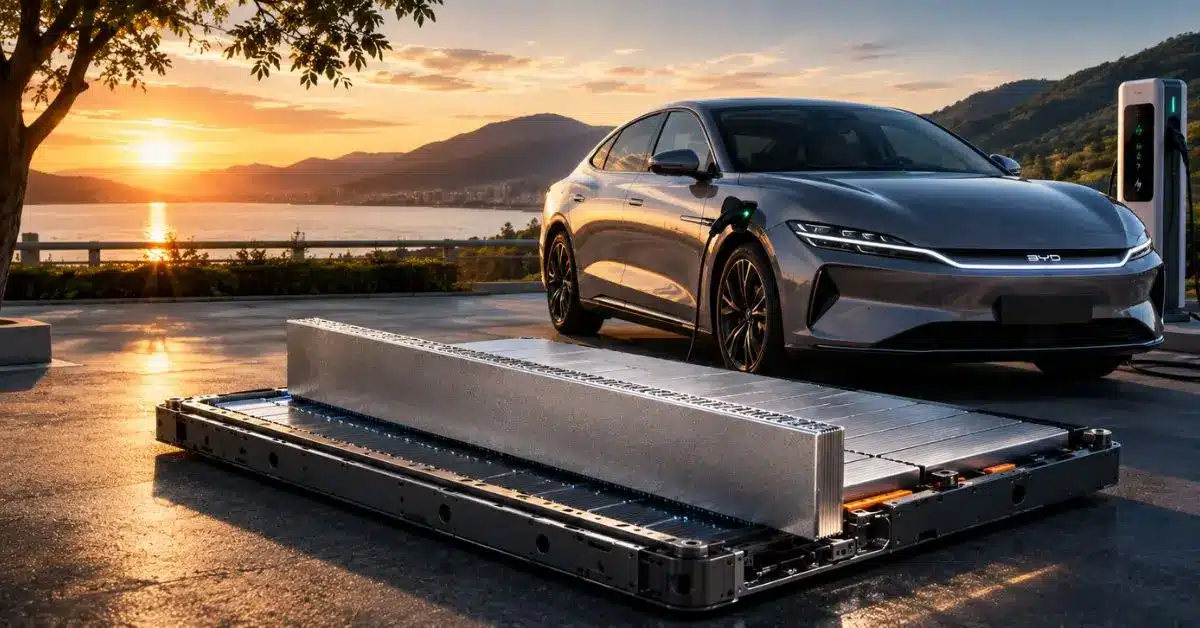
The Blade Battery is BYD’s lithium iron phosphate (LFP) battery, built by its subsidiary FinDreams and launched on 29 March 2020. Its cells are long, thin blades — the production cell measures about 965 mm long — laid directly across the pack with no modules in between (cell-to-pack), so the cells double as the pack’s structure. The design trades cell-level energy density for pack-level efficiency, low cost and LFP’s inherent thermal stability.
Key figures:
Launched 29 March 2020 · Chemistry: LFP · Cell: ~965 × 90 × 14 mm, 3.2 V, ~135 Ah, 160 Wh/kg (independent teardown) · First car: BYD Han EV, 76.9 kWh · Blade 2.0 (March 2026): still LFP, Flash Charging up to 1,500 kW
What makes the Blade Battery different
A blade cell is a structural beam: it spans the pack, carries load, and deletes the module level entirely.
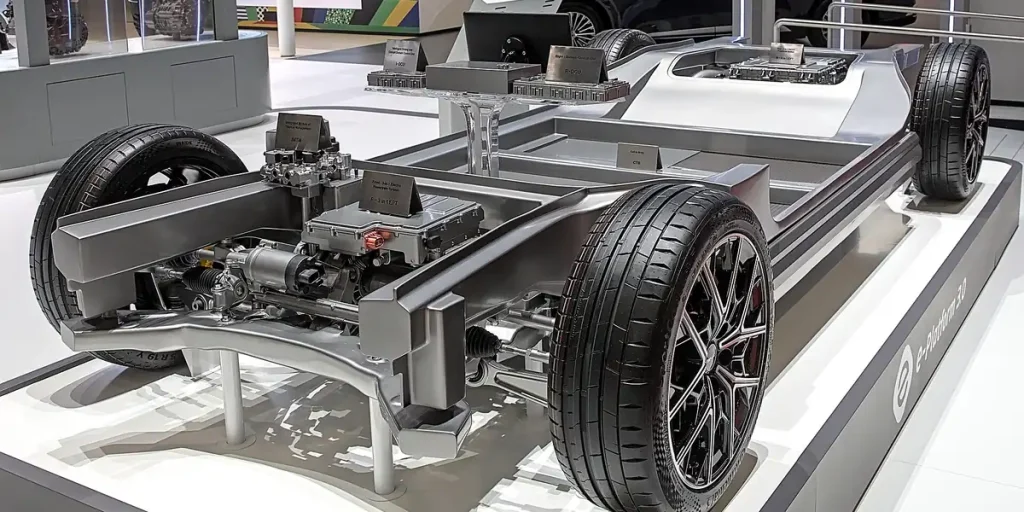
In a conventional pack, short prismatic cells are grouped into modules, and the modules are bolted into the pack — two levels of casing, wiring and dead space. A Blade pack lays its long cells directly across the full width of the floor, each cell a beam in the structure: cell-to-pack (CTP) in its purest form. BYD’s launch claim was that this raised the share of the pack’s volume used by cells from about 40% to about 60% — a “50% improvement” in space utilisation, in BYD’s own framing.
What did the independent measurement find?
Independent measurement supports the shape if not every number: RWTH Aachen University’s peer-reviewed teardown of a production Blade cell (2025) measured it at 965 × 90 × 14 mm, 3.2 volts and about 135 amp-hours. BYD’s patents describe cells anywhere from 400 to 2,500 mm — the near-metre cell in the teardown is what actually ships.
The chemistry: why LFP
Everything the Blade does starts with LFP — the most thermally stable cathode chemistry in mass production.
Lithium iron phosphate gives up energy density (LFP cells run about 90–190 Wh/kg against 200–260 for nickel-rich NMC) in exchange for three things BYD built the product on: a cathode that does not release oxygen as it breaks down, so thermal runaway starts later (~270–300°C, against ~200–210°C for nickel-rich cathodes) and runs cooler; raw materials — iron and phosphorus — that are cheap and carry no nickel or cobalt exposure; and long cycle life.
On life, BYD’s numbers have moved with its marketing: the 2020 launch claimed 3,000+ charge cycles and 1.2 million km of driving, and BYD’s current European material claims 5,000+ cycles. Neither figure is independently verified, and the honest reading is “LFP-typical longevity, claimed generously”. The teardown’s measured 160 Wh/kg for the cell — the low end of today’s LFP range — underlines the point: the Blade cell itself is unremarkable; at pack level (~140 Wh/kg in the first Han) the packaging does the work.
The nail penetration test, told straight
The nail test was a launch demonstration, not a certification — and what it demonstrated is still genuinely impressive.
At the March 2020 launch, BYD drove a nail through a charged Blade cell on film: no smoke, no flame, and a surface temperature that stayed between 30°C and 60°C, next to a nickel-cobalt cell that burst into flame in the same test. That is a real property of LFP chemistry and long thin cells, and it deserves its fame. Two corrections matter, though.
Why isn’t the nail test a certification?
First, the test is not a pass/fail national standard: China’s mandatory GB 38031-2020 contains no standalone cell nail test (the procedure sits in a recommended standard, and penetration is one trigger among several in the mandatory pack-level thermal-propagation test) — so “it passed the nail test standard” is a sentence no careful page should print.
Second, no demonstration makes a battery fireproof: in 2022 China’s SAMR regulator forced recalls of BYD’s Tang DM-i (eventually 52,928 cars) because water could enter the Blade pack tray and create a thermal risk — a sealing defect, not a chemistry failure, but a reminder that packs fail at their manufacturing, not their chemistry. China’s rules keep tightening regardless: GB 38031-2025, effective July 2026, requires a pack to show no fire and no explosion for two hours after a single cell’s thermal runaway.
Blade Battery generations: 1.0 and 2.0
Generation 2, launched 5 March 2026, is still LFP — the revolution is in the charging, not the chemistry.
Generation 1 (2020–2025)
The original Blade: near-metre LFP cells at about 160 Wh/kg, packs from ~50 kWh in small cars to 76.9 kWh in the launch Han EV (605 km on the NEDC cycle), built by FinDreams at Chongqing with an initial 20 GWh of capacity. It spread across BYD’s whole range and, from 2021, into other makers’ cars (E10).
Generation 2 (launched March 2026)
Launch-day reporting called Blade 2.0 an LMFP battery; the filings disagree — the first production 2.0 pack, the 150 kWh unit in Yangwang’s U7 flagship, is registered with China’s MIIT as plain LFP, and LMFP remains an inference from BYD patents rather than a confirmed product.
What BYD actually claims for 2.0 is narrower and bigger at once: energy density up only about 5%, but a new Flash Charging system whose chargers are rated to 1,500 kW on a single connector, with claimed charges of 10–70% in 5 minutes and 10–97% in 9 minutes (and 20–97% in about 12 minutes even at −30°C, also a BYD claim). Two cell formats exist: a Short Blade (~450–580 mm) for very high charge rates and a Long Blade (~960 mm, a reported ~210 Wh/kg). BYD reports 4,239 Flash stations at launch and 10,000 by August 2026, targeting 20,000 by the end of 2026; first cars include the Yangwang U7, Denza Z9GT and D9, and the Atto 8 in Europe.
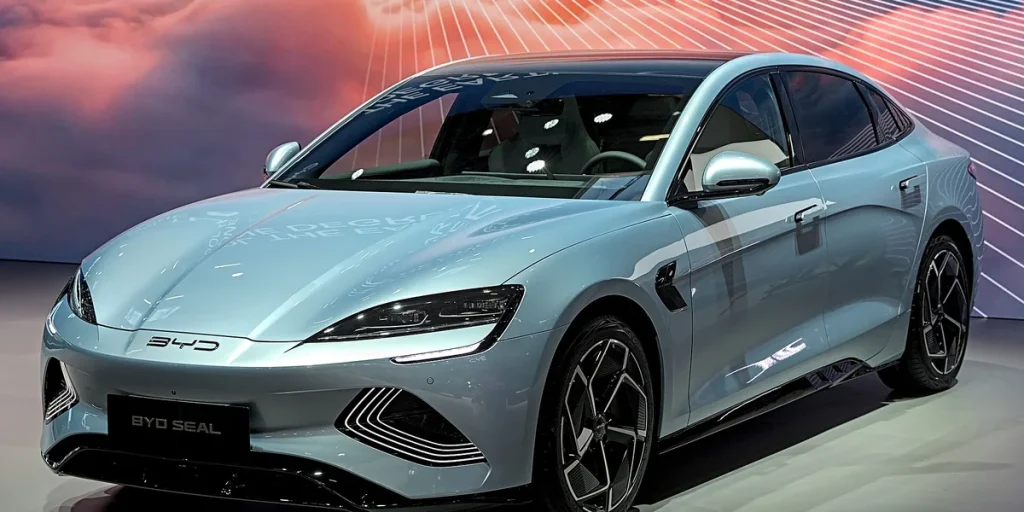
Flash Charging up to 1,500 kW: BYD claims 10–70% in 5 minutes and 10–97% in 9 minutes.
Blade Battery vs NMC and Tesla
Against nickel chemistries the Blade wins on cost, life and thermal stability — and loses, clearly, on energy per kilo.
| Feature | Blade Battery (LFP CTP) | Typical NMC pack |
|---|---|---|
| Cell energy density | ~160 Wh/kg (teardown-measured) | 200–260 Wh/kg |
| Thermal runaway onset | ~270–300°C, no oxygen release | ~200–210°C (cathode decomposition) |
| Cycle life | 3,000+ cycles claimed by BYD at launch | ~1,000–2,500 cycles typical |
| Cathode metals | Iron, phosphorus — no nickel, no cobalt | Nickel, manganese, cobalt |
| Pack design | Cells are the structure (CTP) | Cells in modules in a pack (some CTP/CTB designs now exist) |
| Cold-weather charging | LFP’s known weakness; 2.0 claims big improvements | Generally stronger |
The fairest independent comparison comes from the same RWTH Aachen teardown programme, which also measured Tesla’s 4680 cell at 241 Wh/kg — far denser than the Blade’s 160 — but found the Blade cell produces about half the heat per unit volume at the same charge rate. Dense or cool-running: that is the real choice between the two designs, and different buyers will answer it differently.
Which cars use the Blade Battery?
Every BYD battery-electric car uses it — and since 2021, so have cars from FAW, Toyota and Xiaomi.
Which BYD cars use the Blade?
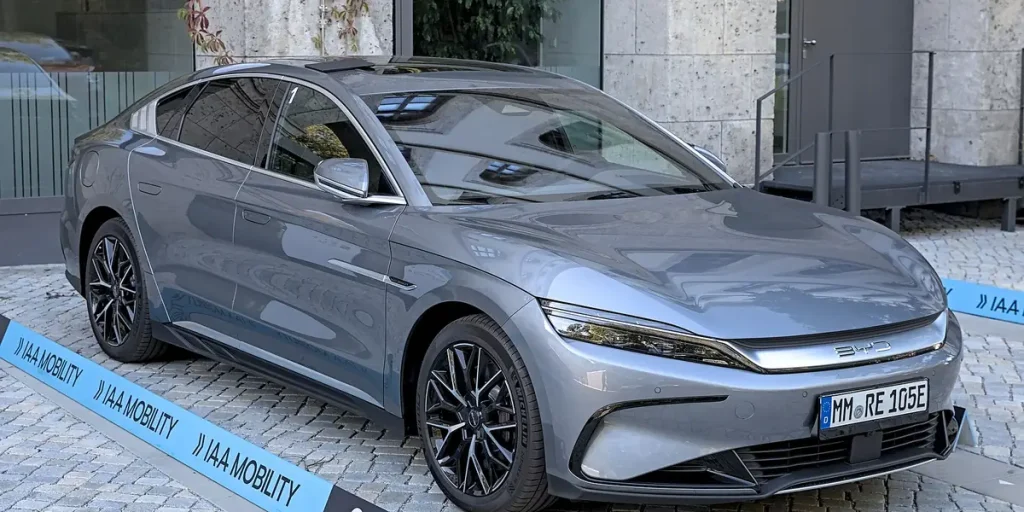
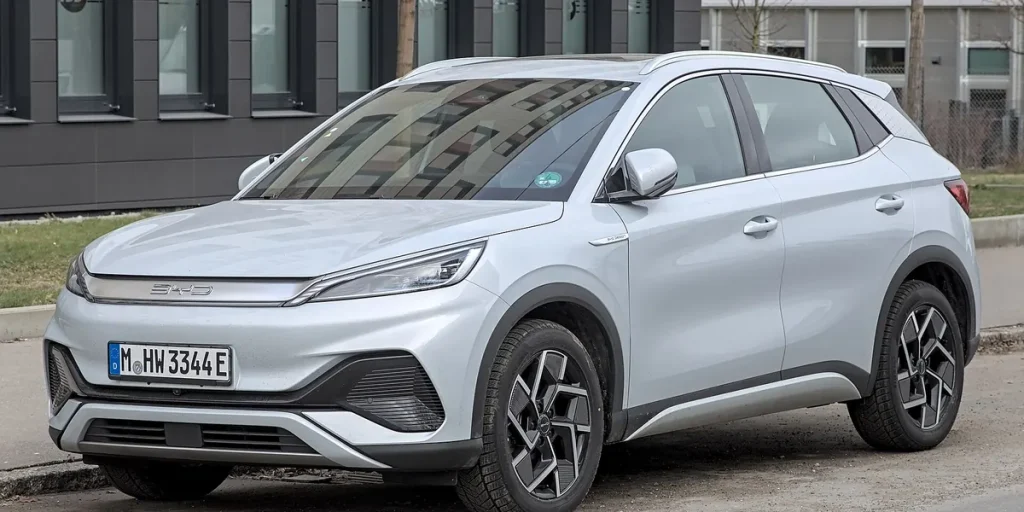
The first Blade car was BYD’s own Han EV sedan (June 2020, 76.9 kWh). The design now spans the range Americans see in headlines: the Atto 3 (Yuan Plus) crossover, the Dolphin hatchback, the Seal sedan — whose cell-to-body variant bonds the pack into the floor — plus the DM-i plug-in hybrids, so Blade cells serve hybrids as well as pure EVs.
Which other makers use Blade cells?
Outside BYD: FAW’s Hongqi E-QM5 and Bestune NAT were the first external users, from 2021 — not the Toyota bZ3, which followed in April 2023 (China only, 49.9 and 65.3 kWh packs) and was later joined by the bZ5. Xiaomi’s standard-range SU7 runs FinDreams blades, and BorgWarner signed an eight-year pact in 2024 to build Blade-based packs for commercial vehicles outside China.
What about Tesla — and the US?
The famous name needs its dates: Tesla’s Berlin-built Model Y RWD used a 55 kWh Blade pack from May 2023 — but the facelifted car switched to CATL cells in January 2025, so that chapter is closed. And for US readers: BYD sells no passenger cars in the United States (a 100% tariff and the connected-vehicle rule see to that); its American business is buses, forklifts and energy storage from Lancaster, California.
Frequently asked questions
What is a blade battery?
BYD’s lithium iron phosphate battery, built by FinDreams: long, thin cells (about 965 mm in production) laid directly into the pack without modules, so the cells form part of the structure. Launched 29 March 2020 in the BYD Han.
Why is the Blade Battery considered safer?
Partly chemistry — LFP does not release oxygen as it decomposes and reaches thermal runaway at higher temperatures (~270–300°C) — and partly geometry: long thin cells shed heat well. BYD’s launch nail-penetration demonstration (no smoke or flame, 30–60°C surface) showed the chemistry off; it was a demonstration, not a certification, and Blade packs have still been recalled for manufacturing defects.
Do blade batteries last longer?
LFP chemistry is long-lived, and BYD claims 3,000+ cycles (its launch figure, equating to 1.2 million km) and now markets 5,000+. Treat both as manufacturer claims; the chemistry’s reputation for longevity is well earned even if the exact numbers are BYD’s.
Is the Blade Battery used in hybrids or only EVs?
Both. BYD’s DM-i plug-in hybrids (such as the Song Plus DM-i and Tang DM-i) use Blade cells alongside the pure-electric range.
Are Tesla batteries made by BYD?
One was, briefly: the Berlin-built Model Y RWD used a 55 kWh BYD Blade pack from May 2023 until the facelift switched to CATL cells in January 2025. No Tesla on sale today uses BYD cells.
Can I buy a BYD Blade Battery car in the USA?
No. BYD does not sell passenger cars in the United States; tariffs and the connected-vehicle rule keep them out. Its US operations cover buses, forklifts and energy storage.
Is Blade Battery 2.0 a different chemistry?
No — despite launch-day LMFP reporting, the first production 2.0 pack is filed in China as LFP. Generation 2’s step is charging: BYD’s Flash chargers are rated to 1,500 kW, with claimed 10–70% charges in five minutes.
Conclusion
The Blade Battery’s lesson is that how you pack a chemistry can matter as much as the chemistry itself.
LFP was the industry’s budget option until BYD stretched it into a structural blade and recovered the lost ground at pack level. The design is not magic — its cell is measurably less dense than Tesla’s 4680, and its safety story is chemistry plus engineering, not immunity — but it made safe, cobalt-free batteries good enough for the world’s best-selling EVs, and Generation 2 aims the same trick at charging speed.
