
Tesla Model S Battery Life: Real-World Longevity Data & Range Guide

The Tesla Model S is one of the longest-lasting electric vehicles ever built — and the data backs that up. Real-world driving records from thousands of owners show the Model S battery loses only 10 to 12% of its capacity after 200,000 miles. Some owners have crossed 400,000 miles on the original pack.
This guide covers Model S-specific degradation data, real-world range expectations, and simple habits that keep it performing well for the long haul.
Compare Tesla battery ranges across all models → Tesla Battery Range Guide: All Models Compared 2026
The Truth About Tesla Model S Battery Longevity
When you buy a new car, you want to know it will last. For a Tesla Model S, the battery’s life is the key to the car’s value. The good news is that the battery technology is much better than many people think.
Tesla’s Official Stance and Warranty
Tesla stands behind its battery technology with a strong warranty. For the Model S, the warranty is for 8 years or 150,000 miles, whichever comes first. The most important part of this warranty is that it guarantees the battery will keep at least 70% of its original capacity during that time.
Tesla has also stated that Model S battery packs are designed to last between 300,000 and 500,000 miles. For the average driver doing about 15,000 miles a year, this means the battery could last for 20 to 33 years.
Real-World Battery Degradation Data
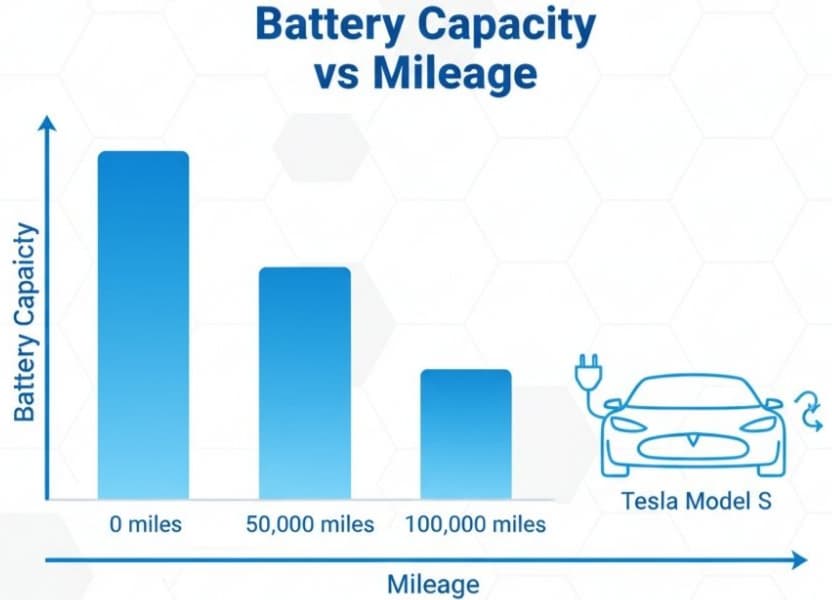
- Initial Drop: Most batteries see a quick drop in capacity during the first year or two, often losing about 5% in the first 50,000 miles.
- Slowing Down: After this initial drop, the rate of degradation slows significantly.
Mileage (Miles) | Expected Capacity Retention (%) | Expected Capacity Loss (%) |
|---|---|---|
50,000 | 95% – 92% | 5% – 8% |
100,000 | 90% – 88% | 10% – 12% |
200,000 | 88% – 85% | 12% – 15% |
300,000 | 80% – 75% | 20% – 25% |
Case Study: The High-Mileage Model S
One famous owner drove a Model S over 400,000 miles on the original battery pack — proving the battery can handle massive amounts of driving while still holding a usable charge.
Tesla Model S Range: EPA vs. Reality
The latest Model S Long Range has an EPA range of up to 405 miles. The high-performance Plaid model reaches 396 miles EPA. Real-world range is typically 10–15% lower depending on driving conditions.
Driving Condition | Typical Range Loss | Why It Happens |
|---|---|---|
Highway Speed (75+ mph) | 15% – 25% | Air resistance is much higher at fast speeds. |
Extreme Cold (Below 20°F) | 20% – 35% | Battery needs energy to stay warm. |
Aggressive Driving | 10% – 20% | Quick acceleration uses a lot of power fast. |
Using Heater/AC Heavily | 5% – 15% | Power used to heat or cool the large cabin. |
Expert Tips to Maximize Your Model S Battery Health

1. Set the Daily Charge Limit to 80–90%
For everyday driving, set your charge limit to 80% or 90%. Charging to 100% daily causes wear and tear. Only charge to 100% right before a long road trip — and start driving soon after.
2. Keep the Sweet Spot: 40–80%
The best range for battery health is between 40% and 80%. If you can keep your car in this range for most of your driving, you are doing a great job.
3. Avoid Deep Discharge
Try not to let your battery drop below 20% often. Running the battery very low puts stress on the cells and accelerates degradation.
4. Keep the Car Plugged In
When not driving, keep the car plugged in. This lets the BMS manage cell health and lets the thermal system use wall power (not battery power) to maintain the right temperature — especially important in extreme weather.
5. Use Supercharging for Trips Only
Supercharging creates more heat than Level 2 home charging. Use it for long trips, not daily charging. Home charging on a Wall Connector is the best option for day-to-day battery health.
Conclusion
The Tesla Model S battery is a great example of modern engineering. Real-world data shows it keeps most of its power for many hundreds of thousands of miles. Battery care is simple: keep the car plugged in, set a daily charge limit of 80–90%, and avoid extreme temperatures. Even after 200,000 miles, most Model S batteries still retain 85–88% of their original capacity.
Want tips to make your Model S battery last longer? See: Best Practices to Extend Your Tesla Battery Life →
For a full breakdown of Tesla battery replacement pricing by model and year, see our Tesla battery replacement cost guide.
