
Which EVs Support Bidirectional Charging?

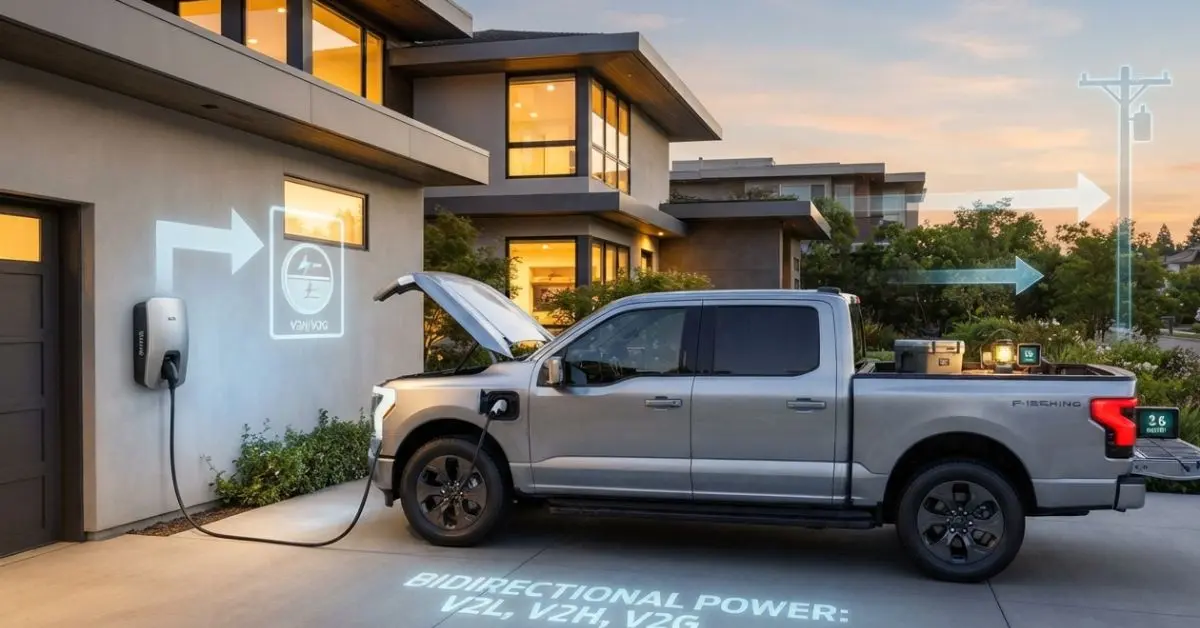
Not all electric vehicles support bidirectional charging. V2L (Vehicle-to-Load) is the most common type and works with dozens of models. V2H (Vehicle-to-Home) needs extra home equipment and works with fewer cars.
V2G (Vehicle-to-Grid) is the rarest option because it needs a special car, a certified charger, and a signed-up utility program.
Not sure which of these terms actually applies to you? See our explainer on bidirectional EV charging: V2G vs V2H vs V2L.
EVs With V2L (Vehicle-to-Load) in 2026
V2L is now standard or optional on a wide range of EVs, typically delivering 1.5 to 3.6 kW through a V2L adapter that plugs into the charging port. Power capacities vary by model.
| EV Model | V2L Power Output | Notes |
|---|---|---|
| Hyundai Ioniq 5 | 3.6 kW | Standard — adapter included or optional by trim |
| Hyundai Ioniq 6 | 3.6 kW | Standard on LR trims |
| Kia EV6 | 3.6 kW | Standard on most trims |
| Kia EV9 | 3.6 kW | Standard |
| Ford F-150 Lightning | 7.2–9.6 kW (Pro Power Onboard) | Multiple 120V/240V outlets in truck bed — best V2L in class |
| Rivian R1T / R1S | 1.5 kW external / more via bed outlets | Camp Kitchen outlet and gear tunnel outlets |
| BYD Seal, Atto 3, Sealion 7 | 3.3 kW | Standard via V2L adapter |
| XPENG G6 | 3.3 kW | Standard |
| Leapmotor B10 | 3.3 kW | Standard |
| Hyundai Inster / Casper EV | 3.6 kW | Standard on all trims — class-leading for a mini EV |
| Renault 5 E-Tech | 3.6 kW | Standard on 52 kWh variant |
| Renault 4 E-Tech | 3.6 kW + V2G | Both V2L and V2G standard |
| Skoda Elroq / Epiq | Supported | V2L via adapter |
| Genesis GV60, GV70 E | 3.6 kW | Standard |
EVs That Support Vehicle to Home (V2H)
V2H requires both a capable EV and a compatible home system, including a transfer switch and a bidirectional charger. The most practical implementations in 2026 include:
Ford F-150 Lightning
Ford Intelligent Backup Power works with the Ford Charge Station Pro and a whole-home transfer switch. It can deliver up to 9.6 kW to power an entire home during a power outage.
Renault 4 and Renault 5 E-Tech
These models are compatible with Mobilise Power Solutions and can provide home backup power when paired with a compatible home system.
Nissan Leaf
Certain markets support V2H through the CHAdeMO charging standard. The technology has been available in Japan for years, but deployment remains limited in the United States because of the decline of CHAdeMO infrastructure.
Mitsubishi Outlander PHEV
The Outlander PHEV supports V2H in Japan through CHAdeMO. Availability remains limited in most other markets.
EVs That Support Vehicle to Grid (V2G)
V2G remains the most limited bidirectional charging technology in 2026. It requires a V2G-certified charger and participation in a compatible utility program.
Renault 4 and Renault 5 E-Tech
These models offer full V2G support through the Mobilise V2G charger, making them one of the most complete consumer V2G solutions currently available in Europe.
Nissan Leaf
The Leaf supports V2G through the CHAdeMO standard in Japan and selected European pilot programs. Its adoption is limited because CHAdeMO charging infrastructure continues to decline.
Mitsubishi Outlander PHEV
The Outlander PHEV also supports V2G in Japan where compatible infrastructure is available.
Volkswagen Group Models
The Volkswagen ID.4, ID.5, and CUPRA Born received V2G capability through a software update on 2026 models. Owners still need a compatible bidirectional charger, which is not yet widely available.
Conclusion
V2L is now widely available on many modern EVs. If you want V2L capability today, the Hyundai Ioniq 5, Kia EV6, Ford F-150 Lightning, Rivian R1T, and BYD Sealion 7 are among the strongest choices.
V2H is currently most practical with the Ford F-150 Lightning and the Renault 4 and Renault 5 E-Tech. V2G continues to expand but is still limited to selected vehicles, compatible chargers, and utility programs. As more automakers add V2G capability between 2026 and 2028 and utility programs continue to grow, bidirectional charging is expected to become a standard energy management feature for EV owners.
Curious how much of your home a V2H setup can actually power? See our guide on whether your EV can power your house during a blackout.
