
Can Your EV Power Your House During a Blackout?

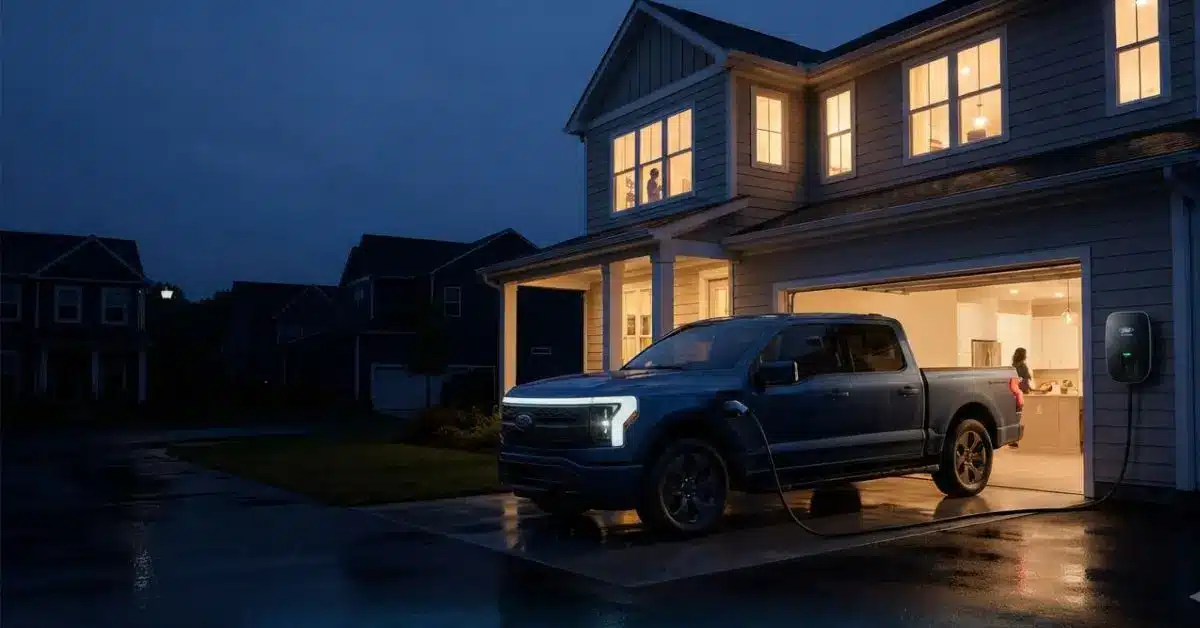
Yes, your EV can power your house during a blackout, using the battery as a backup electricity source for 1 to 3+ days of typical home power use. This capability is called V2H (Vehicle to Home) or bidirectional home charging. A 75 kWh EV battery holds as much energy as a typical U.S. home uses in about 2 days. The catch is that powering your home from an EV requires a specialised home system installation, not just plugging into a Level 2 charger. Here is exactly how it works and which EVs support it.
Want to understand the difference between V2L, V2H, and V2G first? See our explainer on bidirectional EV charging: V2G vs V2H vs V2L.
How V2H Home Backup Works
A V2H setup uses a bidirectional charger to convert the EV battery’s DC power back into AC power for your home.
How the System Powers Your Home
A transfer switch, either for the whole home or for a critical-loads panel, isolates your home from the grid during an outage. This prevents backfeed that could injure utility workers.
The system automatically detects a power outage, switches to island mode, and starts drawing power from the EV battery to run selected home circuits.
What You Need for Installation
The system must be professionally installed and include:
- Electrical upgrades to connect the system safely
- A compatible bidirectional EV charger
- An automatic transfer switch
How Long Can an EV Power a House?
| EV Battery Size | Essential Loads Only (~10 kWh/day) | Average Home (~30 kWh/day) | High-Use Home (~50 kWh/day) |
|---|---|---|---|
| 40 kWh (small EV) | ~4 days | ~1.3 days | ~0.8 days |
| 75 kWh (mid-size EV) | ~7.5 days | ~2.5 days | ~1.5 days |
| 100 kWh (large EV/truck) | ~10 days | ~3.3 days | ~2 days |
| 131 kWh (F-150 Lightning LR) | ~13 days | ~4.4 days | ~2.6 days |
Ford F-150 Lightning: The Best EV for Whole Home Backup
The Ford F-150 Lightning with Ford Intelligent Backup Power is the most practical whole-home EV backup system available in the U.S. in 2026.
Why It Stands Out
The system uses the Ford Charge Station Pro, a bidirectional Level 2 charger, connected to an automatic transfer switch and a whole-home gateway. It can power your home during an outage and automatically switch within milliseconds upon detecting a grid failure.
The system delivers up to 9.6 kW of continuous power, which is enough to run most household essentials at the same time. The 131 kWh Extended Range battery can provide about 4.4 days of power for an average home during an extended outage.
V2H Installation Requirements and Costs
Bidirectional Charger
A V2H-compatible charger, such as the Ford Charge Station Pro or another compatible bidirectional Level 2 charger, typically costs $1,000 to $2,500.
Transfer Switch Installation
A professionally installed automatic transfer switch usually costs $1,500 to $4,000, depending on whether it supports the whole home or only critical loads.
Total System Cost
A complete V2H system typically costs $3,000 to $8,000 installed. This is comparable to a Tesla Powerwall 3, which costs about $8,500 plus installation and lets you use your existing EV battery.
Federal Tax Credits
V2H equipment may qualify for the 30% Alternative Fuel Vehicle Refuelling Property Credit. Confirm your eligibility with a tax professional, as IRS guidance for bidirectional charging equipment was clarified in 2024.
Home Battery vs. V2H Backup Power
A dedicated home battery, such as the Tesla Powerwall 3 or Enphase IQ Battery, provides backup power whenever you need it. These batteries cost between $8,000 and $12,000 to install. They work even if your EV is away from home.
V2H (Vehicle-to-Home) technology from an EV offers much more energy capacity than a home battery, ranging from 75 to 131 kWh. However, you must keep your car parked and plugged in to use this power during an outage.
If your car supports V2H and you experience frequent power outages, this feature provides great value. If you need guaranteed backup at all times, a dedicated home battery offers more reliability, even though it holds less energy.
Conclusion
Your EV can power your house during a blackout. A large-battery EV like the Ford F-150 Lightning can power a home for three to four days on one charge. This technology works today, and you can hire a professional to install a V2H (Vehicle-to-Home) system for $3,000–$8,000.
Ford’s implementation is the most mature V2H solution for consumers in the U.S. As more EVs add bidirectional charging—which allows energy to flow both ways—and installation costs drop, this home backup feature will become a top reason to own an electric vehicle.
Curious which other EVs beyond the Lightning support this? See our list of which EVs support bidirectional charging.
FAQs
Can every electric vehicle power a house during a blackout?
No. Only EVs that support bidirectional charging and V2H technology can power a home during a blackout.
Can I power my house by plugging my EV into a regular Level 2 charger?
No. You need a compatible bidirectional charger, a transfer switch, and professional installation to safely power your home.
What household appliances can an EV run during a power outage?
Depending on the battery size and system capacity, an EV can run lights, a refrigerator, Wi-Fi, medical devices, and other essential home appliances.
