
Bidirectional EV Charging Explained: V2G vs V2H vs V2L

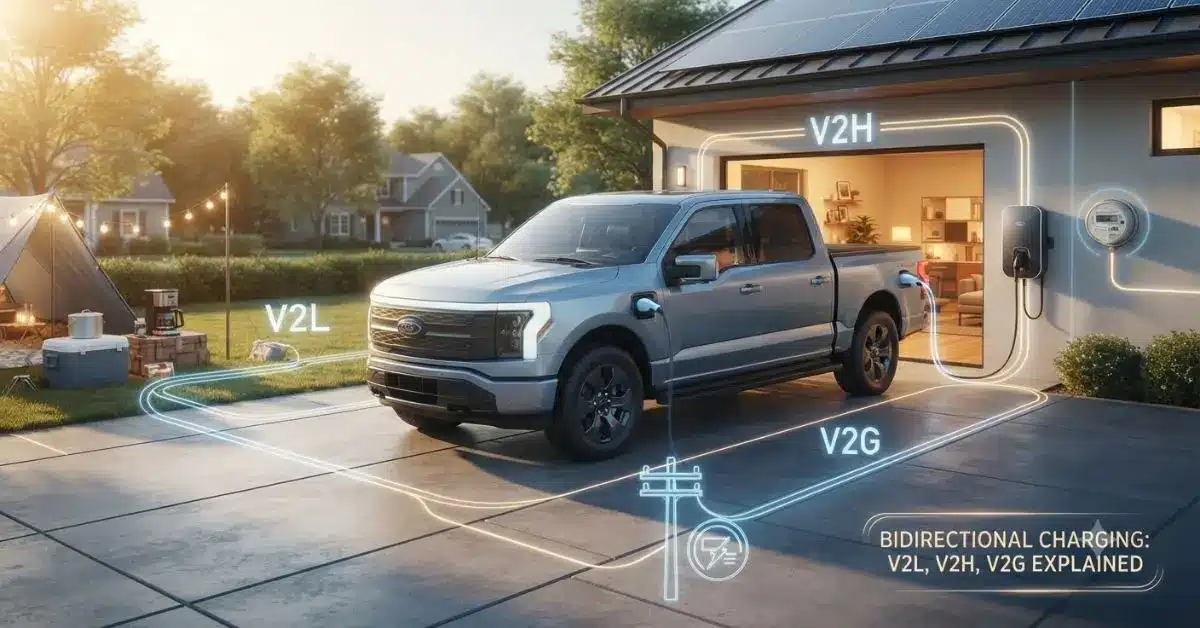
Bidirectional EV charging allows your electric car to send power back out of the battery — to your home, to the grid, or to external devices. There are three types: V2L (Vehicle-to-Load) powers appliances and devices directly from the car; V2H (Vehicle-to-Home) powers your home during an outage; and V2G (Vehicle-to-Grid) sends power back to the electricity grid for financial credits. Each technology has different requirements, compatible EVs, and practical applications. This guide explains all three clearly.
Not sure which EVs actually support this? See our list of which EVs support bidirectional charging.
V2L, V2H, and V2G: At a Glance
| Technology | Power Flow Direction | What It Powers | Equipment Needed | Typical Power | EVs Supporting It |
|---|---|---|---|---|---|
| V2L (Vehicle-to-Load) | EV → Devices/appliances | Laptops, power tools, camping gear, small appliances | V2L adapter (often included) | 1.5–3.6 kW | Hyundai Ioniq 5/6, Kia EV6, Ford F-150 Lightning, Rivian R1T, many others |
| V2H (Vehicle-to-Home) | EV → Home electrical system | Whole home during grid outage | V2H inverter + installation ($3,000–$8,000) | 3.6–11.5 kW | Renault 5 E-Tech, Ford F-150 Lightning (via Pro Power Onboard), Nissan Leaf (some), Hyundai Ioniq 5 (select configs) |
| V2G (Vehicle-to-Grid) | EV → Electricity grid | Grid stability; earns utility bill credits | V2G-capable charger + utility programme enrollment | 3.6–11 kW | Renault 5 E-Tech, Nissan Leaf, Mitsubishi Outlander PHEV, select others |
V2L: The Most Common and Accessible Form
V2L is the simplest form of bidirectional charging — the car exports power through an adapter that plugs into the charging port, providing a standard 120V or 240V outlet. No home installation is required. Common V2L uses include powering a campsite (refrigerator, lighting, fan), running power tools on a job site, charging other EVs or devices in an emergency, or running home appliances during a short power outage from the driveway. The Ford F-150 Lightning’s “Pro Power Onboard” system delivers up to 9.6 kW from outlets in the truck bed — industry-leading V2L capability that makes the Lightning a genuine mobile power station.
V2H: Powering Your Home During a Blackout
V2H (Vehicle-to-Home) connects the EV battery to your home’s electrical system through a specialised inverter and transfer switch — allowing the car to power your entire home during a grid outage. A 75 kWh EV battery provides approximately 2–3 days of typical home power use (at an average U.S. home consumption of 30–40 kWh/day). V2H requires a professionally installed inverter system ($3,000–$8,000 including installation) that creates an island mode from the grid when an outage occurs. The Renault 4 and 5 E-Tech models include V2G capability that also supports V2H in compatible setups; the Ford F-150 Lightning supports V2H through Ford Intelligent Backup Power with a Gateway installation.
V2G: Earning Money From Your EV Battery
V2G allows your EV to export power back to the electricity grid during peak demand periods — when utilities are willing to pay a premium for additional power. In participating programmes, EV owners earn credits of approximately $0.10–$0.30/kWh exported, typically during 4–8 pm peak periods. Over a year, a V2G-enrolled EV owner might earn $200–$800 in credits depending on programme parameters and participation frequency. The practical challenge: V2G requires both a V2G-capable EV and a V2G-certified charger, and enrolled utility programmes remain limited in geographic coverage in 2026.
EVs With Bidirectional Charging in 2026
- V2L standard: Hyundai Ioniq 5, Ioniq 6, Kia EV6, EV9, Ford F-150 Lightning, Rivian R1T/R1S, Renault 4 and 5 E-Tech, BYD Seal, Sealion 7, XPENG G6, Leapmotor B10, Hyundai Inster — V2L is now very widespread across mid-to-higher trim EVs
- V2H capable: Ford F-150 Lightning (with Gateway), Nissan Leaf (select variants), Renault 4/5 E-Tech, Mitsubishi Outlander PHEV — requires additional home installation
- V2G capable: Renault 5 E-Tech, Nissan Leaf (with bidirectional charger), Mitsubishi Outlander PHEV — most limited; requires utility programme availability
Conclusion
Bidirectional electric vehicle charging turns electric cars from simple power users into active power sources. Vehicle-to-load gives you quick power for camping, jobs, and outdoor tasks without any setup. Vehicle-to-home provides real backup power during blackouts, giving you two to three days of home electricity from a standard 75 kWh battery.
Vehicle-to-grid earns utility bill credits by helping the power grid during high demand, though program availability remains limited right now. As more vehicles standardise these systems and utility programs grow, bidirectional charging becomes a major practical benefit of owning an electric vehicle.
Curious exactly how much of your home this can power during an outage? See our guide on whether your EV can power your house during a blackout.
