
What Battery Chemistry Does GM Use in the Ultium Battery?

Researched from GM’s own announcements (its May 2025 LMR release and October 2026 fourth-generation platform launch), IEEE Spectrum’s engineering reporting, InsideEVs, Ars Technica, Samsung SDI and LG Energy Solution. Where two credible sources disagree — one cell format — this guide shows both.
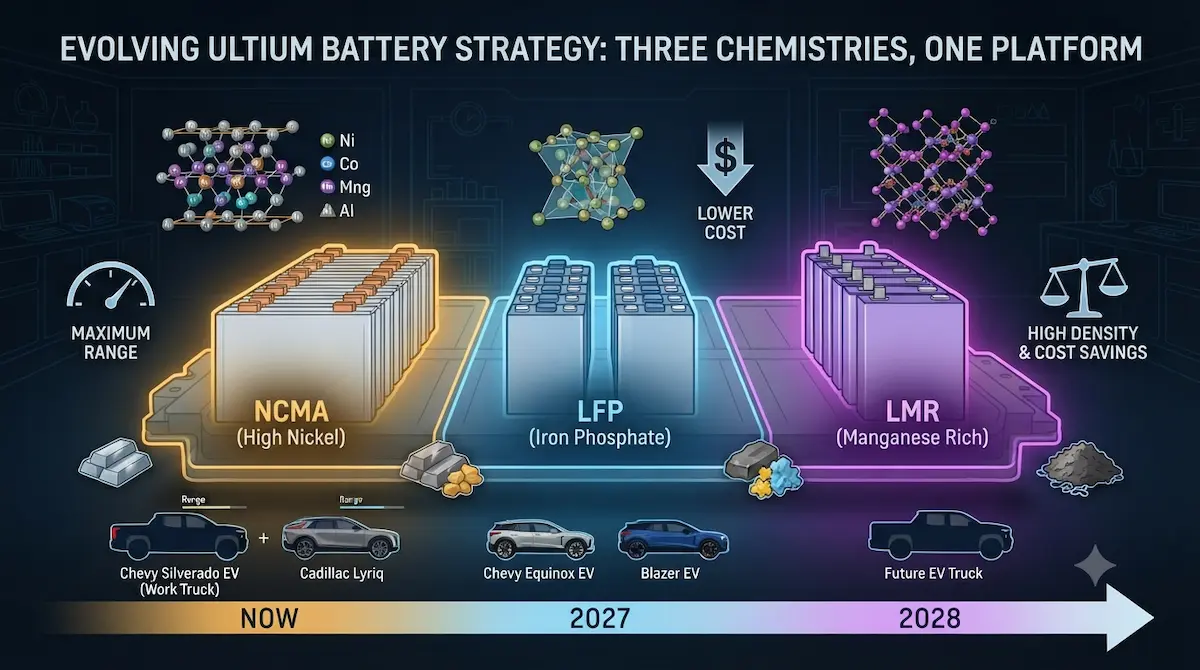
GM’s Ultium battery chemistry today is NCMA — a high-nickel cathode (roughly 85% nickel, 10% manganese, 5% cobalt) in large 103 Ah pouch cells, made by Ultium Cells, the GM–LG Energy Solution joint venture. Two more chemistries are joining it: LFP for affordable models, with US production at Spring Hill, Tennessee from 2027, and LMR (lithium manganese-rich) prismatic cells for trucks from 2028, promising LFP-level cost with 33% more energy. One naming note: GM retired the “Ultium” brand in 2024 — the technology programme continues under plainer names.
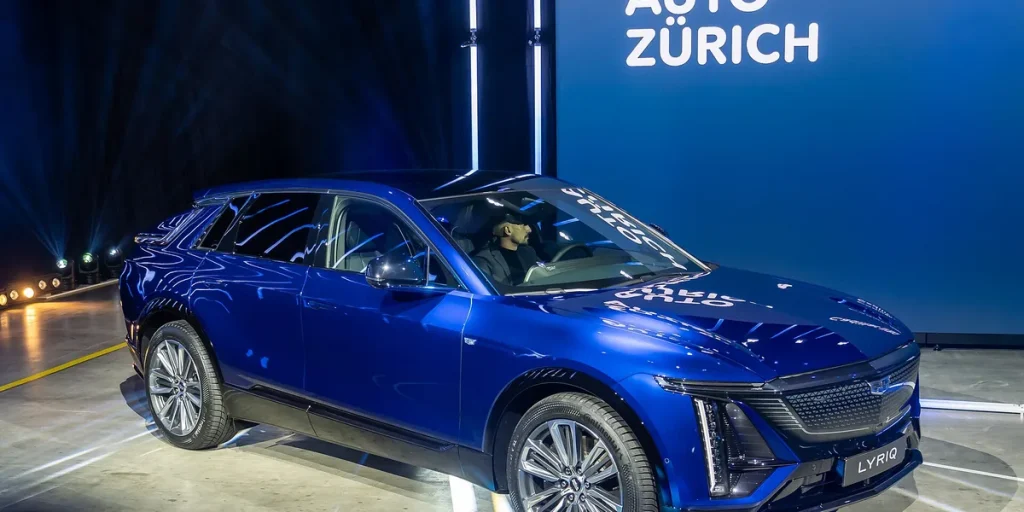
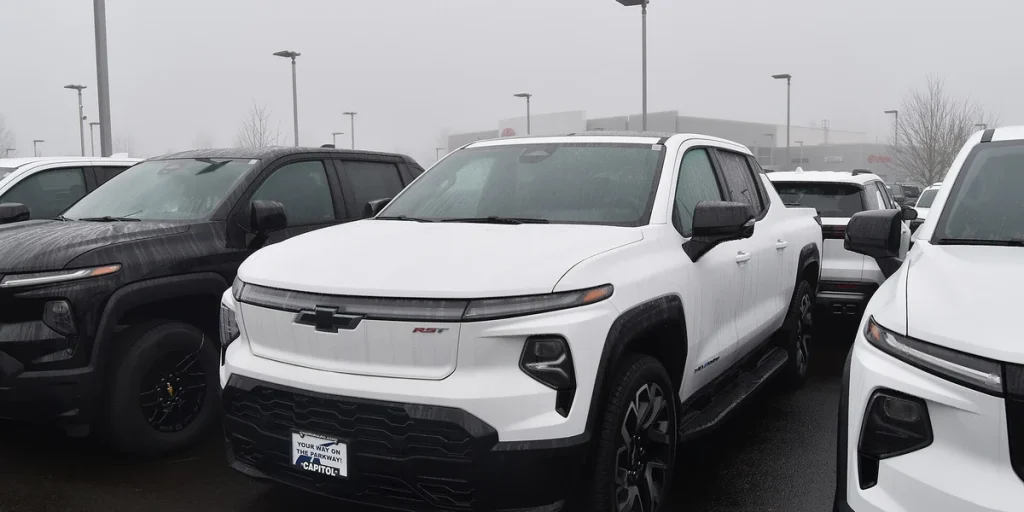
- Now: NCMA pouch — Equinox EV, Lyriq, Hummer EV, Silverado EV
- 2027: LFP prismatic — the returning Chevrolet Bolt first
- 2028: LMR prismatic — full-size trucks and SUVs, 400+ miles promised
What chemistry does GM use in the Ultium battery today?
NCMA: nickel, cobalt, manganese and aluminium, tuned for as little cobalt as GM could manage.
The cathode mix reported by IEEE Spectrum is roughly 85% nickel, 10% manganese and 5% cobalt — GM cut cobalt by 70% compared with the previous Chevrolet Bolt EV’s battery, substituting aluminium and leaning on nickel for energy. The chemistry itself — and how NCMA differs from the NMC family it descends from — is covered in our NCMA battery chemistry explainer.
The cell is a long, slender 103 Ah pouch (about 0.37 kWh per cell, 280 Wh/kg by Wikipedia’s figures), stacked into modules and packs from about 50 kWh to the Hummer’s 200-plus. Production sits with Ultium Cells LLC, the GM–LG Energy Solution joint venture, at Warren, Ohio (opened 2022) and Spring Hill, Tennessee (2024) — the same NCMA supply sits under the Acura ZDX’s 102 kWh pack, detailed in our ZDX battery guide.
The strategy in one table
Three chemistries, three price points — GM is deliberately ending the one-chemistry era that “Ultium” originally meant.
| Chemistry | Format | Job | Status |
|---|---|---|---|
| NCMA | Large pouch | Premium range and performance | In production (Ohio, Tennessee) |
| LFP | Prismatic | Affordable models | Bolt first (2027); Spring Hill cell production completes 2027 |
| LMR | Prismatic | Trucks: LFP cost, near-NCMA energy | Production 2028, Spring Hill |
| NMC (China) | Disputed (see below) | China-market vehicles | CATL-supplied |
A fourth line belongs in the footnotes rather than the table: in June 2026 GM also partnered with Peak Energy on sodium-ion cells — for grid storage, not cars — the technology is explained in our sodium-ion battery guide.
LFP: the affordable turn, and the Bolt
LFP is how GM gets its cheapest EVs back — starting with the nameplate that started it all.
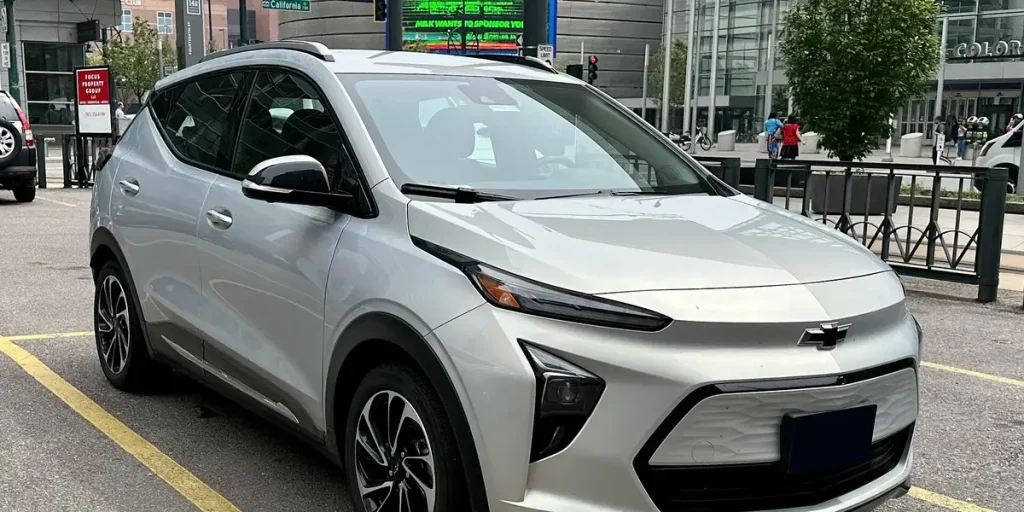
The returning 2027 Chevrolet Bolt runs a 65 kWh LFP prismatic pack: 255 miles of EPA range, 150 kW DC charging (10–80% in 26 minutes) and a $29,990 starting price, built in Kansas (Ars Technica). Cell production follows at home: GM is converting the Spring Hill Ultium Cells plant to LFP, with the conversion completing in late 2027, explicitly “to scale production of lower-cost LFP cells in the United States”.
Two honesty notes. First, the 2027 Bolt’s cell supplier has not been confirmed in any source this guide could verify — claims naming one should be treated as unproven. Second, LFP in GM trucks is, so far, a possibility its battery chief has discussed, not a confirmed model — for the chemistry trade-offs themselves, see our LFP vs NMC comparison.
LMR: the 2028 bet
LMR — lithium manganese-rich — is GM’s attempt to delete the LFP compromise.
Announced with LG Energy Solution in May 2025, the cathode is about 65% manganese and 35% nickel with only trace cobalt (IEEE Spectrum). Manganese is cheap and abundant; the historical problem was durability, which GM says a decade of work since 2015 has solved. The deep dive on the chemistry itself lives in our LMR battery chemistry explainer; the programme facts are these:
- Energy: 33% higher density than the best LFP cells, “at a comparable cost” (GM)
- Format: prismatic — far fewer parts (a truck pack could drop from 24 NCMA modules to 6 LMR modules)
- Production: Ultium Cells at Spring Hill, with pre-production in late 2027 and commercial production in 2028
- First vehicles: full-size trucks and SUVs, with “more than 400 miles” of range promised for an electric truck
- Cost colour: one GM executive estimated an LMR pack could cost about $6,000 less than today’s packs
In October 2026 GM folded LMR into its fourth-generation EV platform announcement, calling it “the world’s first production lithium-manganese-rich battery” — the programme is now the centrepiece of GM’s next platform, not a side project.
Why did GM drop the “Ultium” name?
Because one brand no longer described a multi-chemistry, multi-format programme — and GM wanted the freedom to say so.
At its October 2024 Investor Day, GM announced it would stop branding its EV architecture, battery cells and components “Ultium” in North America. The hardware did not change at all; only the badge went. Two survivals confuse people. The manufacturing joint venture is still legally Ultium Cells LLC, and GM’s own releases still use that company name in 2025 and 2026. And millions of cars already sold carry the chemistry the name described. Read “Ultium” in older material as “GM’s current-generation EV battery programme” and you will not go wrong.
Cell formats: pouch, prismatic — and the cylindrical question
GM’s format story is a migration: pouch today, prismatic tomorrow.
The NCMA pouch cell was the original Ultium signature; both new chemistries (LFP and LMR) are prismatic, and in December 2024 GM and LG agreed to jointly develop prismatic technology — LG positioning itself as the first maker offering all three formats.
One claim needs correcting rather than repeating. A family of detailed search queries asks about LG cylindrical NCMA cells for GM’s hybrid (PHEV/HEV) vehicles: no such programme appears in any source this guide read. Cylindrical cells enter GM’s story in two verified places only — China-market EVs (below) and LG’s own 46-series product line, which is LG’s to sell, not a GM hybrid programme.
What about GM’s batteries in China?
Different supply entirely — and one genuine factual dispute.
GM’s China-market EVs use cells produced by CATL, as CEO Mary Barra confirmed in 2023, rather than the GM–LG joint venture’s American pouch cells. The format is where sources split: the 2023 reporting described cylindrical cells, while GM’s own propulsion chief told Motor1 in 2024 that Chinese Lyriqs use “a different form factor of prismatic cans”. This guide prints the dispute rather than picking a winner: China CATL supply is settled; the can shape is not, on current public evidence.
Frequently asked questions
Who makes the Ultium battery for GM?
Ultium Cells LLC, the joint venture between GM and LG Energy Solution, at plants in Warren, Ohio and Spring Hill, Tennessee. (GM’s third planned JV plant, in Lansing, Michigan, is no longer GM’s — GM sold its stake to LG in 2024, and the plant now makes cells for other customers, including Toyota.)
Is GM’s Ultium battery better than Tesla’s?
They are different answers to the same problem. GM’s NCMA pouch packs compete on range in large vehicles and on a shared platform across many models; Tesla’s mix of 4680 cylindrical and bought-in cells competes on manufacturing cost and charging network. Neither is simply “better” — the honest comparison is per vehicle, per price.
What is the difference between GM’s LFP and LMR cells?
LFP (iron phosphate) is the proven, cheap, durable chemistry with modest energy density; LMR (manganese-rich) targets the same cost with about 33% more energy density, at the price of being unproven in production until 2028. GM is adopting both: LFP for affordable cars, LMR for trucks.
Does GM use NCA in any battery?
The previous Bolt EV used an NCA-family chemistry; the current NCMA programme replaced it. Searches asking “what is NCA in GM” are usually tracing that older Bolt pack.
Will the Silverado EV use LMR batteries?
Full-size trucks are LMR’s announced first application from 2028, and the Silverado EV is GM’s flagship electric truck — but GM has not named the Silverado specifically in its LMR releases, so treat the connection as highly likely rather than confirmed.
Conclusion
GM’s chemistry strategy is a spread bet placed by the biggest incumbent in American EVs: NCMA for today, LFP for the affordable end, LMR for the truck future, and the brand name sacrificed to make room for all three.
The dates that will prove or break it are public: LFP cells from Spring Hill by late 2027, LMR production in 2028, and a fourth-generation platform already announced around them. This guide will be judged against those dates — and updated when GM meets or misses them.
