
LMFP vs LFP: Is Manganese-Enhanced LFP Worth It?

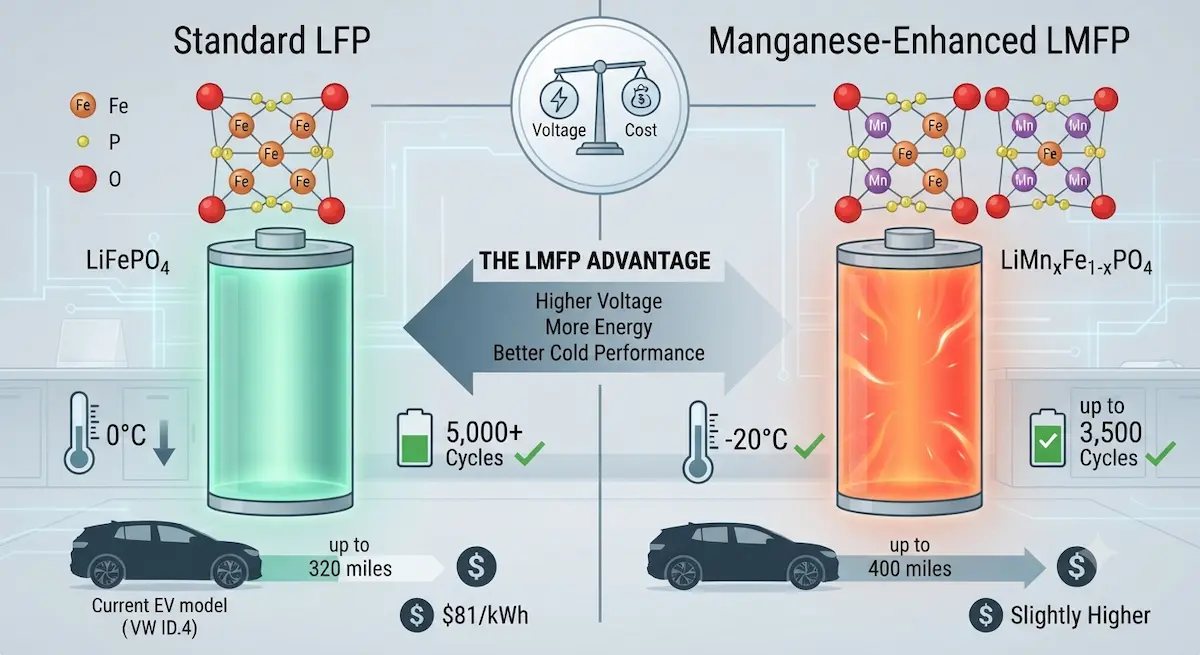
LMFP is worth it if you want more range than LFP can deliver — while keeping zero cobalt, zero nickel, excellent safety, and lower cost than NMC. Adding manganese to LFP raises cell voltage from ~3.2V to ~3.7V, delivering 15–20% more energy density than standard LFP. For mid-range EVs where LFP’s range is borderline, and NMC’s cost or cobalt content is undesirable, LMFP offers a genuinely compelling middle ground.
New to the base chemistry itself? Start with our full explainer on what LMFP battery chemistry is.
LMFP vs LFP: What the Manganese Actually Changes
Manganese substitution in the LFP olivine structure (LiMnxFe1-xPO₄) does three things:
- Raises operating voltage: Mn²⁺/Mn³⁺ redox couple operates at ~4.1V vs Fe²⁺/Fe³⁺ at ~3.4V. The manganese platform raises average cell voltage to ~3.7 V
- Boosts energy density: Higher voltage × same capacity = more energy stored per gram. 80% Mn content provides approximately 18% boost to initial gravimetric energy density over LFP
- Improves cold weather performance: Higher operating voltage reduces the relative impact of cold-induced voltage drops — LMFP performs better than LFP below 0°C
LMFP vs LFP: Full Comparison
| Feature | LFP | LMFP | Winner |
|---|---|---|---|
| Cell voltage | ~3.2V | ~3.7V | LMFP |
| Energy density | 90–170 Wh/kg | 160–240 Wh/kg | LMFP (+15–20%) |
| Cycle life | 2,000–5,000+ | ~2,000–3,500 | LFP |
| Thermal stability | ~270°C | Similar to LFP | Tie |
| Cold weather | Weak below 0°C | Better than LFP | LMFP |
| Cost | $81/kWh avg. | Slightly higher | LFP |
| Cobalt/Nickel | Zero | Zero | Tie |
| Manufacturing maturity | Fully mature | Early commercial | LFP |
| Range in EVs | Competitive 250–320 miles | Competitive 300–400 miles | LMFP |
The Manufacturing Challenge
LMFP has one significant manufacturing challenge: manganese dissolution. At high states of charge in the presence of trace moisture, Mn²⁺ ions can dissolve from the cathode into the electrolyte and migrate to the anode — causing capacity fade. This Jahn-Teller distortion effect at the Mn³⁺ state is a known challenge. Battery manufacturers address it through:
- Carbon coating of LMFP particles to reduce electrolyte contact
- Precise stoichiometry control (Fe: Mn ratio optimization)
- Electrolyte additive packages that suppress Mn dissolution
- Strict moisture control in manufacturing
BYD’s Gen 2 Blade Battery resolved these challenges sufficiently for mass production — but LMFP manufacturing remains more demanding than standard LFP.
Curious what’s driving the broader shift toward phosphate chemistries overall? See our guide on why so many new EVs are switching to LFP batteries.
Is LMFP Worth It? A Decision Framework
| Use Case | Better Choice | Why |
|---|---|---|
| Maximum cycle life (fleet, taxi) | LFP | 5,000+ cycles vs LMFP’s ~3,500 |
| Mid-range EV (250–350 miles) | LMFP | Better range than LFP at lower cost than NMC |
| Cold climate performance | LMFP | Higher voltage handles cold better than LFP |
| Lowest possible cost priority | LFP | Cheaper raw materials, mature supply chain |
| Premium 350+ mile range | NMC | LMFP not yet competitive at highest density tier |
Frequently Asked Questions
Is LMFP worth it vs LFP?
Yes — if range is a priority and you don’t need maximum cycle life. LMFP delivers 15–20% more energy density than LFP through a higher cell voltage, better cold-weather performance, and competitive safety. The tradeoffs are slightly shorter cycle life and higher manufacturing complexity. For mid-range EVs where LFP’s range is marginal, LMFP’s extra density is clearly worth the modest additional cost.
Does LMFP last as long as LFP?
Slightly less — typically 2,000–3,500 cycles vs LFP’s 2,000–5,000+. The manganese dissolution challenge (Jahn-Teller distortion) creates a degradation mechanism that doesn’t exist in pure LFP. Manufacturing advances are reducing this gap, but LFP retains a cycle life advantage for ultra-high-use commercial applications.
Will LMFP replace LFP completely?
Not completely — they’ll coexist for different applications. LFP will remain dominant for ultra-high-cycle commercial fleet use and the lowest-cost segments. LMFP will capture mid-range EVs where the 15–20% energy density boost justifies a modest cost premium. A BloombergNEF report suggested over half of EV deliveries in 2027 will use LFP or LMFP chemistry — with LMFP’s share growing rapidly.
Conclusion
LMFP is worth it — for the right applications. Adding manganese to LFP delivers a meaningful 15–20% energy density improvement, better cold-weather performance, and maintains the zero-cobalt, zero-nickel safety profile that makes LFP so commercially compelling. For mid-range EVs where LFP’s range is borderline, and NMC’s cost is unattractive, LMFP hits a sweet spot. BYD’s Gen 2 Blade Battery has proven the chemistry works at scale — and CATL’s M3P follows. The manganese-enhanced phosphate era is here.
For premium 350+ mile range needs, NMC still holds the edge over both — see our full explainer on what NMC battery chemistry is.
