
How Does Nickel Mining Affect EV Battery Sustainability?

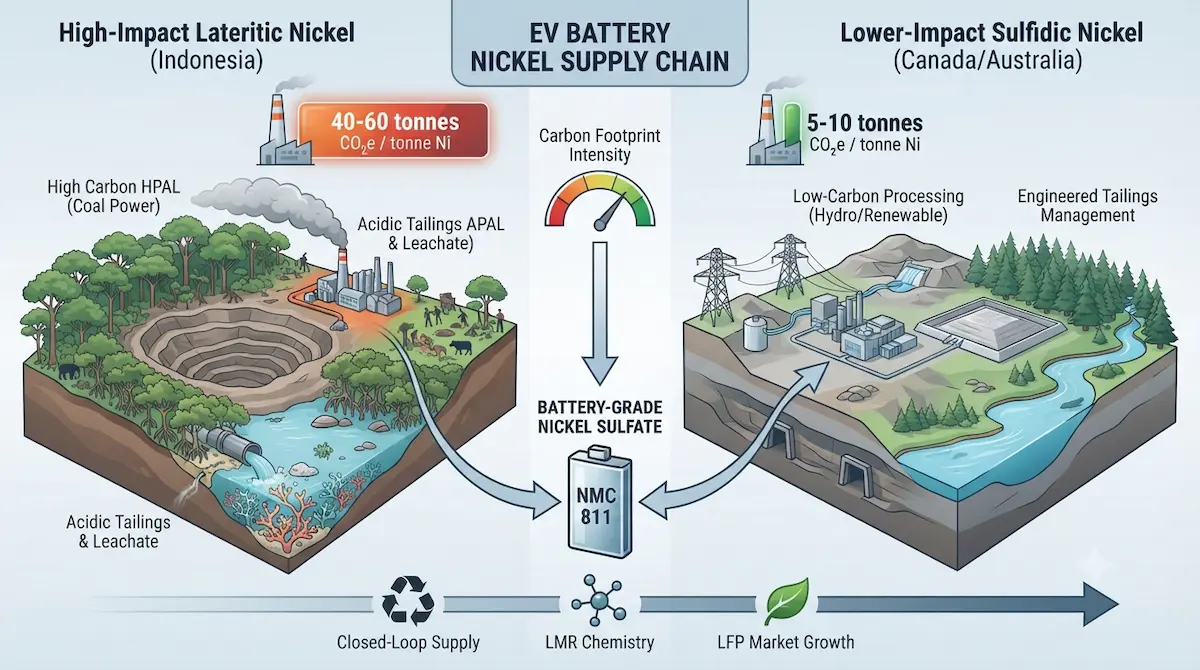
Nickel mining for EV batteries is one of the most significant environmental criticisms of the electric vehicle transition. Indonesia — home to approximately 25% of global nickel reserves — has cleared tropical rainforest and mangroves, created acidic mining leachate, and generated large volumes of tailings to supply the nickel that NMC and NCA EV batteries require. However, the environmental picture is nuanced: lifecycle analyses consistently show that high-nickel NMC EVs still produce 50–70% less carbon over their lifetime than equivalent gasoline vehicles, even accounting for nickel mining impacts. And the industry is responding with better mining practices, battery chemistry evolution toward lower nickel content, and recycling infrastructure that reduces future virgin nickel demand.
Lithium sourcing faces a parallel sustainability challenge — see our explainer on what direct lithium extraction is and how it helps EVs.
How Much Nickel Does an EV Battery Require?
The amount of nickel in an EV battery depends directly on the cathode chemistry:
| Chemistry | Nickel Content (% cathode metals) | Nickel in 75 kWh Pack (kg) | At $17/kg Nickel Price |
|---|---|---|---|
| LFP | Zero | 0 kg | $0 |
| NMC 532 | ~50% | ~35 kg | ~$595 |
| NMC 622 | ~60% | ~42 kg | ~$714 |
| NMC 811 | ~80% | ~56 kg | ~$952 |
| NCMA (~89% Ni) | ~89% | ~62 kg | ~$1,054 |
| NCA (~82% Ni) | ~82% | ~57 kg | ~$969 |
Where EV Nickel Comes From: The Indonesia Problem
Indonesia holds approximately 24–25% of global nickel reserves and has become the world’s largest nickel producer — accounting for over 50% of global nickel mine output in 2025. The vast majority of Indonesia’s new nickel capacity is in Sulawesi and the Moluccas, where lateritic nickel ore deposits lie beneath tropical ecosystems including lowland rainforest, mangroves, and coastal fisheries.
The environmental impacts of Indonesian nickel mining are substantial:
- Deforestation: Nickel mining areas in Indonesia’s “Nickel Triangle” (North Maluku, Central Sulawesi, Southeast Sulawesi) have cleared thousands of hectares of tropical rainforest — high-biodiversity ecosystems that store enormous amounts of carbon. When this forest carbon is released, it creates a “carbon debt” that delays the point at which an NMC EV becomes net-positive for climate vs gasoline vehicles.
- Mining leachate and acid drainage: Lateritic nickel mining produces acidic drainage that contaminates nearby waterways and estuaries. In Indonesia’s Weda Bay and other mining zones, reports of coral reef damage, fish kills, and contaminated drinking water sources near mining operations have been documented by environmental organizations.
- High-Pressure Acid Leach (HPAL) processing: Converting Indonesian lateritic ore to battery-grade nickel sulfate requires HPAL — a high-temperature, high-pressure acid leaching process that is significantly more energy-intensive and environmentally burdensome than processing sulfidic nickel ore (the type found in Canada, Russia, and Australia). HPAL plants in Indonesia are typically powered by coal-fired electricity — substantially increasing the carbon footprint of Indonesian nickel vs sulfidic nickel processed with cleaner energy.
- Tailings: HPAL generates large volumes of acidic tailings that must be safely contained. Indonesian environmental regulations and enforcement capacity have been questioned by NGOs, with some facilities lacking adequate tailings containment infrastructure.
The Carbon Footprint of Nickel Mining
The type of nickel ore and processing method create significantly different carbon footprints per tonne of battery-grade nickel sulfate produced:
- Indonesian lateritic nickel (HPAL, coal-powered): Approximately 40–60 tonnes CO₂e per tonne of nickel sulfate — one of the highest-carbon nickel supply chains available
- Philippine lateritic nickel: Similar to Indonesian, approximately 35–55 tonnes CO₂e per tonne
- Canadian sulfidic nickel (Vale, clean hydro power): Approximately 5–10 tonnes CO₂e per tonne — dramatically lower due to cleaner ore processing and low-carbon electricity
- Australian sulfidic nickel (BHP, Nickel West): Approximately 8–15 tonnes CO₂e per tonne
This 5–10x difference in nickel carbon footprint by source means that two NMC 811 batteries with identical chemistry but different nickel supply chains can have total manufacturing carbon footprints differing by 15–25% — a meaningful variation in lifecycle environmental performance.
Does Nickel Mining Make EVs Environmentally Harmful?
Despite nickel mining’s real environmental impacts, lifecycle analysis consistently shows that NMC EVs remain substantially better for climate than gasoline vehicles over their full lifetime. The key numbers: manufacturing an NMC EV generates approximately 8–15 tonnes more CO₂e than manufacturing an equivalent gasoline vehicle (the “carbon debt” from battery production including nickel mining). This carbon debt is paid back in approximately 1.5–3 years of driving in regions with average electricity mix, after which the EV emits less greenhouse gas per mile than the gasoline equivalent for the remaining 10–15 years of service life. Total lifetime NMC EV emissions are 50–70% lower than equivalent gasoline vehicles even when accounting for mining impacts.
However, the environmental comparison with LFP is less favorable. LFP’s zero nickel content eliminates nickel mining’s carbon debt entirely — meaning LFP EVs have a smaller manufacturing carbon footprint than NMC EVs of equivalent size, even though they may need slightly larger packs for equivalent range (due to lower energy density). LFP batteries have a significantly reduced carbon footprint over their full lifecycle compared to NMC, primarily due to lower upstream mining impact.
Industry Response: Cleaner Nickel and Reduced Nickel Dependence
The EV battery industry is responding to nickel mining’s environmental impact through multiple strategies:
- Responsible sourcing commitments: Tesla, BMW, Ford, and General Motors have all signed sourcing commitments requiring nickel suppliers to meet specific environmental and labor standards. The Initiative for Responsible Mining Assurance (IRMA) provides third-party audit standards that battery supply chain participants increasingly require of nickel mining operations.
- Canadian and Australian nickel preference: Western automakers are increasingly prioritizing lower-carbon sulfidic nickel from Canada (Vale) and Australia (BHP, IGO) over Indonesian lateritic nickel — accepting higher price premiums for cleaner supply chains and IRA compliance (requiring critical minerals from FTA partner countries).
- Nickel content reduction roadmap: The industry’s shift from NMC 532 → NMC 622 → NMC 811 → NCMA has simultaneously improved energy density while reducing cobalt content per kWh. The LMR chemistry (GM/LG Energy Solution, ~65% Mn, 35% Ni) reduces nickel content dramatically vs NCMA while maintaining competitive energy density — potentially delivering 33% more energy per kWh than LFP at LFP-comparable cost with much less nickel than NCMA.
- Recycled nickel growth: Redwood Materials targets recycling 100 GWh of batteries annually by 2025 — recovering nickel sulfate for reuse in new NMC cathodes. At scale, recycled nickel could supply 25–40% of battery-grade nickel demand by 2030, reducing primary mining pressure and the associated environmental impacts.
- LFP market share growth: The most direct solution — using LFP where energy density requirements permit. LFP’s global EV battery market share exceeding 50% in 2025 represents the largest single-year reduction in per-EV nickel demand in battery history.
All of these nickel costs flow directly into the cell price — see our guide on how battery chemistry affects manufacturing cost.
Recycling this nickel back into new cells is the other half of the solution — see our guide on which EV battery chemistry is most recyclable.
Frequently Asked Questions
How does nickel mining affect EV battery sustainability?
Nickel mining — especially Indonesian lateritic nickel processing — involves deforestation, acidic drainage, high HPAL energy consumption often from coal power, and tailings management risks. This creates a carbon debt of 8–15 tonnes CO₂e per NMC EV beyond equivalent gasoline vehicle manufacturing. However, the carbon debt is paid back in 1.5–3 years of driving, and total NMC EV lifetime emissions remain 50–70% lower than equivalent gasoline vehicles. LFP batteries eliminate nickel mining impacts entirely, having a lower lifecycle carbon footprint than NMC.
Is Indonesian nickel worse for the environment than other nickel?
Yes — significantly. Indonesian lateritic nickel processed via HPAL using coal-powered electricity produces approximately 40–60 tonnes CO₂e per tonne of nickel sulfate vs 5–10 tonnes CO₂e for Canadian sulfidic nickel processed with hydro power. The 5–10x difference reflects both ore type (laterites require more energy-intensive HPAL processing than sulfidic ores) and electricity source (Indonesian grid is 60%+ coal vs Canadian hydro). Western automakers are increasingly paying premiums for lower-carbon Canadian and Australian nickel to reduce their supply chain carbon footprint.
Will EV batteries need less nickel in the future?
Yes — through two parallel trends. First, chemistry evolution: LMR (lithium manganese rich, GM/LGES) uses ~35% nickel vs NCMA’s 89%, potentially delivering equivalent energy density at much lower nickel content by 2028. Second, recycling growth: Redwood Materials, Li-Cycle, and others are recovering battery-grade nickel sulfate from end-of-life NMC packs — with recycled nickel expected to supply 25–40% of battery nickel demand by 2030. Combined with LFP’s zero-nickel market share growth, primary nickel demand per kWh of battery capacity will fall significantly through this decade.
Conclusion
Nickel mining affects EV battery sustainability in real and documented ways — deforestation, acidic drainage, and high-carbon HPAL processing in Indonesia create environmental burdens that are part of the honest accounting of NMC battery production. These impacts do not eliminate EVs’ climate advantages over gasoline vehicles (which remain 50–70% lower lifetime emissions), but they are meaningful and worth addressing. The industry is responding: responsible sourcing programs, preference for lower-carbon Canadian and Australian nickel, LMR chemistry reducing nickel content toward 35%, and recycled nickel from end-of-life batteries growing toward 25–40% of supply by 2030. The most complete response, however, is LFP — eliminating nickel from the equation entirely. For the 50%+ of global EVs now using LFP, nickel mining’s environmental impact is simply irrelevant.
