
What Is Wireless EV Charging?

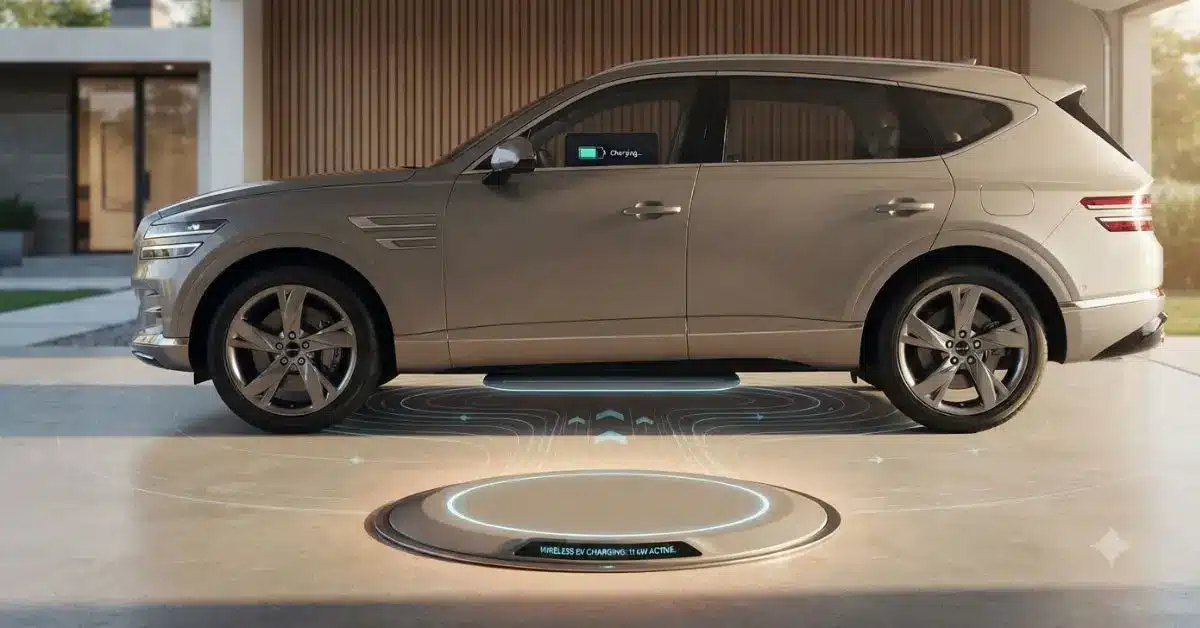
Imagine parking your EV and having it charge without touching a cable. Wireless EV charging is making that possible, bringing a simpler and more convenient way to power electric vehicles.
Wireless EV charging, also known as inductive or contactless charging, delivers electricity to an EV’s battery without a physical cable. It uses electromagnetic induction between a ground pad and a receiver on the bottom of the vehicle.
This technology currently works in small, commercial projects but is not yet common for most people. It is moving from a test phase to limited production. Companies like Toyota, BMW, Genesis, and other infrastructure providers now offer or have announced their first generation of consumer wireless charging systems.
Prefer a proven plug-in option for your home instead? See our guide to the best home EV chargers with WiFi and app control.
How Wireless EV Charging Works
Wireless EV charging works like wireless phone charging using electromagnetic induction. A ground pad sends an alternating current to create a magnetic field. A receiver pad on the car turns this field back into electricity to charge the battery.
This technology must move 3.3–22 kW of power across a 20–30 cm air gap. Current static wireless charging systems are 85–93% efficient. This is similar to the 88–92% efficiency of wired Level 2 charging.
Current State of Wireless EV Charging in 2026
| Deployment Type | Status in 2026 | Examples |
|---|---|---|
| Residential wireless (static) | Limited availability — first-gen products emerging | WiBotic, Evatran Plugless (discontinued then relaunched) |
| Commercial / fleet depot (static) | Available — used in bus and taxi fleets | Momentum Dynamics, Witricity commercial fleets |
| OEM factory-installed (static) | In development / early limited release | BMW 530e, Genesis GV80 Electrified wireless charging concept |
| Dynamic (road charges while driving) | Pilot projects only — not commercially available | Sweden and Israel road pilots; Indiana DOT test section |
Static vs Dynamic Wireless Charging
Static Wireless Charging
Static wireless charging powers a parked EV. The vehicle sits on the ground pad in a garage, parking space, or taxi stand while electricity is transferred to the battery. This is the technology available today. It eliminates the need to plug in, as charging starts automatically when the vehicle is parked in the correct position.
Dynamic Wireless Charging
Dynamic wireless charging powers an EV while it is moving. Charging coils are built into the road surface, and the vehicle receives power through a receiver underneath. This technology could reduce range anxiety on equipped highways, but it is still in the research and pilot stages due to high infrastructure costs.
Benefits of Wireless EV Charging
- No plugging in: Automatic charging on parking — particularly valuable for disabled drivers, elderly users, and any situation where cable handling is inconvenient
- Weatherproof convenience: No cable handling in rain, snow, or cold weather
- Fleet efficiency: Taxi, bus, and delivery fleet depots can eliminate the time and labour of plugging in each vehicle — particularly valuable for autonomous vehicles that have no driver to connect cables
- Reduced wear on charging ports: Physical charging ports suffer mechanical wear over thousands of plug cycles — wireless eliminates this entirely
Wireless EV Charging Limitations
Wireless charging currently operates like Level 2 home charging, delivering power between 3.3 kW and 22 kW. No wireless DC fast-charging systems are available to buyers yet.
Cost is a big problem. A wireless charging pad and car receiver cost between $3,000 and $6,000. This is much higher than the $500 to $1,600 price for a standard wired wallbox.
Standardisation is also limited. The SAE J2954 standard supports wireless charging, but not all cars support it. Until prices drop and more car companies use this technology, wireless charging will stay an expensive extra feature instead of a common tool.
Conclusion
Wireless EV charging is now real and working. It is starting to appear in some new vehicles and at centres for commercial fleets. However, it is not yet a practical choice for most people who own electric cars. The cost is much higher than standard Level 2 wired chargers, and few car makers support it.
For fleet businesses that need efficiency, wireless charging is a great solution. It is also useful for autonomous vehicles, where cables are difficult to use. Experts expect mainstream wireless EV charging to grow between 2027 and 2030. As hardware costs drop and more car makers start using it, it will become easier for everyone to access.
FAQs
Can I install wireless EV charging at home?
Yes. A few residential wireless charging systems are available, but they are still expensive and support only a limited number of compatible vehicles.
Is wireless EV charging slower than wired charging?
In most cases, wireless charging provides Level 2 charging speeds and has slightly lower efficiency than a wired Level 2 charger.
Can an EV charge wirelessly while driving?
Not yet. Dynamic wireless charging is still being tested in pilot projects and is not commercially available.
